

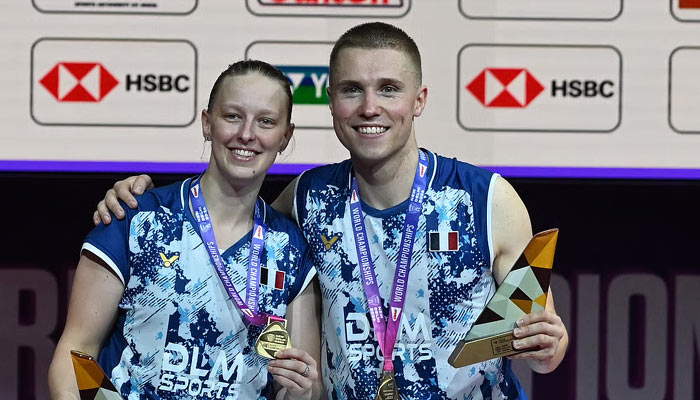
France’s badminton journey from a largely overlooked sport to producing two world champions has been decades in the making.
Alex Lanier’s historic men’s singles triumph and Thom Gicquel-Delphine Delrue’s mixed doubles victory in New Delhi marked a breakthrough for a country still better known globally for football, rugby and cycling.
Lanier became the first Frenchman to win the men’s singles title at the BWF World Championships. Earlier that day, Gicquel and Delrue had secured France’s first badminton world title in mixed doubles. Their double triumph even earned praise from French President Emmanuel Macron.
Yet the celebrations also underlined badminton’s relatively modest place in France’s sporting culture. Lanier joked that he could probably walk down the street after becoming world champion and nobody would notice. Gicquel similarly wondered whether anyone would be waiting for the French team at the airport.
Behind those jokes, however, lies a remarkable transformation.
Decades of preparation
French badminton’s rise was not built in a matter of years. Federation technical director Cyrille Gombrowicz traces the beginning of the country’s high-performance programme to 1980, when France created its first national performance centre.
The federation gradually expanded the structure by establishing more national centres for young athletes and nine regional centres. Today, it works with around 60 clubs and has developed a sizeable network of coaches involved in elite-level training.
That long-term investment has produced a generation capable of challenging the traditional badminton powers. Lanier, along with brothers Christo and Toma Junior Popov, has strengthened France’s position in men’s singles. Gicquel and Delrue have developed into one of the country’s leading mixed doubles combinations.
Lanier’s coach Kestutis Navickas believes the current success is the result of years of groundwork rather than a sudden breakthrough.
Developing more than technique
Lanier joined the French performance system as a teenager. His development involved technical and tactical training, but also focused heavily on fitness, recovery, nutrition and mental preparation. Navickas says the aim has been to bring different aspects of performance together rather than concentrating on one area.
That approach has also changed as Lanier has matured. His coaches recently reduced the amount of gym work he was doing, seeking a balance that would allow him to retain his strength while becoming quicker and more capable of maintaining his level throughout long tournaments.
The French programme increasingly relies on sports science to support such decisions.
Performance staff analyse training loads, match demands and tournament schedules, using data alongside coaching experience. French players also wore tracking devices during the World Championships in Delhi to help monitor their physical output.
For Gicquel, the purpose is to make athletes better prepared throughout an entire season rather than simply targeting one tournament.
- Patience behind the mixed doubles success
- Gicquel and Delrue’s world title is another example of France’s long-term approach.
The pair began playing together at around 17 after entering the national training structure. Their partnership was not immediately successful. Gicquel admits that they hardly spoke to one another during their first few years together.
Coaching and mental support eventually helped them develop better communication and a clearer understanding of how they wanted to play.
Their progress accelerated gradually. A Super 100 victory gave them confidence that badminton could become a profession, while defeating a top-five pair showed them that they could compete against the sport’s established stars.
Their bronze medal at the 2025 World Championships in Paris was a significant milestone. It was the first World Championships medal produced directly by the French development system.
- Twelve months later, that bronze had become gold.
- A team getting stronger
- France’s growing depth in men’s singles has also changed expectations.
Christo Popov has established himself among the world’s leading players, while Toma Junior and Lanier have added further strength. Their performances have created internal competition and raised the standards across the team.
That depth was particularly evident in the Thomas Cup earlier this year. France reached the final of the world men’s team championship for the first time after defeating India 3-0 in the semi-final.
Christo Popov defeated Ayush Shetty, Lanier beat Kidambi Srikanth and Toma Junior Popov overcame HS Prannoy.
Although France lost 3-1 to China in the final, the silver medal was historic and represented the country’s first Thomas Cup medal.
The result showed that France was no longer dependent on one exceptional player. It had several singles players capable of competing against the world’s best.
From grassroots to the world stage
France’s progress is supported by a sizeable badminton community, with around 250,000 licensed players.
Lanier’s career demonstrates how the country’s pathway can convert that large grassroots base into elite talent. After developing at a club in Normandy, he moved to a regional centre in Caen before progressing to the national centre at INSEP.
His family also played an important role during his early years.
The system now combines clubs, regional centres, national training facilities, coaches, government assistance and performance specialists. The aim is to identify talent early and provide athletes with the support needed to reach the highest level.
The bigger challenge
France’s double triumph in Delhi does not mean the country has suddenly joined the badminton elite across every discipline.
Gombrowicz acknowledges that France still lacks the depth of China, Japan, South Korea, Indonesia and Malaysia. At present, the country is particularly competitive in men’s singles and mixed doubles.
The next objective is to increase the number of French players inside the world’s top 30 and develop strength in additional events.
For now, however, the two world titles represent proof that the strategy is delivering results.
France began building its elite badminton structure in 1980. More than four decades later, its players have reached the summit of the sport.
Lanier may still joke that nobody will recognise him when he walks down a French street.
But after France’s historic success in New Delhi, badminton is no longer something the country can easily overlook.
Comments are closed.