
Nepal’s Climate Crisis: Almost No Emissions, Yet Among the Worst Hit

Nepal’s Climate Paradox: Almost No Emissions, Yet Facing Catastrophic Costs
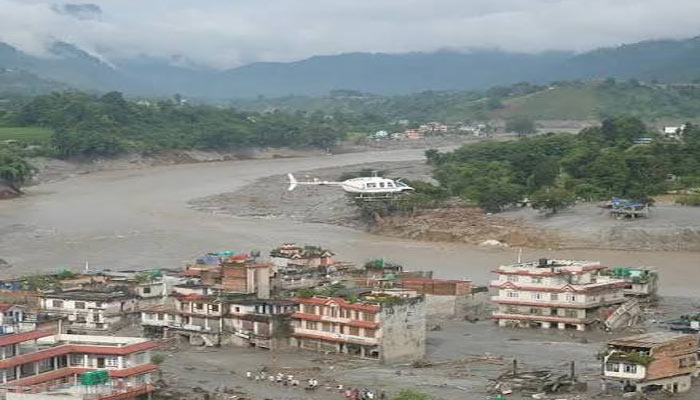
In the early hours of August 26, 2026, a huge surge of water, mud and boulders tore through the high-altitude valleys of central Nepal.
Near the Nepal-China border, a massive glacial collapse sent a violent torrent through the Lhende Khola and into the Bhote Koshi and Trishuli river systems. Within minutes, the Trishuli’s water levels surged, damaging automated flood-monitoring stations before emergency alerts could reach downstream communities.
The destruction across Rasuwa, Nuwakot and Dhading districts was devastating. In Rasuwagadhi, entire settlements and vital border infrastructure were swept away. Roads and bridges were destroyed, while hydropower generation was disrupted after floodwaters entered underground tunnels at major projects.
Yet the disaster is about more than a single extreme event. It has exposed a stark climate paradox.
Nepal contributes less than 0.1% of global greenhouse-gas emissions. Its contribution to the warming of the planet is therefore negligible compared with that of major industrial emitters. But its location in the Himalayas puts it directly in the path of some of the most destructive consequences of a warming climate.
A Climate Crisis Nepal Did Little To Create
The physical processes driving global warming are largely linked to emissions from high-consuming, industrialised economies. Nepal, meanwhile, is dealing with the consequences in a landscape where even small changes in temperature and precipitation can have dramatic effects.
Warming in the Himalayas can destabilise glaciers and increase the risk of glacial lake outburst floods, ice and rock avalanches, landslides and intense rainfall-driven flooding. Shashi Chaudhary, Director of the Nepal Environmental Research Institute (NERI), told NDTV that the latest disaster should be viewed through the lens of climate justice.
“The recent tragedy in Nepal should remind the world that climate change is not simply an environmental problem. It is a question of justice and accountability,” Chaudhary said. He questioned why a country responsible for less than 0.1% of global greenhouse-gas emissions should have to bear such severe consequences.
Nepal has been working to strengthen its resilience through its National Adaptation Plan, community disaster-preparedness networks and anticipatory-action mechanisms. But Chaudhary said these measures cannot fully protect a developing country from climate impacts driven by global emissions.
Countries with greater historical responsibility for greenhouse-gas emissions, he said, should provide greater support for vulnerable nations through climate finance, technology transfer, resilient infrastructure and stronger early-warning systems.
“This is not charity; it is a matter of responsibility, accountability and fairness,” he said.
Why The Himalayas Amplify Climate Risks
Nepal’s geography makes it exceptionally vulnerable to climate-related disasters.
Dr Ramesh Raj Pant, Assistant Professor at the Central Department of Environmental Science at Tribhuvan University, said the country’s rugged terrain, fragile ecosystems and limited adaptive capacity create conditions in which climate hazards can rapidly escalate.
Glacial lake outburst floods, landslides, unstable ice and rock formations and erratic monsoon rainfall can combine to create cascading disasters. “Nepal’s contribution to global greenhouse-gas emissions is negligible, yet the Himalayan nation finds itself on the frontline of climate devastation,” Pant said.
The impact is not limited to damaged infrastructure. Roads, bridges and power projects can be destroyed, while communities face the loss of homes, livelihoods, food security and cultural assets. For people living in vulnerable mountain regions, Pant said, adaptation has become a matter of survival.
Nepal Needs More Than Emergency Aid
Once search-and-rescue operations end, Nepal will face the enormous task of rebuilding. The financial burden of reconstruction could put additional pressure on an economy already dealing with limited resources, potentially diverting money from healthcare, education and poverty reduction.
Chaudhary said international assistance should therefore extend beyond immediate humanitarian relief.
Displaced families need help rebuilding homes, restoring livelihoods and returning to economic independence. Reconstruction should not simply replace what was destroyed; it should make communities safer against future disasters.
Nepal needs long-term, concessional financing to rebuild climate-resilient roads, bridges, settlements and other critical infrastructure. International climate funds, multilateral development banks, donor countries and development partners can help finance these efforts.
Strengthening early-warning systems, emergency-response capabilities and risk-sensitive planning will also be essential.
- Nepal Must Address Its Own Vulnerabilities
- Climate injustice does not mean Nepal can ignore its domestic challenges.
The country has strengthened its disaster-management framework through measures including the Disaster Risk Reduction and Management Act of 2017, the establishment of the National Disaster Risk Reduction and Management Authority and the Climate Change Policy of 2019.
But implementation across federal, provincial and local levels remains a major challenge. Chaudhary said authorities must reconsider how settlements and infrastructure are approved, particularly in high-risk areas.
“Development cannot come at the cost of human lives,” he said, arguing that environmental and disaster risks must be incorporated into every major infrastructure and development decision. Settlements along rivers remain a particular concern. Risk-sensitive land-use planning needs to be enforced rather than remaining limited to policies and official documents.
If infrastructure continues to be built without accounting for natural hazards, extreme weather events can turn into disasters whose impacts could have been reduced.
The Himalayas Require Cross-Border Cooperation
Nepal’s vulnerability also cannot be addressed by Kathmandu alone. The Himalayas form a shared ecosystem, and rivers, glaciers and flood risks cross national boundaries. Dr Pant said Nepal needs stronger coordination between government agencies, security forces, local communities and neighbouring countries.
He called for greater cooperation among Nepal, India and China on river-basin management, glacial monitoring and transboundary early-warning systems. “Nepal, India and China must work together to build robust early warning systems, strengthen basin management and monitor GLOFs to safeguard lives and property in the future,” Pant said.
The August disaster therefore carries a message far beyond Nepal.
A country responsible for a tiny fraction of global emissions is confronting some of the most severe consequences of a warming planet. Its experience highlights the growing imbalance between responsibility for climate change and exposure to its effects.
For Nepal, building resilience will require stronger domestic planning, better disaster preparedness and sustained international support. The climate crisis may be global, but its costs are not being shared equally.
Comments are closed.