
Putin Takes Swipe At G7, Says BRICS Now Accounts For Nearly 40% Of Global GDP

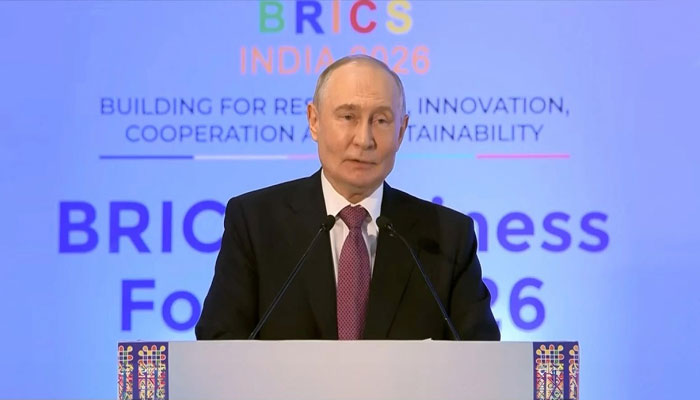
Putin Highlights BRICS’ 40% Global GDP Share, Takes Aim At G7 And Western Economic Policies
Russian President Vladimir Putin used the BRICS Business Forum in New Delhi to underline the growing economic weight of the emerging-economy bloc, contrasting its contribution to global GDP with that of the G7.
Putin said BRICS countries have generated more than 40 per cent of global GDP over the past five years, while the G7’s share stands at around 29 per cent. “Over the last five years, more than 40 per cent of the world GDP has been produced by the BRICS countries,” Putin said, adding that the G7 accounts for only 29 per cent.
His remarks came as the expanded BRICS grouping seeks to strengthen its economic and political influence amid major shifts in the global order.
- Putin Says Economic Power Is Shifting
- Putin argued that the figures demonstrate a fundamental change in the world economy.
“The world is always changing,” he said, describing the current period as one of “structural, deep, profound shifts”. According to the Russian president, countries that once served as the main engines of global growth are increasingly being challenged by new centres of economic expansion.
“The so-called old leaders, which used to be the vanguard of economic growth, are being replaced by new engines of growth,” he said. The remarks reflect Moscow’s broader argument that the global economic system is becoming increasingly multipolar.
‘Competition Is Taking Ugly Forms’
Putin also launched a sharp criticism of Western economic policies, accusing Western countries of trying to regain their previous competitive advantage. He said competition had increasingly taken “ugly forms”, citing what he described as the destruction of pipelines, attempts to block international transport corridors and the seizure of maritime vessels.
While he did not explicitly name Iran, his comments appeared to refer to concerns surrounding the Strait of Hormuz crisis amid the ongoing US-Iran conflict. Putin also criticised the sanctions imposed on Russia following the Ukraine war.
He said countries were facing “illegal restrictions” and threats of secondary sanctions for refusing to align their economic policies with the interests of other nations.
Russia Says It Faces Over 30,000 Sanctions
Putin claimed that Russia has faced more than 30,000 sanctions, saying the number was twice the combined total imposed on all other countries in the world. Despite the pressure, he said Russia had strengthened its economic sovereignty by relying on domestic businesses, scientific institutions, educational systems, engineering capabilities and its workforce.
“We have reinforced our national sovereignty; we are developing ties with reliable, predictable partners,” Putin said. His remarks positioned BRICS as an alternative platform for countries seeking greater economic cooperation outside traditional Western-led structures.
Modi Echoes The 40% GDP Figure
Prime Minister Narendra Modi later highlighted similar statistics during his concluding address at the BRICS Business Forum. “Today, BRICS nations represent 50 per cent of the world’s population, 40 per cent of its GDP, and over 25 per cent of global trade,” Modi said.
He also compared the pace of economic expansion.
Modi said global GDP had grown approximately two-and-a-half times over the period, while the combined GDP of BRICS countries had increased nearly four-and-a-half times. “In other words, the economic strength of BRICS has grown at nearly twice the pace of the rest of the world,” he said.
Modi added that BRICS countries were emerging as important centres of innovation, technology and economic solutions.
From Five Countries To An Expanded BRICS
BRICS originally comprised Brazil, Russia, India and China, with South Africa joining later. The grouping has now expanded to 11 full members, including Egypt, Ethiopia, Iran, Saudi Arabia, the UAE and Indonesia. It also has 10 partner countries — Belarus, Bolivia, Cuba, Kazakhstan, Malaysia, Nigeria, Thailand, Uganda, Uzbekistan and Vietnam.
The G7 consists of Canada, France, Germany, Italy, Japan, the UK and the US, with the European Union also participating. The contrasting figures cited by Putin and Modi illustrate the increasingly prominent role BRICS seeks to play in the global economy.
India Pushes Trade, Services And MSMEs
The BRICS Business Forum serves as the grouping’s main private-sector platform and is held in the host country ahead of the leaders’ summit. Commerce Minister Piyush Goyal said India’s BRICS chairship had focused on creating more balanced trade between member countries and expanding cooperation in services.
He said India wanted BRICS economic cooperation to create opportunities for farmers, women, young entrepreneurs and micro, small and medium enterprises. The approach reflects New Delhi’s effort to give BRICS a stronger economic and business dimension alongside its geopolitical role.
Modi-Putin Talks Focus On Wars And Trade Routes
Putin’s remarks came shortly after his bilateral meeting with Modi on the sidelines of the 18th BRICS Summit in New Delhi. The two leaders reviewed cooperation in political affairs, trade, defence, energy, space, skill mobility and people-to-people ties, according to the Indian Ministry of External Affairs.
They also discussed the conflicts in West Asia and the Black Sea region.
Both conflicts have affected maritime trade and raised concerns over the safety of Indian seafarers.
Modi once again stressed that dialogue and diplomacy were the way forward for resolving conflicts and said India remained ready to support peace initiatives.
Putin Invites Modi To Russia
Putin also invited Modi to Russia for the 24th India-Russia Annual Summit.
Modi accepted the invitation, with the dates expected to be decided through diplomatic channels.
The invitation comes against the backdrop of intensifying conflicts in both West Asia and the Black Sea region.
The US-Israel confrontation with Iran has heightened instability in West Asia, while the Russia-Ukraine conflict continues to affect security and maritime trade in the Black Sea.
India Repeats Its Message On Ukraine
Modi had delivered a similar message during his August 31 meeting with Putin in Bishkek, where he said India supported all efforts aimed at peace in Ukraine.
“Every day spent in war sets humanity back,” Modi had said, calling for an end to prolonged conflict.
He also told Putin that India had consistently discussed the Ukraine issue with Russia and supported efforts towards a peaceful settlement.
Modi invoked the messages associated with Mahatma Gandhi and Gautama Buddha to underline India’s emphasis on peace and diplomacy.
The Russia-Ukraine war began in February 2022.
At the 2022 SCO Summit in Samarkand, Modi had told Putin that “today’s era is not an era of war”.
Three years later, as BRICS expands and the global economy becomes increasingly divided between competing blocs, India continues to push dialogue, diplomacy and economic cooperation as alternatives to confrontation.
Comments are closed.