
Nepal Floods: Scientists Link Glacier Collapse to Climate Change
A 7.8-magnitude earthquake that struck the region in 2015 may have weakened the mountain’s underlying rock and contributed to the collapse, though scientists say its exact impact remains unclear.

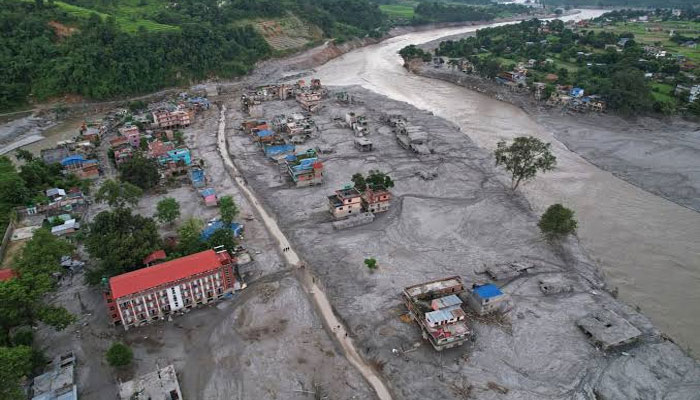
Climate change likely helped create the conditions that led to the massive glacier collapse responsible for deadly floods in parts of Nepal and Tibet in late August, according to scientists.
The collapse on Langtang Lirung mountain involved nearly 2 square kilometres of rock and glacier ice. The resulting floods killed around 1,400 people, while thousands more are still reported missing. Researchers from the World Weather Attribution (WWA) said rising temperatures across the Himalayas have accelerated glacier loss and thawed permafrost beneath mountain slopes, weakening the terrain over time.
Warming Increased Risk of Collapse
Scientists said they cannot determine the exact extent to which climate change triggered the collapse. However, they said long-term warming had altered the mountain environment and made the slope more vulnerable. Friederike Otto, a climatologist at Imperial College London, said human-caused warming contributed to the disaster by driving permafrost thaw, reducing glacier thickness and increasing the likelihood of rainfall instead of snow at high elevations.
The WWA uses established attribution methods to examine the influence of climate change on extreme weather events.
Temperatures Rose Sharply
The study found that average Himalayan temperatures in August were about 5°C above the normal level, with approximately 1.5°C of that rise linked to climate change.
Researchers also highlighted unusually heavy snowfall recorded in October and November last year. As temperatures increased, the accumulated snow produced additional meltwater, which may have added pressure to the already unstable slope.
Himalayan glaciers have also been thinning at an estimated rate of around 0.5 metres a year since 2000, according to the study. Scientists said this retreat is altering the stresses within surrounding rock, while thawing permafrost may further weaken the mountain structure.
2015 Earthquake Also Under Investigation
The researchers said a 7.8-magnitude earthquake in 2015 may have weakened the bedrock beneath the same mountain. However, the precise contribution of the earthquake to the latest collapse remains uncertain. Walter Immerzeel, a mountain hydrologist at Utrecht University, described the site as a geologically vulnerable slope that may already have been weakened by the 2015 earthquake.
He said subsequent glacier and permafrost retreat, combined with excessive meltwater and unusually high temperatures immediately before the collapse, further destabilised the slope.
The findings highlight the complex interaction between geological hazards and a rapidly warming Himalayan environment, where retreating glaciers and thawing permafrost are increasingly altering the stability of high-altitude terrain.
Comments are closed.