
Karthik Unnikrishnan’s long-awaited Asian Games debut ends in disappointment

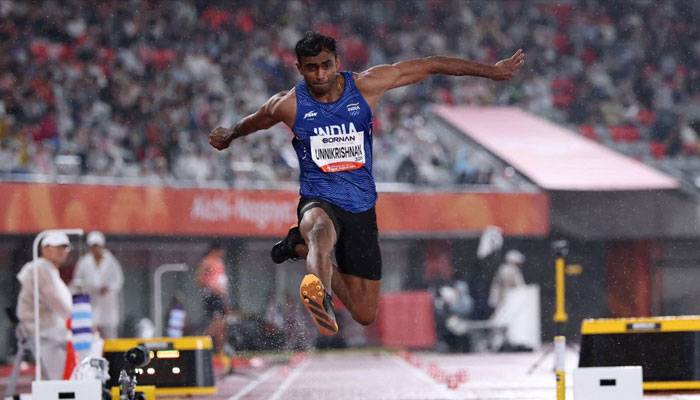
Fate denies Karthik Unnikrishnan a fairytale ending at 33
The rain refused to let up at Nagoya City Mizuho Park Athletic Stadium.
The runway was slippery and unforgiving, and for Karthik Unnikrishnan, every step carried the weight of years spent waiting for this moment. At 33, when many triple jumpers are nearing the final chapters of their careers, Karthik was only just making his Asian Games debut.
He had waited a long time for this chance. Perhaps too long.
And almost immediately, the odds seemed to turn against him.
India’s other contender, Praveen Chithravel — the 2022 Asian Games bronze medallist — injured himself in his opening attempt and was unable to continue. With Chithravel out, the responsibility of keeping India’s challenge alive fell entirely on Karthik.
The circumstances were far from ideal. But then, ideal circumstances have rarely been part of Karthik’s journey.
From a tea shop to the Asian Games
Born in 1993, Karthik entered India’s triple-jump circuit in 2015. His journey to the Asian Games was not the story of a prodigy who rose rapidly through the ranks. It was a slow climb shaped as much by circumstances as by talent.
His parents ran a tea shop in Ooty, while Karthik grew up with his maternal grandparents in Kerala. Studies never came naturally to him, and sport became an escape and, eventually, a calling.
At Parali High School in Palakkad, he first tried the hurdles. It did not work.
For a youngster living away from his parents and struggling to find success, the repeated failures began to take their toll. There were tears, loneliness and plenty of self-doubt.
His fortunes improved after he switched to the triple jump, but progress remained painfully slow. State-level success was followed by stagnation.
So Karthik stopped looking too far ahead.
He did not dream of the Olympics or Asian Games. He simply wanted to wear the Kerala jersey.
The break that changed everything
Then came an opportunity he had not expected.
Called up as an injury replacement at a national meet, Karthik finished second. That performance brought him to the attention of coach P.G. Manoj, who gave him a simple piece of advice: get a job first and then build your athletic career.
The Indian Air Force provided that opportunity through its sports quota.
For Karthik, it was more than employment. It transformed his sporting environment.
His family initially misunderstood the opportunity, even believing that an Air Force job meant he might become a pilot. Instead, Karthik found himself training in an environment where a domestic medal was merely a starting point.
His ambitions began to expand.
First came 15 metres. Then 16. Then 17.
The targets that once seemed impossible slowly became measurable.
So did the dreams of the Asian Games and Olympics.
Every comeback came with a price
But just as Karthik began to believe in those dreams, setbacks kept arriving.
The Covid-19 lockdowns stranded him in Patiala, away from his support network. Recovery after the pandemic, coupled with the absence of his coach, disrupted his preparations for the Tokyo Olympic trials.
At the Commonwealth Games trials, an ankle injury struck just after he had breached the 17-metre mark and entered an elite group of Indian triple jumpers.
Then came perhaps his most difficult setback.
A serious tendon injury in 2023 disrupted his muscle coordination so badly that Karthik and his physiotherapist, Garima, had to rebuild his jumping technique almost from scratch. Garima would later become his wife.
None of the setbacks alone was enough to define his career.
Together, they became a burden.
Every new competition carried memories of the previous disappointment. Every attempt was accompanied by the knowledge of how quickly an injury, illness or bad break could derail months of preparation.
Still, Karthik rebuilt himself.
By the time he felt capable of producing a 16.80m jump, he was 33 and heading to Nagoya with years of unfinished business behind him.
Six attempts, one final chance
Then came the rain.
Karthik had six attempts to turn years of waiting into an Asian Games moment. But the conditions made the runway difficult, and he managed to cross 16 metres only once.
He finished sixth.
There was no medal. No fairytale ending.
Yet reducing Karthik’s Nagoya story to a sixth-place finish would miss the larger point.
For years, he had been fighting an opponent he could never train against — circumstance. A lockdown. An injury. A lost opportunity. A body that refused to cooperate at the wrong moment.
In Nagoya, it was the rain.
For an athlete, those moments are brutally visible. Under the stadium lights, every missed opportunity becomes a number on a scoreboard.
But Karthik’s career has never really been about the scoreboard.
It is about how many times he returned to the runway after being told, in one way or another, that his moment had passed.
At 33, he finally reached the Asian Games. The medal never came. Fate, once again, got there first.
But Karthik did too.
He showed up.
Comments are closed.