
Nobel Peace Laureate Stands Firm on International Justice as US Criticism Mounts

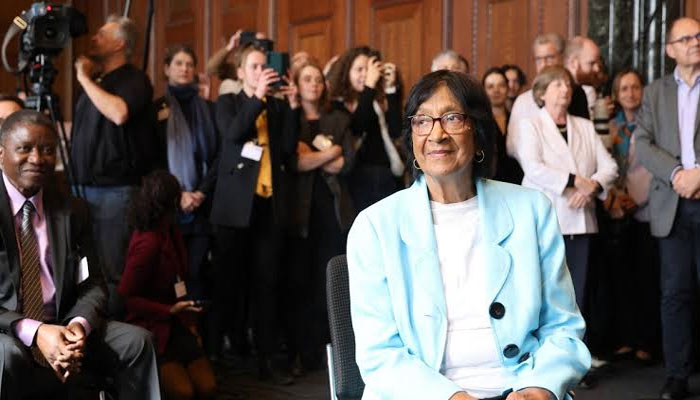
Nobel Laureate Navi Pillay Calls for Global Action to Protect International Justice
South African-born jurist Navi Pillay, who received the Nobel Peace Prize last week for her work advancing international law, has urged countries to defend the global justice system against growing political pressure, particularly from the United States.
In an interview with The Associated Press on Monday, the 85-year-old said she initially sought written confirmation of the award before believing the announcement, drawing on the evidence-based approach she followed throughout her judicial career.
“I received the letter in writing … so now I have read it for myself, and it’s true,” Pillay said.
Her decades-long career has included defending the rights of imprisoned anti-apartheid leader Nelson Mandela, serving on three international courts and leading a United Nations commission that concluded Israel had committed genocide in Gaza.
Pillay said the Nobel recognition was significant not only for her but also for the colleagues who have worked to uphold international law.
“To be honored for that kind of work is tremendous, not only for me, but for all my colleagues,” she said.
Nobel Committee Highlights Rule of Law
The Norwegian Nobel Committee presented the award in the context of mounting challenges to international legal institutions. Marking the 125th anniversary of the Nobel Prize, committee Chairman Jørgen Watne Frydnes stressed that justice and the rule of law are essential to maintaining peace.
“The rule of law, national and international, underpins the system we have set up to ensure peace and resolve conflicts nonviolently. Peace requires justice,” Frydnes said.
Pillay’s award has been interpreted as a pointed message amid criticism from US President Donald Trump and Israeli Prime Minister Benjamin Netanyahu of the UN commission she chaired. Both leaders have also criticised the International Court of Justice (ICJ) and the International Criminal Court (ICC), where Pillay previously served as a judge.
Pillay welcomed the committee’s decision to draw attention to international justice, warning that weakening respect for legal principles could affect countries across the world.
“I value the focus of the selection committee on this important area, because it does affect the whole world if the rule of law is not respected,” she said.
Pillay Criticises US Campaign Against ICC
Pillay sharply criticised Washington’s actions against the ICC, describing the US campaign as “completely unlawful” as well as “negative and cruel.”
She argued that political leaders have a responsibility to uphold international legal standards and respect the institutions established to enforce them. Trump, who has repeatedly expressed his desire to receive the Nobel Peace Prize, has pursued measures against the ICC.
Hours after Pillay’s award was announced in Oslo, US Secretary of State Marco Rubio unveiled sweeping new sanctions targeting the court as part of the Trump administration’s broader effort to pressure the institution.
Pillay called on governments to respond with practical measures to protect international justice rather than limiting themselves to statements of support.
She said she wanted to see “collective action, not just words” from countries committed to preserving the international legal order.
Concerns Over Accountability of Powerful Nations
Pillay said people around the world want accountability and are frustrated by what they perceive as unequal application of international law.
She highlighted the position of the United States and Russia, neither of which is a member of the ICC, while both possess permanent seats on the UN Security Council. Their veto powers can block substantive council resolutions, including efforts to address international crises.
The situation, she suggested, raises broader questions about whether powerful nations can be held accountable under the same standards as other states.
Gaza Findings Draw Israeli Opposition
Pillay’s work on Gaza has been a major source of controversy. The UN commission she led concluded last year that Israel had committed genocide against Palestinians in Gaza, including with the specific intent to destroy Palestinians in the territory. Israel has strongly rejected the findings.
Responding to Israeli criticism, Pillay said the condemnation came from the government whose conduct the commission had examined.
“We just have this condemnation by the state of Israel because they are the ones that we have held responsible,” she said.
Human rights organisations and some experts on genocide have also made allegations of genocide concerning Israel’s actions in Gaza. The allegations remain contested, and related legal proceedings are separate from the commission’s findings.
The ICC has issued arrest warrants for Netanyahu over alleged war crimes and crimes against humanity in Gaza. Israel denies the allegations.
‘Justice Is Slow’
Despite the political challenges confronting international institutions, Pillay said international law represents a relatively recent development in human history and that building an effective system of justice requires patience.
“Justice is slow, so we must not be impatient,” she said.
However, she cautioned against passivity, urging people to scrutinise political claims and distinguish evidence from propaganda.
“Don’t fall for false propaganda or just repeat slogans,” Pillay said, encouraging the public to examine the facts before reaching conclusions.
Her message was that protecting international justice requires both sustained public scrutiny and concrete action from governments, particularly at a time when the authority of global legal institutions is under increasing pressure.
Comments are closed.