
Canada Faces Unity Challenge as Alberta Independence Movement Gains Attention

Alberta Independence Referendum: Oil-Rich Province’s Vote Puts Canada’s Unity to the Test Amid US Tensions
Alberta is preparing for a crucial referendum that could set the stage for a potential separation from Canada, bringing renewed attention to regional grievances, energy politics and the country’s strained relationship with the United States. Voters in the oil-rich province will decide on Monday whether to support beginning the process of independence.
Despite opinion polls suggesting that fewer than one in four of Alberta’s approximately five million residents favour leaving Canada, separatist campaigners believe public support is significantly higher.
Mitch Sylvestre, head of the Alberta Prosperity Project, the province’s most prominent separatist organisation, told AFP on Tuesday that he believed the campaign could secure an unexpected victory.
“I wouldn’t be surprised if we actually win this referendum,” Sylvestre said, adding that he would be surprised if the movement received less than 40 per cent of the vote.
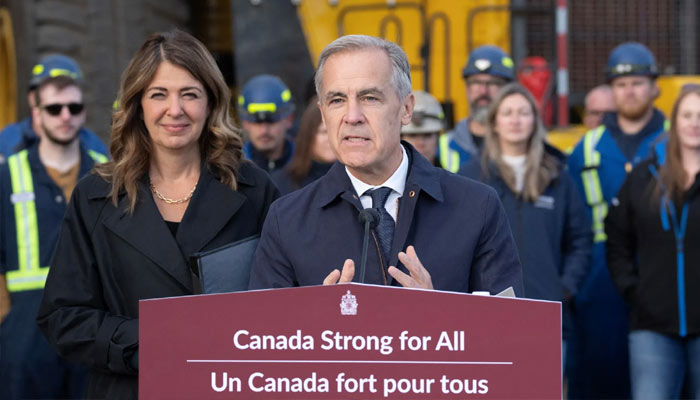
The referendum presents a political challenge for Canadian Prime Minister Mark Carney, who grew up in Alberta and returned to the province this week to campaign against separation. The vote comes at a time when relations between Ottawa and Washington have become increasingly strained under US President Donald Trump.
Carney Links Alberta’s Energy Future to Canadian Unity
Alberta’s oil and gas industry is central to Carney’s efforts to strengthen Canada’s economy and reduce its dependence on the United States. His government has supported a proposed new pipeline and other initiatives aimed at increasing crude oil production.
The approach marks a shift from the policies of former prime minister Justin Trudeau, whose environmental agenda and handling of the energy sector generated considerable resentment in Alberta.
In a video address released on Canadian Thanksgiving, Monday, Carney returned to his former high school in Edmonton to make the case for keeping the province within Canada. He presented the proposed pipeline as an opportunity to generate economic benefits for Alberta and the wider country.
“We can’t achieve any of this if we are divided,” Carney said.
His message reflects the government’s attempt to address Alberta’s economic concerns while arguing that remaining part of Canada offers a stronger foundation for future growth.
Why Does Alberta Want to Separate From Canada?
The independence movement is rooted primarily in disagreements over federal control, energy policy and the management of Alberta’s natural resources.
Separatists argue that the province’s economic interests have been undermined by decisions made in Ottawa. Their campaign also draws support from conservative concerns about immigration and what they regard as restrictions on individual freedoms.
However, the movement differs from several better-known separatist campaigns around the world because its central grievances are largely economic.
Ryan Griffiths, a Syracuse University professor specialising in separatist movements, described Alberta’s independence push as “mostly an outlier”.
He noted that economic grievances frequently contribute to separatism but are often accompanied by linguistic, cultural or national identity issues. In comparison, the independence movements in Catalonia, Scotland and Quebec have developed around more established debates about identity and self-determination.
Alberta’s campaign, by contrast, centres heavily on the belief that the province should have greater control over its oil industry and economic future.
Danielle Smith Rejects Independence Despite Criticism of Ottawa
Alberta Premier Danielle Smith has acknowledged the frustration surrounding federal energy policies, particularly those introduced under Trudeau.
“When you have a federal government that is actively trying to kill your principal industry, that has a real impact on people,” Smith told CBC last week.
Despite her criticism of the former federal government’s approach, Smith has said she will vote against independence. She has also welcomed Carney’s greater openness to Alberta’s oil and gas industry.
Smith has described the nonbinding referendum as a way to settle the divisive question of separation within the province.
She has said that if a majority votes in favour of independence, she will begin the legally binding process required to pursue separation. If voters choose to remain in Canada, she has indicated that she will not approve another referendum.
A vote supporting independence would not automatically make Alberta a separate country. Further legal and political negotiations would be required before separation could be completed.
US Political Connections Raise Questions
The involvement of people connected to Trump’s political circle has added another dimension to the Alberta independence debate.
US Treasury Secretary Scott Bessent has described Alberta as a “natural partner” for the United States. Meanwhile, representatives of the Alberta Prosperity Project have held several meetings at the US State Department.
Canada’s The Globe and Mail reported earlier this month on contacts between Sylvestre, his associates and Republican Party operatives, prompting scrutiny of possible American involvement in the separatist movement.
The issue is particularly sensitive given the tensions between Washington and Ottawa and Alberta’s importance as a major energy supplier.
Sylvestre has rejected the suggestion that American interests are driving his campaign. Speaking to AFP, he said US interests played no role in his current efforts, although he would seek to maintain open trade with the United States if Alberta became independent.
“There’s no animosity toward America here,” he said, arguing that continued commercial ties with the world’s largest economy would make sense.
What Is at Stake for Canada?
The referendum will test the strength of separatist sentiment in a province whose energy resources are important to Canada’s economic plans. It also comes at a time when Carney is seeking to strengthen the country’s economic independence while managing difficult relations with Washington.
For Alberta’s independence supporters, the vote is an opportunity to demonstrate that dissatisfaction with federal policies has translated into meaningful public backing for separation. For the provincial and federal governments, it is a test of whether economic grievances can be addressed without breaking up the federation.
Even if the independence camp secures a majority, Alberta would still face a lengthy legal and political process before it could leave Canada.
The immediate outcome will therefore be measured not only by the referendum result but also by what it reveals about regional discontent, the future of Canada’s energy policy and the country’s ability to maintain national unity amid external pressure.
Comments are closed.