

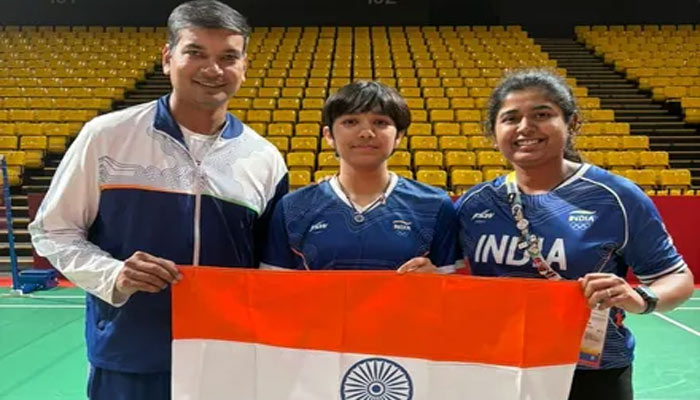
Tanvi Patri: From Learning Badminton in China to Making History at the Youth Olympics
Indian teenager Tanvi Patri is emerging as one of the country’s promising badminton talents after an impressive run at the 2026 Youth Olympics in Dakar. The 15-year-old created history by becoming the first Indian girl to reach the badminton singles final at the competition, eventually winning a silver medal after a closely fought battle against China’s Zhang Yi Xin.
Tanvi pushed the reigning junior world champion through an intense 82-minute contest. After taking the first game, she lost the second but refused to give up in the decider. Trailing 10-19, she produced a spirited comeback, saving five gold-medal points to bring the score level at 20-20. However, Zhang held her nerve to win 21-15, 13-21, 24-26.
While the final ended in defeat, Tanvi’s performance demonstrated her fighting spirit and growing ability to compete against top international opponents. Behind this achievement lies a journey that began in China and was shaped by her family’s sacrifices and years of training in Bengaluru.
A Childhood Introduction to Badminton in China
Tanvi’s badminton journey began when her father, Rabinarayan Patri, was working in Jiangsu province in eastern China. Having grown up in Odisha, Rabinarayan had always wanted to play badminton but could not pursue the sport because of financial limitations and a lack of proper facilities.
His professional move to China gave him an opportunity to introduce his daughter to the game. Badminton facilities were easily accessible, coaching was affordable and children had plenty of opportunities to practise.
Tanvi soon started training at a local badminton club. Interestingly, her father also received coaching alongside her, with trainers helping him improve his technique so that he could practise with his daughter at home.
Her early progress was encouraging. In 2019, Tanvi participated in approximately 10 provincial and national-level tournaments in China and won nine of them. These performances helped build her confidence and strengthened her interest in pursuing badminton professionally.
Chinese badminton legend Lin Dan became her idol, while her early exposure to systematic coaching helped establish a strong technical foundation.
The Family’s Decision That Changed Her Career
The Covid-19 pandemic forced the Patri family to return to India and settle in Bhubaneswar. However, Tanvi’s father soon realised that the available training environment was not providing the competitive opportunities she needed.
Concerned about her development, Rabinarayan decided to leave his well-paying job in China and return to India permanently. Although the decision involved financial risks, he believed his daughter’s badminton career deserved priority.
The family eventually approached the Prakash Padukone Academy in Bengaluru. After successfully completing a trial, Tanvi joined the academy in 2021 at the age of 10.
Her mother also made significant adjustments, eventually leaving her IT-sector job to manage Tanvi’s food, nutrition, travel and everyday requirements as the competition schedule became increasingly demanding.
Olympic Gold Quest (OGQ), a non-profit organisation supporting Indian athletes, has also backed her development.
How Bengaluru Helped Develop Her Badminton Skills
At the academy, now known as the Centre for Badminton Excellence, Tanvi received structured training to build on the foundation she had acquired in China.
Coach Sagar Chopda noticed her exceptional footwork, sharp timing and ability to move efficiently around the court. Her playing style gradually developed into an all-round combination of attacking and defensive skills.
Rather than depending entirely on powerful smashes, she uses accurate strokes, intelligent placement and the ability to sustain rallies.
Training alongside established players has also provided valuable exposure. The presence of Olympic medallist PV Sindhu at the academy offers younger players an opportunity to observe the discipline and dedication required at the highest level.
Asian Championships and International Success
Tanvi’s achievements have extended beyond the Youth Olympics. She won the Asian U-15 title in 2024 before capturing the Asian U-17 championship in 2026.
She also began competing in senior-level international tournaments, testing herself against more experienced opponents.
At the Pontianak International Challenge in Indonesia, she delivered a dominant performance in the women’s singles final, defeating South Korea’s Kim Min Sun, ranked World No. 71, 21-5, 21-6.
Her progress, however, was not without challenges. Illness affected her campaign at the World Junior Championships in Cairo, where she suffered from a viral fever.
She subsequently returned to competition with renewed determination and reached the final of the Youth Olympics in Dakar after defeating Japan’s Yuzuno Watanabe in the semi-final.
Why Her Coaches Want to Avoid Early Comparisons
Despite her growing achievements, Tanvi’s coaches believe she needs time to develop physically and mentally before taking the next step in her career.
At 15, she is still growing, making strength development, injury prevention and recovery important priorities. Her coaches also want her to gain experience through regular international competition rather than face premature expectations.
They believe her ability to learn quickly, understand match situations and execute instructions is among her biggest strengths.
Her father, meanwhile, continues to encourage her to concentrate on improving her own performance rather than comparing herself with other players.
From her first badminton lessons in China to a historic silver medal in Dakar, Tanvi Patri’s journey reflects the importance of early opportunities, family commitment and consistent coaching. At 15, she has already achieved a significant milestone, but her coaches and family believe there is much more to come as she continues developing into an international badminton player.
Comments are closed.