

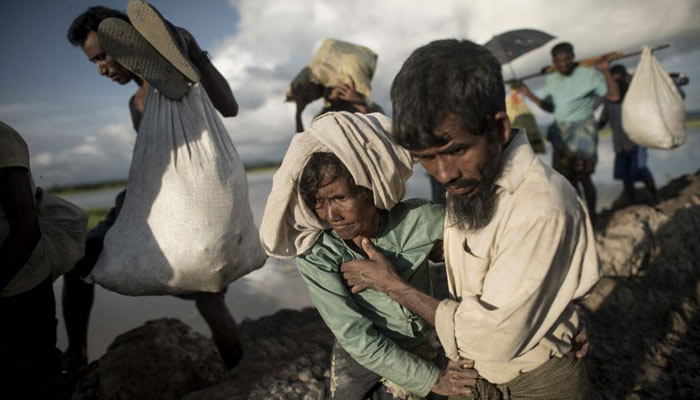
The International Court of Justice (ICJ) on Thursday delivered a historic verdict, holding Myanmar responsible for committing genocide against its Rohingya minority during the 2017 military crackdown.
The top United Nations court also directed Myanmar to facilitate the safe and dignified return of displaced refugees and ensure compensation for victims.
The judgment is unprecedented in the ICJ’s 80-year history, marking the first occasion on which its judges have formally ruled that a state committed genocide. The decision follows years of legal proceedings over the persecution and mass displacement of the Rohingya community in Myanmar’s Rakhine State.
Announcing the verdict at the court’s headquarters in The Hague, ICJ President Yuji Iwasawa said Myanmar had committed genocide against the Rohingya population in northern Rakhine State.
In a detailed presentation lasting nearly three hours, the judges examined evidence of widespread atrocities committed by Myanmar’s security forces during the 2017 operation. The military campaign forced hundreds of thousands of Rohingya to flee to neighbouring Bangladesh.
The court cited the killing of thousands of civilians, extensive sexual violence against women and severe brutality against children. It also found that Rohingya settlements had been systematically destroyed and subsequently occupied by members of other communities.
The judges concluded that the evidence pointed to an intention to destroy the Rohingya population, fulfilling the legal requirement of genocidal intent under the UN Genocide Convention.
MYANMAR DIRECTED TO ENSURE SAFE RETURN OF REFUGEES
In addition to establishing Myanmar’s responsibility, the ICJ ordered the country to facilitate the safe, voluntary and dignified return of Rohingya refugees to their places of residence.
The court also directed Myanmar to investigate the genocide, prosecute those suspected of involvement and ensure accountability. Compensation for the victims will be determined in subsequent proceedings.
ICJ decisions are legally binding and cannot be challenged through an appeal. However, the court lacks its own enforcement mechanism, leaving questions over whether Myanmar’s authorities will implement the directions.
The ruling is expected to increase international pressure on Myanmar’s leadership, particularly Min Aung Hlaing, who led the military during the 2017 crackdown.
Hlaing later overthrew the elected government of Aung San Suu Kyi in a military coup in 2021. He subsequently became civilian president following elections held under restrictions, while continuing to face international scrutiny.
ROHINGYA SURVIVORS HOPE FOR JUSTICE
The judgment has drawn particular attention among more than one million Rohingya refugees living in Bangladesh, many of whom escaped Myanmar during the military operation.
For survivors who have spent years in refugee camps, the verdict has raised hopes of justice and accountability for the violence they experienced.
Ahead of the announcement, a 23-year-old Rohingya woman who survived rape urged the international court to ensure strict punishment for those responsible for sexual violence against women.
Survivors have recounted accounts of mass executions, gang rapes, arson and attacks on families. Many refugees lost relatives and were forced to abandon their homes during the crackdown.
Mohammed Osman, a 20-year-old refugee, also expressed hope that the ruling would eventually allow him to return to his village and perform the last rites for his parents and younger brother, who were killed by Myanmar’s military.
He recalled how soldiers shot his father, sexually assaulted his mother and other women, and subsequently burned down their family home.
THE GAMBIA INITIATED LEGAL PROCEEDINGS
The genocide case was filed by The Gambia under the 1948 UN Genocide Convention, an international agreement established after World War II to prevent and punish genocide.
The Gambia approached the ICJ after examining credible reports of widespread violence and long-standing persecution of the Rohingya community.
Its legal campaign received support from the 57-member Organisation of Islamic Cooperation (OIC).
Gambian Justice Minister Dawda Jallow said the proceedings were not simply about international legal principles but concerned the lives and experiences of people who had suffered severe persecution.
Myanmar consistently rejected the genocide allegations and maintained that its military operations were aimed at combating armed insurgents. Its representative, Ko Ko Hlaing, argued during January’s hearings that the government could not allow armed groups to operate freely after attacks had killed security personnel.
The ICJ’s latest judgment has now delivered a decisive legal finding on Myanmar’s responsibility in the case.
RULING ALSO DRAWS ATTENTION TO GAZA GENOCIDE CASE
The proceedings were also being closely monitored by international legal experts because of their potential relevance to another high-profile case involving allegations of genocide against Israel in Gaza.
The Myanmar verdict has renewed focus on the standards used by the ICJ to establish genocidal intent, assess evidence and determine a state’s responsibility under international law.
For the Rohingya community, however, the central question is whether the historic judgment will lead to concrete action.
While the ruling establishes Myanmar’s responsibility for genocide, the return of refugees, punishment of those responsible and delivery of compensation will depend on the implementation of the court’s directions and further international efforts.
Comments are closed.