
Back-to-Back Asian Games Gold for India, But Was Nagoya Really Special?

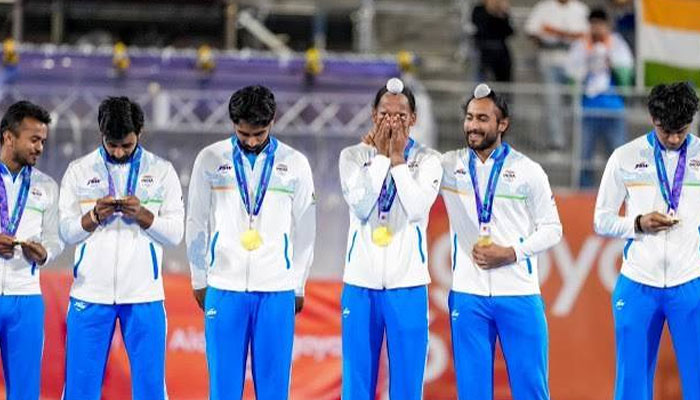
India Won Hockey Gold Again. So Why Didn’t It Feel Special?
Indian hockey left Nagoya with two Asian Games gold medals, but the stories behind the two triumphs could hardly have been more different.
The women ended a 44-year wait for the title, winning their first Asian Games gold since 1982. It was an emotional breakthrough, achieved after an unbeaten campaign and against the weight of decades of disappointment.
The men did something else entirely.
They did exactly what everyone expected them to do.
Harmanpreet Singh and his teammates retained the Asian Games crown, went unbeaten and booked their place at the Los Angeles Olympics. On paper, it was another highly successful campaign.
Yet somehow, it did not carry the same emotional punch.
Perhaps that is the price of becoming the dominant team in Asia. When winning gold is the expectation rather than the surprise, even a major achievement can begin to feel ordinary.
PR Sreejesh’s reaction after the final summed up that strange reality.
“Nothing special. We won. We were supposed to win. We are the Asian Champions. And yes, WE ARE GOING TO LA!”
Sreejesh was obviously celebrating. But there was something revealing about those words too.
India were supposed to win.
And that is precisely why the victory felt different.
WHEN GOLD BECOMES THE MINIMUM EXPECTATION
India entered Nagoya with little room for error.
The men’s team was not merely among the favourites. It was expected to win the tournament. Anything less would have been viewed as a failure.
That expectation is a sign of India’s progress, but it also changes the way success is perceived.
The women’s gold represented a breakthrough.
The men’s gold represented continuity.
India had already won the previous Asian Games title. In Nagoya, the task was simply to prove they remained the best side on the continent.
They did that convincingly.
But dominance can have an unintended consequence: it removes suspense.
THE GAP IN ASIAN HOCKEY IS GROWING
The biggest reason India’s campaign felt routine may have had little to do with India themselves.
The standard of Asian men’s hockey has fallen.
The recent World Cup provided a stark indication of the gap. India finished eighth, while Pakistan were 11th, Japan 14th and Malaysia 15th. South Korea, historically one of Asia’s strongest teams and a four-time Asian Games champion, did not even qualify.
In Nagoya, India therefore faced a field that offered limited resistance.
They won three group games by margins of at least 10 goals. Korea conceded eight. Japan, the only team to keep India to two goals, still lost comfortably.
Pakistan provided the one genuinely tense contest in the semi-final.
Even that eventually ended in India’s favour.
The final against Malaysia followed a familiar script. India were briefly tested before pulling away to win 5-1.
There was nothing fortunate about India’s gold.
They were clearly the best team in the competition.
But there was also little uncertainty about where they would finish.
And that matters when assessing the feeling around a tournament.
THE WORLD CUP PROBLEMS HAVE NOT DISAPPEARED
India’s dominant Asian Games campaign should not be allowed to hide the weaknesses exposed at the World Cup.
The semi-final against Pakistan was a reminder.
India led 3-0 and appeared completely in control. Then the intensity dropped, defensive structure disappeared and Pakistan came roaring back to make it 3-3.
India eventually survived after a late penalty stroke.
The comeback itself was impressive, but the manner in which India surrendered a three-goal advantage raised familiar concerns.
Defensive errors, unnecessary fouls and discipline issues have troubled the team for some time.
Former India goalkeeper Romeo James pointed out that the defensive improvements promised before the World Cup were not sufficiently visible against Pakistan.
That should concern the management.
Against weaker Asian opposition, India can often overcome such mistakes through superior individual quality.
Against the world’s best, those mistakes are far more expensive.
THE WOMEN OFFERED A DIFFERENT MODEL
The contrast with India’s women’s team is particularly interesting.
Their success was built around a feeling of renewal.
Under Sjoerd Marijne, the side appeared better organised, physically stronger and mentally more prepared for pressure situations.
Specialists were brought in for fitness, mental conditioning and goalkeeping. Players such as Savita Punia and Bichu Devi benefited from focused coaching, while the entire team appeared clearer about its responsibilities.
There was energy in the squad.
There was competition for places.
And there was a sense that the team was moving somewhere new.
That is something the men’s side had itself experienced a few years earlier.
HANGZHOU FELT DIFFERENT
The 2022 Asian Games were a turning point for Indian men’s hockey.
India had endured disappointment at the 2018 Asian Games and a disastrous World Cup on home soil.
Then came Craig Fulton.
The new coach brought a clear tactical identity and helped create a team that appeared capable of overwhelming opponents.
India won every match at Hangzhou by at least two goals.
Pakistan were beaten 10-2.
That campaign felt like the beginning of something.
Nagoya, by comparison, felt more like an extension of something that already existed.
That is not necessarily a criticism of the result.
It is a criticism of the lack of evolution.
HAS INDIA’S FORMULA RUN ITS COURSE?
Fulton’s emphasis on building from the back transformed India’s approach and helped produce results.
But the World Cup suggested that the formula may now need another layer.
India’s defensive problems have persisted. Their discipline remains an issue. And against top-ranked teams, the gap between their best hockey and their inconsistent hockey can become costly.
The Asian Games did not answer those questions because India were rarely forced to.
That makes the Olympic cycle crucial.
The team cannot afford to mistake Asian dominance for global readiness.
THE NOISE AROUND HOCKEY INDIA
There is also another problem that has nothing to do with tactics.
Hockey India’s internal power struggle between President Dilip Tirkey and Secretary General Bhola Nath Singh has continued to generate headlines.
While the players were focused on winning gold in Nagoya, the federation remained embroiled in its own battle.
Former goalkeeper Romeo James, who was part of a recent protest by hockey legends in Delhi, has warned that such infighting can eventually affect the players.
With Hockey India’s elections scheduled for November, the conflict could become even more intense.
Players can shut out external noise during a tournament.
It is much harder to shut it out over an entire Olympic cycle.
TIME TO BRING IN THE NEXT GENERATION
India also need to think seriously about succession.
Several members of the current squad have accumulated more than 100 international caps. Players such as Manpreet Singh, Mandeep Singh and Amit Rohidas continue to offer experience and quality, but Los Angeles should not be approached simply as an extension of the previous Olympic cycle.
Young players need opportunities now.
The objective should be to introduce them alongside experienced campaigners rather than wait until veterans are forced out by age or fitness.
A successful transition needs time.
INDIA NEEDS TO LEAVE ASIA MORE OFTEN
There is another obvious requirement: tougher competition.
India cannot prepare for the Olympics by repeatedly dominating teams that they are already expected to beat.
At the World Cup, India struggled to defeat higher-ranked opposition.
That is where the real learning happens.
As James suggested, India should regularly travel to Europe to play the leading hockey nations or bring those teams to India.
Playing better teams exposes weaknesses.
Young players gain experience.
Established players are forced to raise their standards.
And coaches get a much clearer idea of where their team actually stands.
SO, WAS THE GOLD SPECIAL?
Yes — but perhaps not in the way the celebrations suggested.
India went unbeaten, won the Asian Games title and secured Olympic qualification. None of that should be taken for granted.
A gold medal is still a gold medal.
But the muted reaction tells us something about how expectations have changed.
For India’s men’s team, Asian Games gold is no longer the destination.
It is the starting point.
The real question is what happens next.
Los Angeles will provide a far more demanding examination than Nagoya. And if India want their next major triumph to feel genuinely special, they will need to do more than remain the best team in Asia.
They need to challenge themselves against the world’s best, strengthen the defence, introduce the next generation and rediscover the tactical freshness that once made this team so difficult to contain.
Comments are closed.