
Brahmin-Muslim Equation: Can Congress Rebuild Its Base in Uttar Pradesh?

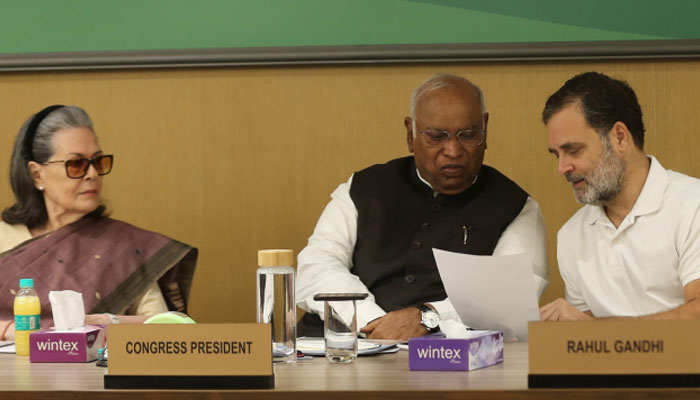
With the 2027 Uttar Pradesh Assembly elections approaching, the Congress has unveiled a new state leadership team that brings together leaders from different social groups, including Brahmin, Muslim, OBC and Dalit communities.
The party has appointed three-term Rampur Khas MLA Aradhana Misra Mona as the new Uttar Pradesh Congress president, replacing Ajay Rai, who had held the post since August 2023. Saharanpur MP Imran Masood has been named working president.
Congress president Mallikarjun Kharge also appointed Devinder Nishad and Alok Prasad as senior vice-presidents of the state unit. Meanwhile, Congress MLA Chaudhary Virendra Singh has taken over as Leader of the Congress Legislature Party in the Assembly, replacing Misra.
The reshuffle comes at a crucial time for the Congress, which has only two MLAs in the 403-member Uttar Pradesh Assembly.
A New Social Combination
The appointments have drawn attention to the social composition of the new leadership. Misra is a Brahmin, Masood is a Muslim, Nishad represents the OBC Nishad community, while Prasad is a Dalit leader.
Within the Congress, the combination of Misra and Masood is being seen as an attempt to put together two social groups that have historically featured prominently in the party’s electoral base in parts of Uttar Pradesh.
The broader appointments also echo the Samajwadi Party’s PDA — Pichhda, Dalit and Alpsankhyak — formulation, particularly through the inclusion of OBC and Dalit leaders.
The question for the Congress, however, is whether representation at the top can be converted into a stronger organisation at the grassroots.
Why Aradhana Misra’s Elevation Matters
Misra, daughter of veteran Congress leader and Rajya Sabha MP Pramod Tiwari, has represented Rampur Khas in Pratapgarh since 2014. She has won the seat three consecutive times, giving her an electoral base of her own.
Her appointment also marks the return of a woman as UP Congress president after nearly 15 years. Rita Bahuguna Joshi was the last woman to occupy the post, serving from 2007 to 2012 before later joining the BJP.
Misra has been closely involved in the Congress’ campaigns in Uttar Pradesh, particularly during Priyanka Gandhi Vadra’s extensive outreach in the state ahead of the 2022 Assembly elections.
She was also associated with the party’s “Ladki Hoon, Lad Sakti Hoon” campaign, which sought to increase the Congress’ appeal among women voters.
Despite coming from an established political family, Misra’s electoral career began at the grassroots. She entered politics through local-level elections before becoming an MLA and retaining her Rampur Khas seat in successive elections.
Imran Masood Gets Key Role
Masood’s appointment gives the Congress a prominent face from western Uttar Pradesh.
The Saharanpur MP returned to the Congress after a stint with the Samajwadi Party and won the 2024 Lok Sabha election from Saharanpur.
His elevation gives the party a senior Muslim leader with an electoral base in western UP, a region where Muslim voters constitute a significant part of the electorate in several constituencies.
Masood has also been outspoken about the Congress-Samajwadi Party relationship. His differences with the Akhilesh Yadav-led party could become relevant as the two INDIA bloc partners discuss their approach to the 2027 Assembly elections.
At the same time, the Tiwari family has maintained a relatively cordial relationship with the Samajwadi Party leadership, potentially providing another channel for dialogue between the alliance partners.
Beyond the Brahmin-Muslim Formula
The Congress’ reshuffle is not limited to the Brahmin-Muslim combination.
Devinder Nishad, who heads the party’s fishermen unit, has been made a senior vice-president. Alok Prasad, a Dalit leader from Gorakhpur, has also received the same designation.
Rajendra Pal Gautam, another Dalit leader, continues as the Congress’ AICC in-charge for Uttar Pradesh.
The appointments therefore give the state unit a leadership structure that attempts to reflect several social constituencies — Brahmin, Muslim, OBC and Dalit.
This is broadly in line with the Congress’ alliance partner Samajwadi Party’s emphasis on PDA politics, although the two parties have their own organisational structures and political strategies.
The Bigger Test: Organisation on the Ground
For the Congress, the reshuffle comes against the backdrop of a limited electoral and organisational presence in Uttar Pradesh.
The party won six Lok Sabha seats in the state in the 2024 general election, while its Assembly strength remains only two MLAs. The new leadership will therefore have to build beyond the party’s established pockets and strengthen its network at the constituency and booth levels.
The Congress will also have to navigate its relationship with the Samajwadi Party as discussions over a possible seat-sharing arrangement for 2027 take shape.
The new leadership’s social composition may provide the party with a framework for outreach, but its electoral significance will depend on whether the Congress can turn that representation into sustained grassroots mobilisation, organisational expansion and support across different regions of Uttar Pradesh.
Comments are closed.