
Centre Allows E100 Fuel for Flex-Fuel Cars, Clarifies No Impact on E20 Vehicles

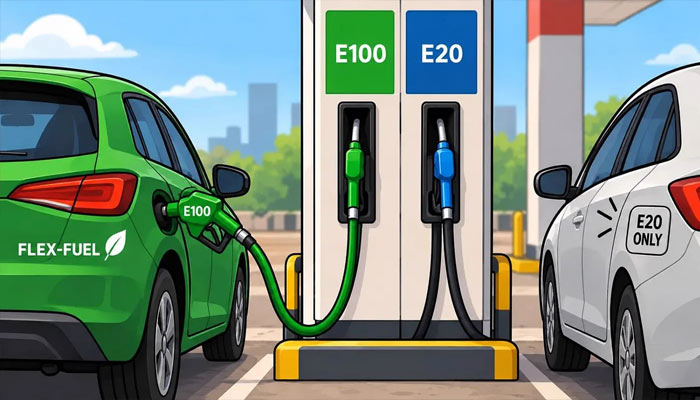
Centre Updates Motor Vehicle Rules to Permit E100 Fuel for Flex-Fuel Cars, E20 Vehicles Remain Unaffected
The Ministry of Road Transport and Highways (MoRTH) has amended the Central Motor Vehicles Rules, 1989, to formally recognise E100 fuel for flex-fuel vehicles designed and certified to operate on petrol blended with up to 100% ethanol.
The amendment was notified on October 23, extending relevant emission-related provisions to include E100 alongside E85 for eligible vehicles. The changes also update Rule 115 and associated technical provisions governing vehicle classifications, fuel specifications and emission testing requirements.
A senior ministry official told PTI that fuels containing more than 20% ethanol and up to 100% ethanol are intended exclusively for vehicles specifically designed and certified to use them. Conventional petrol vehicles and those approved for E20 cannot automatically use E85 or E100.
E100 Fuel: What Do the New Rules Mean?
E100 fuel consists of nearly 100% ethanol, while E85 contains 85% ethanol and 15% petrol. E20, which is already available in India, comprises 20% ethanol blended with 80% petrol.
Unlike conventional petrol vehicles, flex-fuel vehicles are engineered to operate on a wider range of ethanol-petrol blends. The revised rules establish regulatory provisions for eligible vehicles capable of running on higher ethanol concentrations.
The ministry has clarified that the amendment does not authorise the use of E85 or E100 in every petrol-powered vehicle. Compatibility depends on the vehicle’s design and certification.
The government has also revised the weight threshold for certain light petrol and diesel vehicles covered by the changes, increasing it from 3,000 kg to 3,500 kg.
Maruti Suzuki Launches Wagon R Flex Fuel
In June 2026, Maruti Suzuki India launched the Wagon R Flex Fuel, described as India’s first flex-fuel passenger vehicle. The model is designed to operate on ethanol-petrol blends ranging from E20 to E100.
Other major automobile manufacturers, including Toyota Motor Corporation, Tata Motors and Hyundai Motor Company, are also developing flex-fuel vehicles for the Indian market as the country expands its focus on alternative fuels.
The introduction of regulatory provisions for E100 is expected to provide a framework for vehicles specifically engineered to use higher ethanol blends.
Why Is India Promoting Ethanol-Blended Petrol?
India has been encouraging the use of ethanol-blended petrol to reduce its dependence on imported crude oil. The country’s substantial oil import bill places pressure on its external finances, making alternative fuels an important part of its energy strategy.
Concerns over global energy supplies, particularly amid the conflict in West Asia, have further highlighted India’s exposure to fluctuations in international oil markets.
Greater use of ethanol blends could help reduce the consumption of conventional petrol and support efforts to lower dependence on imported fossil fuels. However, the extent of the benefit will depend on the availability of suitable vehicles, fuel infrastructure and domestically produced ethanol.
Earlier, MoRTH had proposed amendments to vehicle emission regulations to facilitate the adoption of higher ethanol blends and other alternative fuels across different vehicle categories.
The draft provisions included measures relating to E85 and E100, B100 biodiesel and hydrogen-CNG combinations. The latest notification formally incorporates E100 into the relevant provisions for eligible flex-fuel vehicles.
Comments are closed.