

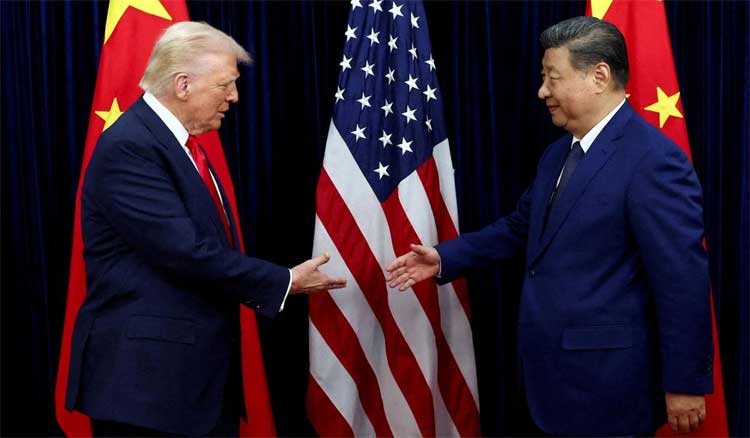
China said on Monday it is prepared to work with the United States to bring “more stability” to bilateral ties, as Beijing confirmed that Donald Trump will visit China this week — the first trip by a US president to the country since 2017.
The announcement comes as Washington and Beijing remain at odds over issues including trade tariffs, the Middle East conflict and Taiwan, which China claims as part of its territory.
Senior trade negotiators from both countries are set to meet in Seoul on Wednesday, a day before Trump’s summit with Chinese President Xi Jinping, in an effort to finalise key economic and trade discussions ahead of the high-stakes visit.
China’s foreign ministry confirmed that Trump will travel to China from Wednesday to Friday. The visit had originally been planned for late March or early April but was postponed as Trump focused on the US-Israel conflict involving Iran.
“Top-level diplomacy plays an irreplaceable strategic guiding role in China-US relations,” Chinese foreign ministry spokesperson Guo Jiakun said at a regular briefing.
“China is willing to work with the United States in the spirit of equality, respect and mutual benefit, to expand cooperation, manage differences, and inject more stability and certainty into a volatile and intertwined world,” he added.
Trade talks begin in Seoul
Trump’s trip will mark the first official China visit by a sitting US president since his own 2017 visit, and is expected to feature symbolic events including a visit to Beijing’s Temple of Heaven and a state banquet.
The White House has described the visit as being of “tremendous symbolic significance” and said Trump aims to secure new economic agreements.
US Treasury Secretary Scott Bessent will meet Chinese Vice Premier He Lifeng in Seoul on Wednesday to prepare the groundwork for the summit.
Bessent and He have led trade negotiations between the two countries, and their talks are expected to shape any major announcements during the Trump-Xi meeting.
Before heading to Seoul, Bessent is scheduled to meet Japanese Prime Minister Sanae Takaichi in Tokyo. Takaichi’s remarks on Taiwan in November sparked diplomatic tensions with Beijing.
“Economic security is national security, and I look forward to a productive series of engagements as we work to advance President Trump’s America First economic agenda,” Bessent said on social media.
Iran conflict looms over summit
Trump and Xi last met in person in October during a regional summit in South Korea, where they agreed to a one-year pause in an escalating trade war that had pushed tariffs on many goods above 100 percent.
This time, however, the conflict in the Middle East is expected to dominate discussions.
China remains one of Iran’s largest trading partners, and Iranian Foreign Minister Abbas Araghchi visited Beijing last week.
Chinese Foreign Minister Wang Yi told his Iranian counterpart that Beijing would play a “greater role” in efforts to restore regional peace.
US officials say Trump is expected to press Xi on China’s stance toward the conflict.
Responding to questions on Monday, Guo said China’s position on Iran remains “consistent” and that Beijing would continue playing a “positive role” in promoting a ceasefire and peace talks.
Tensions were further heightened after the US State Department sanctioned three China-based satellite firms on Friday for allegedly supporting Iran’s military operations.
China condemned the move, saying it “firmly opposes illegal unilateral sanctions.”
“The most urgent task is to do everything possible to avoid renewed conflict, not to exploit the situation to maliciously smear other countries,” the foreign ministry said.
The US Treasury Department has also imposed sanctions on several mainland Chinese and Hong Kong-based firms accused of helping facilitate Iran’s weapons supply chain.
Comments are closed.