

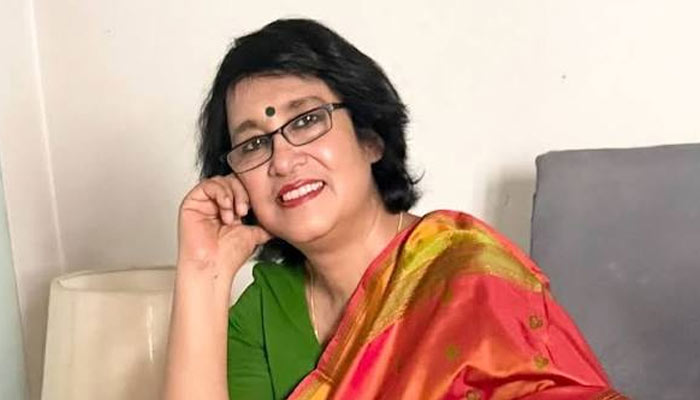
Exiled Bangladeshi author Taslima Nasreen on Sunday said the recent Cockroach Janta Party (CJP) protests in Delhi reminded her of the student-led movement.
That led to the fall of Sheikh Hasina’s government in Bangladesh in 2024, cautioning that the consequences of such movements should not be overlooked. Speaking at a press conference in Kolkata, a day after her felicitation ceremony was briefly disrupted, Nasreen said Bangladesh’s experience offered an important lesson.
‘WHAT HAPPENED IN BANGLADESH SHOULD BE A LESSON’
“What is happening here reminds me of the July student movement in Bangladesh. People were misled. The outcome has not been good. Jihadis have taken over power there,” Nasreen said.
The 2024 protests in Bangladesh began over a controversial government job quota system before snowballing into a nationwide anti-government movement. Weeks of unrest eventually forced then Prime Minister Sheikh Hasina to leave the country, after which Nobel laureate Muhammad Yunus headed an interim administration. Since then, Bangladesh has undergone a political transition, while minority communities, including Hindus, have voiced concerns over alleged attacks and insecurity.
Nasreen alleged that the condition of Hindus had deteriorated after the change in government.
“There were attacks on Hindus during Sheikh Hasina’s tenure as well, but the atrocities have increased under the Yunus government,” she claimed, blaming growing religious influence and deficiencies in the education system.
CALLS FOR SECULAR EDUCATION, UNIFORM CIVIL CODE
Advocating a secular state, Nasreen said religion should remain separate from governance and urged Bangladesh to strengthen secular education. She criticised the madrasa education system, alleging that it fostered communal thinking.
She also reiterated her support for a Uniform Civil Code, saying India, Bangladesh and Pakistan should adopt “one law for everyone” to guarantee equal rights, especially for women.
Nasreen also voiced support for jailed Hindu monk Chinmoy Krishna Das, saying she had joined others in protesting against his imprisonment.
Commenting on Bangladesh’s political future, she said the Awami League should not be banned and argued that it would be preferable for the party to remain the principal opposition rather than Jamaat-e-Islami. She also said Sheikh Hasina should be allowed to return to Bangladesh despite her criticism of some policies pursued during the former prime minister’s tenure.
REACTS TO KOLKATA EVENT DISRUPTION
Nasreen also spoke about the disruption at her felicitation ceremony at Kolkata’s Rabindra Sadan on Saturday, where noted Bengali poet Joy Goswami was prevented from addressing the audience after protests by a section of those present.
“I felt bad. It was not only Joy Goswami’s humiliation but mine as well because I had invited him. Political ideologies can differ, but everyone has the right to express their views,” she said, adding that she planned to visit the poet at his residence.
Reflecting on her political journey in India, Nasreen remarked, “One government barred me, one government expelled me, and one government invited me,” in an apparent reference to the Left Front, the Trinamool Congress and the BJP.
She also thanked Leader of the Opposition Suvendu Adhikari for assuring her security during her visit to Kolkata.
Expressing hope for stronger ties between India and Bangladesh, Nasreen said India had played a crucial role in Bangladesh’s Liberation War in 1971 and that the relationship between the two neighbouring countries should remain friendly.
Comments are closed.