
Congress-CJP Credit Battle Escalates as Youth Protests Fuel Opposition Rivalry

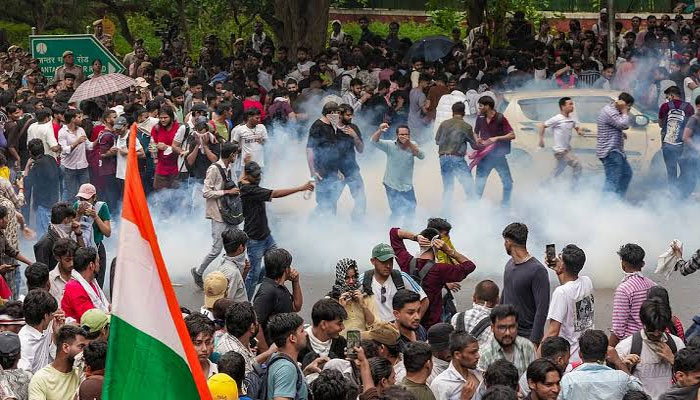
A battle over political credit is intensifying between the Congress and the student-led Cockroach Janta Party (CJP), after recent developments linked to youth protests at Delhi’s Jantar Mantar brought.
The two camps into direct confrontation on social media. The dispute centres on the question of who deserves credit for the legal relief secured for student protesters. After the Supreme Court quashed police proceedings against demonstrators, Congress supporters began sharing posts on Instagram and X linking the development to Rahul Gandhi’s political and legal intervention.
CJP activists strongly disputed the claim. They argued that the protests were organised independently by young activists and that those protesters, rather than established political parties, faced police action and legal pressure on the ground. CJP representatives subsequently posted screenshots and messages accusing Congress supporters of trying to claim ownership of a grassroots movement.
The disagreement has exposed a larger tension within the opposition space, where established parties and newer youth-led platforms are increasingly competing for influence.
HOW CJP GREW BEYOND SOCIAL MEDIA
The Cockroach Janta Party began as a satirical online campaign aimed at highlighting issues such as unemployment, political apathy and the concerns of young Indians. Its growing online following eventually translated into street mobilisation, with thousands of young people joining protests at Jantar Mantar.
The scale of the mobilisation has given CJP a public profile beyond its original identity as an internet satire movement.
Its supporters now insist that the platform must retain its independent character and should not be presented as an extension of any established political party. Congress, meanwhile, has sought to project itself as the wider political vehicle for anti-government protests and opposition activity.
The clash over social-media messaging has therefore become a battle over narrative as much as credit.
SWATANTRA BHARDWAJ CONTROVERSY DEEPENS DIVIDE
Tensions were further exposed during the controversy involving self-styled Hindutva influencer Swatantra Bhardwaj.
Bhardwaj was arrested on Saturday following allegations that he assaulted Sanjay Kumar, the father of student activist Nishu Azad, during a CJP rally.
The alleged assault drew condemnation from both Congress and CJP supporters, while questions were raised over the police response. CJP activists and independent representatives subsequently staged protests outside the Parliament Street police station.
However, disagreements emerged over the political handling of the case. CJP leaders objected to attempts to portray the legal developments surrounding the matter as a victory belonging to a particular political party. They argued that activists and the affected family had themselves been at the centre of the struggle for police and judicial action.
A NEW CHALLENGE FOR THE OPPOSITION
The Congress-CJP dispute points to a wider change in the way youth politics is being organised. Traditional parties rely on formal structures, established leadership and organised cadres, while decentralised youth movements can build momentum through memes, viral posts and direct mobilisation.
That difference is creating both opportunities and friction for the broader opposition.
For Congress, youth-led protests offer a potential avenue to connect with a politically active generation. For CJP, keeping its distance from established parties is central to its credibility among supporters.
The emerging credit war suggests that the opposition’s challenge is no longer simply about taking on the government. It is also about determining who gets to speak for a new generation of young protesters—and who ultimately controls the political narrative around their movements.
Comments are closed.