
From Fearing the Shotgun to Asian Games Gold: Neeru Dhanda’s Remarkable Rise

The first time Neeru Dhanda held a real shotgun, she threw it away.
She had always been fascinated by guns. As a child in Haryana, while other girls played with dolls, Neeru preferred toy tractors and toy guns. She remembers a wooden tractor, a larger iron one and a pellet-firing toy gun among her prized possessions.
But the real thing was different.
The shotgun belonged to her cousin Lakshay Sheoran’s father, Somveer. One day, at a farmhouse, the family decided to let young Neeru try it. They put up a tin sheet as a target and fired a few shots.
The noise terrified her.
The weapon was heavy, the recoil was unfamiliar and the sudden crack of the pellets sent her into panic. She dropped it.
“I got scared,” she later recalled.
Years later, that same fear would seem almost unimaginable.
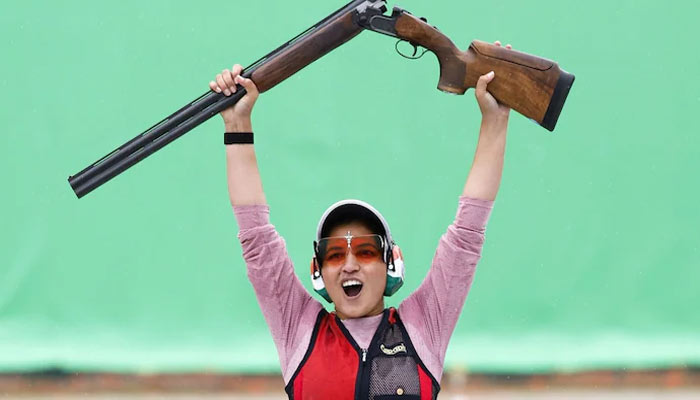
At the Aichi-Nagoya Asian Games, Neeru stood on a rain-soaked range and broke 28 of 30 targets to win individual trap gold — ending India’s 48-year wait for an individual Asian Games gold in the event.
She would go on to leave Japan with three medals: two golds and a silver.
But the medals only tell the final part of a story that began in a modest Haryana village, with borrowed equipment, financial hardship and a teenager who left home without knowing whether her gamble would pay off.
A Girl Who Chose Guns Over Dolls
Neeru grew up in Sangatpura village in Haryana’s Jind district.
Her father is a farmer. Her mother, Sudesh Devi, has helped support the family by selling buffalo milk. The family owned only a modest amount of farmland, making an expensive sport like shotgun shooting an unlikely career path.
Neeru herself never grew up dreaming of becoming an elite shooter.
She played kabaddi and admits that academics were not her strength.
Then her cousin Lakshay entered the picture.
Lakshay had taken up trap shooting and won a silver medal at the 2018 Asian Games in Jakarta. Until then, Neeru knew little about the sport.
“I saw him and thought he was doing some modelling-type shooting,” she recalled.
Then she saw his Asian Games medal.
Her curiosity became ambition.
“I was actually scared. I thought, how would I ever be able to shoot a bird? But when Lakshay won that medal, I became very inspired.”
The girl who had once thrown away a shotgun began training with Lakshay’s gun.
She shot at tin cans. Somveer, a former national wrestler, helped her adjust to the recoil. Lakshay’s family supported her as she explored the possibility of turning shooting into a career.
Eventually, they took her for trials at the Madhya Pradesh State Shooting Academy in Bhopal.
In 2019, Neeru moved there.
She was around 17 or 18.
And leaving home changed everything.
‘It Felt Like I Had Been Sent to Jail’
The first days at the academy were painful.
“When I joined the MP Academy, I cried a lot. I even threw my bag outside the academy,” she said.
“When my family left me there, I cried a lot.”
She was young, away from home and suddenly expected to build a life around a sport she had only recently discovered.
But going back was not really an option.
“Leaving home at 17 or 18 is not easy. You are not mature enough to make such big decisions. It was a risk, but I took that risk because I knew I had to do it, whatever happened.”
For Neeru, there was a reason bigger than medals.
Her family needed her to succeed.
“I had to do it. My family’s condition wasn’t such that I could simply stop. If I didn’t do it, there was no one else who would.”
Her teenage years gradually disappeared into training camps, competitions and travel.
There were no frequent outings for burgers, pizzas or golgappas. Her routine was brutally simple.
“If there were rotis at home, I ate them and left.”
She understood early that sporting success came with a price.
“If you want to achieve something, nature asks you to pay a price. Whatever you want in the future, you have to give something up first.”
Every Cartridge Mattered
The financial demands of shotgun shooting made her journey even harder.
Ammunition is expensive. Equipment is expensive. Travel and training are expensive.
Neeru’s family could not simply fund an elite sporting career.
Institutional support became crucial.
In the early stages, she received Khelo India assistance of Rs 10,000 and 120 cartridges. She also benefited from cartridges available through the TOPS support Lakshay was receiving before eventually becoming a TOPS athlete herself.
Neeru remembers those early benefits vividly — but also believes young athletes need to understand what such support is for.
“I started through SAI and Khelo India. At the beginning, I used to get Rs 10,000 as pocket money and 120 cartridges. That’s where it started.”
Her advice is blunt.
“If a player gets Rs 10,000, it shouldn’t be treated as money to spend on your personal wants, food, clothes or entertainment. You should put it into your training.”
At first, Neeru’s ambition was hardly grand.
“I started with a job as the goal.”
The belief that she could become a serious international shooter came later.
Her performance at the 2022 National Games in Gujarat gave her the confidence that she had a future in the sport.
Then came the Indian Army.
After navigating limited vacancies and other hurdles — including questions over her height — Neeru eventually secured her place.
She is now a Naib Subedar in the Corps of Military Police and trains at the Army Marksmanship Unit in Mhow.
The teenager who once depended on her cousin’s gun now had her own sporting identity.
And the medals soon followed.
From Asian Champion to World Cup Winner
Neeru won Asian Championship gold in 2025.
In July 2026, she made history again, becoming the first Indian woman to win an individual ISSF World Cup gold in trap at Lonato, Italy.
Then came the Asian Games.
But her preparation could hardly have been worse.
Ten days before the individual final, Neeru had been discharged from hospital after an infection. She had spent around three-and-a-half weeks away from training.
She arrived in Nagoya with her preparation badly disrupted.
Then the rain came.
And Neeru simply shot.
Twenty-eight hits out of 30 targets.
Asian Games gold.
She had earlier won women’s team silver with Aashima Ahlawat and Manisha Keer. The following day, she returned to the range and won mixed team gold alongside Kynan Chenai.
Three medals.
Two golds.
One silver.
But there was another honour waiting for her.
‘That Was Bigger Than the Medal’
Neeru became India’s flag-bearer at the Asian Games closing ceremony.
She did not even know about the honour until she returned to India.
The contingent arrived late at night. She reached home around 2 or 3am. By the next evening, she was travelling again to Japan.
Yet the exhaustion could not take away from what the moment meant.
“That was an even bigger feeling than the medal,” she said.
“Medals are won by many athletes. There have been champions before. Raja Randhir Singh was also a champion. But the journey I have had in my life, to carry the Indian flag, was a huge achievement for me.”
The moment also brought back something her mother had told her years earlier.
Around 2017-18, when Neeru was still a teenager, she had asked her mother where she wanted to see her one day.
Her mother’s answer was simple.
“I want to see you carrying the Indian flag. I want to see you winning gold at the Olympics.”
Neeru has now carried the flag.
The Olympic gold remains unfinished business.
“I want God to give me this opportunity again and again,” she said, referring to carrying the flag.
“And the athletes who are coming up, who are working hard and struggling, I want them to also get that strength and experience that feeling.”
The Girl Who Threw the Gun Away
Her Asian Games victory also carried special meaning for coach Mansher Singh, who had never won an individual Asian Games gold in shotgun.
“When I won, it was special for him because his own athlete and favourite athlete had won,” Neeru said.
Lakshay, meanwhile, claimed a piece of the gold for himself.
When Neeru showed him the medal over a video call, he was at a mall.
“He said, ‘I have won now.’ I had a silver and he said, ‘You have gold. My gold is also here. I consider it my own.'”
At 26, Neeru can now look back at the teenager who walked away from home with little more than a dream and a willingness to take a risk.
She knows what that decision gave her.
“I look back at that version of myself and say, ‘You made the right decision.'”
Back then, the goal was simply to find a job and give her family a better life.
Now, the target is much bigger.
“I have many goals now. I want to win awards and I also want to become an Olympic champion.”
Still, Neeru refuses to look too far ahead.
“The journey has only just started. We are not thinking too far ahead. We are focusing on what we have to do today and how we have to prepare for the next competition.”
It is a fitting way to describe her journey.
The little girl who preferred toy guns to dolls once picked up a real shotgun, heard the blast and threw it away.
Years of sacrifice, discipline and belief changed that reaction.
Now, when the gun goes off, Neeru doesn’t flinch.
She aims.
And she hits.
Comments are closed.