
Jensen Huang Controversy Sparks Renewed Demands For Stricter US Policy On China

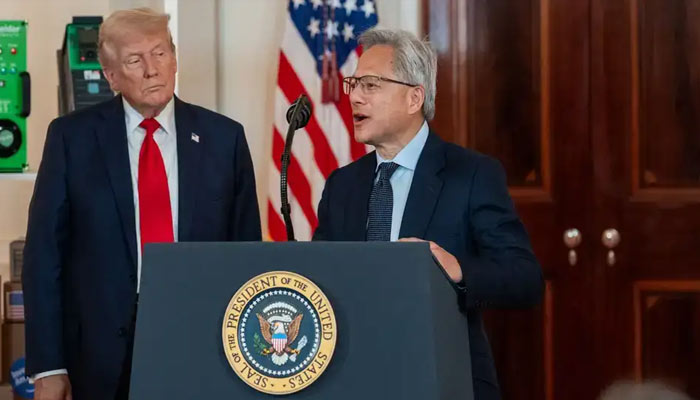
The controversy involving Nvidia CEO Jensen Huang and a woman suspected of having links to Chinese intelligence has sparked fresh debate in Washington over America’s technology policy towards Beijing.
US lawmakers advocating tougher restrictions on China’s access to advanced artificial intelligence chips are using the developments to renew pressure on the Trump administration. Huang, who co-founded Nvidia and transformed it into the world’s leading supplier of AI processors, reportedly admitted to having an affair with Alice Huang, a former executive at Singapore-based Megaspeed. US intelligence officials suspect that Alice Huang was working for Chinese intelligence.
President Donald Trump, who has consulted Jensen Huang on AI-related issues, defended the Nvidia chief, calling him an “honorable guy”. Trump said Huang had assured him that he had no knowledge of the woman’s alleged espionage connections.
China Hawk Lawmakers See Opportunity To Tighten Export Rules
The controversy has brought renewed attention to Huang’s long-standing opposition to restrictions on advanced AI chip exports to China. Last year, Trump approved the sale of Nvidia’s H200 processors to the Chinese market despite objections from lawmakers concerned about national security risks.
Aalok Mehta of the Center for Strategic and International Studies said several China-focused policymakers in Washington had been unhappy with the administration’s relatively relaxed approach to export controls. He suggested that the latest revelations could strengthen their efforts to push for stricter measures.
Kurt Campbell, former US deputy secretary of state and co-founder of consultancy The Asia Group, said the allegations could trigger an extensive investigation. He noted that lawmakers would want to establish when American authorities became aware of the suspected intelligence connections, whether Trump had received warnings and whether the information influenced decisions concerning China.
The New York Times reported that Secretary of State Marco Rubio informed Trump about the allegations in May, although the president reportedly decided not to take action.
Nvidia’s Relationship With Trump Administration Under Scanner
The company’s political engagement has also attracted attention. The Washington Post reported that Nvidia contributed $25 million towards Trump’s proposed White House ballroom, placing it among the project’s largest donors. Nvidia has maintained that the contribution had no connection to its commercial interests.
Meanwhile, three Republican committee chairs in the House of Representatives have requested a closed-door briefing with Huang on November 18. They want explanations about his interactions with Alice Huang and the company’s measures to prevent espionage and protect sensitive technology.
Bipartisan Bill Could Return To Centre Stage
The developments may revive the AI Overwatch Act, a bipartisan legislative proposal that would allow Congress to review and block licences for exporting advanced AI chips to China and other countries regarded as US adversaries.
Kyle Chan of the Brookings Institution’s John L. Thornton China Center said Republicans who had previously been reluctant to challenge Trump might now be more willing to distance themselves from the president’s position following their party’s loss of control of Congress.
Emily Benson, head of strategy at Minerva Technology Futures, said the allegations had generated fresh interest in incorporating stricter export-control provisions into the annual defence authorisation bill.
However, any legislative push could face resistance from Trump, who retains veto powers. Congress would need a two-thirds majority in both chambers to override a presidential veto.
The Commerce Department has reportedly explored additional restrictions, including preventing Chinese entities from remotely accessing advanced American AI processors. However, Commerce Secretary Howard Lutnick is said to be awaiting instructions from Trump before proceeding, according to The Information.
The department has also faced scrutiny over reports that it stopped an investigation into Megaspeed’s business dealings with Nvidia.
China-US Trade Relations Could Face Fresh Tensions
Stricter export controls could put additional pressure on the trade understanding reached between Trump and Chinese President Xi Jinping last year. Emily Benson warned that Beijing could respond to restrictions targeting Chinese technology access with retaliatory measures, potentially disrupting American supply chains.
The allegations have prompted investigations by US authorities. Trump said the FBI was examining the suspected espionage links, while NBC News reported that the Justice Department was investigating whether Megaspeed had smuggled Nvidia processors into China.
Megaspeed has denied the chip-smuggling allegations, while Beijing has rejected the espionage claims as attempts to malign China.
Jensen Huang Controversy Raises Questions Over Nvidia’s Future
The investigation could have wider implications for Nvidia and the American artificial intelligence industry. Kyle Chan said that if wrongdoing were established and Huang were forced to step down, the consequences could be substantial because of his central role in Nvidia’s growth and the development of the wider AI sector.
Aalok Mehta also suggested that the company’s access to influential policymakers in Washington could be weakened significantly as the controversy unfolds.
The episode has brought renewed attention to the intersection of corporate influence, national security and America’s competition with China over artificial intelligence and advanced semiconductor technology.
Comments are closed.