
Le Pen Signals Presidential Run, Vows to Reinstate Rule of Law in France

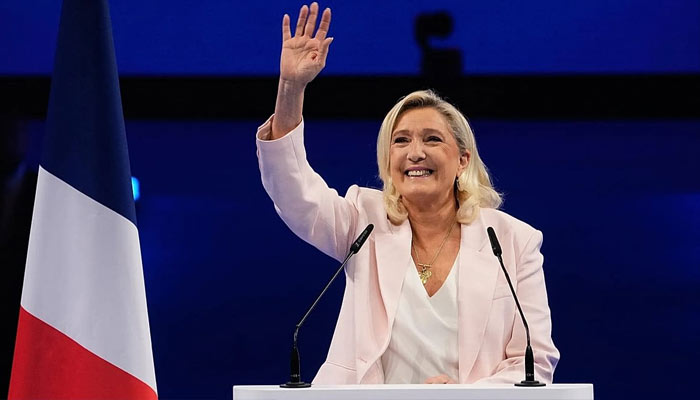
Marine Le Pen Launches Presidential Campaign, Vows to Restore Law and Order in France
French far-right leader Marine Le Pen has officially launched her campaign for next year’s presidential election, pledging to restore the rule of law, tighten immigration policies and strengthen France’s national identity amid growing unrest over living costs and public security.
Addressing approximately 8,500 supporters of her National Rally (RN) party in Orleans on Sunday, Le Pen criticised the government’s handling of violent demonstrations and accused President Emmanuel Macron’s administration of failing to maintain order.
“We are going to restore the rule of law,” Le Pen declared, referring to recent incidents of looting and arson on the sidelines of nationwide protests.
The rally took place in Orleans, a city closely associated with Joan of Arc, the historical figure celebrated by French nationalists as a symbol of resistance. Supporters waved French flags and chanted slogans as Le Pen promised a new direction for the country.
“We are proposing for the country not a return to the past, but the dawn of a new era,” the 58-year-old leader told the gathering.
She also pledged to protect France’s language, traditions, values and way of life, saying the country needed to regain its strength.
Cost-of-Living Protests and Security Concerns Dominate Debate
Le Pen’s campaign launch comes against the backdrop of widespread demonstrations over rising living costs and dissatisfaction with government policies.
More than 400,000 people reportedly marched through major French cities on Saturday. Some protests turned violent after masked groups broke away from the demonstrations, prompting clashes with police. Authorities made more than 1,300 arrests, while Interior Minister Laurent Nunez blamed much of the violence on far-left extremists.
The unrest followed several weeks of student protests over the condition of France’s schools, alongside earlier demonstrations that also witnessed clashes and property damage.
Le Pen has accused Macron’s centrist government of being too lenient towards violent protesters and failing to demonstrate sufficient authority. Her campaign is seeking to make public safety and law enforcement central issues in the presidential race.
Supporters at the Orleans rally expressed concerns about insecurity and economic pressures. Charlene Malingre, a 23-year-old supporter, said she believed Le Pen could address France’s challenges, particularly those involving the economy, security and public order.
Prime Minister Sébastien Lecornu was expected to meet high school student organisations on Monday as the government faced continuing pressure to respond to concerns over education and public services.
Immigration and National Identity at the Centre of Le Pen’s Agenda
Immigration emerged as another major focus of Le Pen’s campaign. The National Rally leader promised stricter border controls and a tougher approach to French citizenship.
“We will restore our borders, and even establish double borders, both French and European,” she said.
Le Pen also argued that French nationality should be treated as a privilege acquired through inheritance or earned under specific conditions.
Her presidential bid comes despite an appeals court upholding a graft conviction against her, adding uncertainty to her political ambitions. She has previously contested the presidency three times.
Jordan Bardella, her deputy and a prominent figure in the party, received a standing ovation before Le Pen addressed supporters. He called for stronger action against far-left groups, proposed lowering the age of criminal responsibility to 16 and advocated deporting offenders and criminals.
Bardella’s address was briefly interrupted by members of a Jewish student union displaying a banner referring to a media report alleging that he had deleted antisemitic messages from an old Facebook account.
Counter-Protests Reflect Opposition to the National Rally
Le Pen’s campaign has drawn opposition from demonstrators concerned about the potential consequences of a far-right government.
Thousands of counter-protesters marched through Orleans on Saturday, chanting anti-fascist slogans and opposing the National Rally’s nationalist and anti-immigration platform. Police subsequently tightened traffic controls around the city ahead of Sunday’s rally.
Antonine Rochet, a 35-year-old yoga teacher who joined the opposition demonstrations, said she feared that a far-right victory could make France’s existing problems worse.
The rival demonstrations highlighted the deep political divisions surrounding immigration, public safety and the country’s future direction.
Polls Indicate Significant Support for Le Pen
An Ipsos survey published on Saturday suggested that Le Pen could receive between 32% and 34% of the votes in the first round of the presidential election. The findings underscored her strong position in the campaign, although the final outcome will depend on the electoral contest.
The survey also indicated widespread public dissatisfaction over the recent unrest, with a majority of respondents believing the government bore responsibility.
Le Pen has outlined several economic proposals, including caps on household energy bills, tax reductions and cuts to France’s financial contribution to the European Union. She has also criticised NATO and France’s support for Ukraine following Russia’s invasion.
However, the next president will face considerable fiscal challenges. France’s public debt and budget deficit remain above EU limits, while Macron’s government has struggled to push through a budget focused on spending cuts.
As France approaches its next presidential election, Le Pen is attempting to channel public frustration over living costs, immigration and security into electoral support. Her campaign is likely to intensify the debate over national identity, government authority and the country’s economic future.
Comments are closed.