
Messi and Argentina: From Heartbreak to Glory on Football’s Biggest Stage

Few sporting relationships have been as emotional, complicated and ultimately rewarding as Lionel Messi’s bond with Argentina.
Sachin Tendulkar and India, Kobe Bryant and the Los Angeles Lakers, Michael Schumacher and Ferrari — sport has produced several partnerships that became bigger than trophies. Messi and Argentina belong in that company.
For years, Messi’s name was inseparable from Barcelona, where he built a career filled with records and silverware. But the Argentina shirt carried a different weight. It represented the country he left as a child, the expectations of a football-mad nation and, for much of his career, a source of unimaginable heartbreak.
Now, at 39, Messi has brought that international journey to a close, announcing his retirement from Argentina duty and confirming that his time in the famous blue-and-white shirt is over.
It is an ending to a story that contained almost everything — early promise, disappointment, criticism, redemption, historic victories and an unwavering sense of belonging.
ARGENTINA WAS ALWAYS HOME
Messi’s international story began when he was still a teenager.
After moving to Spain to continue his football development, questions emerged over whether the young star could eventually represent Spain. The Spanish side had plenty of reasons to be interested, but Messi’s heart remained with the country where he was born.
“I’ve never stopped being Argentine, and I’ve never wanted to,” Messi once said. “I feel very proud of being Argentine, even though I left there.”
His early performances for Argentina suggested that decision was never in doubt.
At the 2005 FIFA U-20 World Cup, Messi was sensational. He scored six times, including both goals in the final against Nigeria, and finished the tournament with both the Golden Boot and Golden Ball.
His senior debut a month later was far less memorable. Messi came on against Hungary and was sent off just 47 seconds later.
It was a chaotic introduction to international football, but it was only the beginning.
Soon came his first Argentina goal — a trademark move from the left followed by a curling finish. Then came the 2006 World Cup, where the teenager scored against Serbia and Montenegro and gave fans their first glimpse of what he could become on the biggest stage.
Argentina were eliminated in the quarter-finals, but Messi’s international journey was gathering pace.
At the 2008 Beijing Olympics, he helped Argentina win gold. Soon afterwards came another huge responsibility: the No. 10 shirt.
The shirt once worn by Diego Maradona was passed to Messi, who was increasingly viewed as the country’s next footballing icon.
WHEN THE TROPHIES REFUSED TO COME
Being Argentina’s No. 10 came with enormous expectations.
Messi experienced the first major disappointment at the 2007 Copa America, when Argentina lost the final to Brazil. But the heartbreak would become far more painful over the next decade.
Argentina reached the 2014 World Cup final, with Messi leading the charge. Germany won in extra time, leaving Messi with the Golden Ball but not the trophy.
Then came back-to-back Copa America final defeats.
In 2015, Chile beat Argentina on penalties. The following year, at the Copa America Centenario, the same thing happened again.
By then, Messi had become Argentina’s all-time leading scorer and was producing outstanding individual performances, yet the major international trophy remained beyond his reach.
The pressure became overwhelming.
After the 2016 defeat, Messi announced that he was retiring from international football.
“I’ve done all I can. It hurts not to be a champion,” he said.
But the decision did not last.
A month later, Messi reversed course and returned to the national team.
The story was not finished.
THE TEAM THAT FINALLY DELIVERED FOR MESSI
Everything began to change under Lionel Scaloni.
Argentina stopped relying solely on Messi’s individual brilliance and instead developed a team capable of carrying the burden alongside him. The players fought for their captain, while Messi was finally able to operate with greater freedom.
The breakthrough came at the 2021 Copa America.
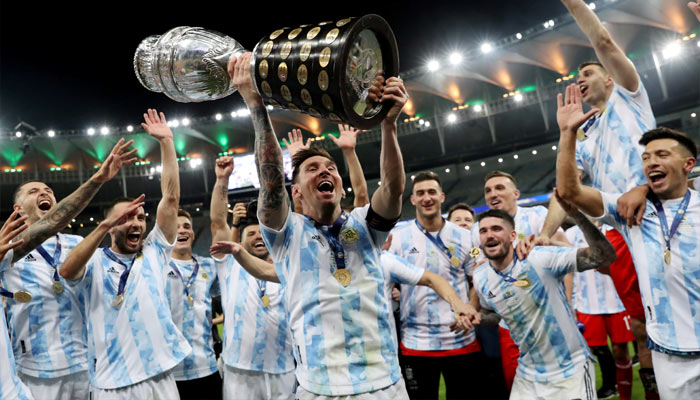
Messi scored four goals and supplied five assists as Argentina reached the final against Brazil. Angel Di Maria scored the only goal, giving Messi the major international title he had chased for so long.
The drought was finally over.
The Finalissima triumph against Italy followed in 2022, setting the stage for the ultimate prize.
Qatar began with a shock.
Argentina lost to Saudi Arabia in their opening World Cup match, immediately raising questions about their chances. Messi responded in the only way he knew — by taking control.
He scored against Mexico, found the net against Australia and then delivered against the Netherlands and Croatia as Argentina marched into the final.
France awaited.
The final became an instant classic. Messi scored twice as Argentina and France fought through 120 minutes to a 3-3 draw. In the penalty shootout, Messi calmly converted before Argentina completed the job.
The World Cup was finally his.
The image of Messi lifting the trophy in Qatar became the defining moment of his international career.
Argentina then won the 2024 Copa America, adding another major title to an era that had transformed Messi’s relationship with his country.
ONE LAST WORLD CUP
When Messi arrived at the 2026 World Cup, there was little left to prove.
He had finally won the World Cup. He had conquered the Copa America. He had rewritten Argentina’s scoring records and transformed his international legacy.
Still, he wanted one more tournament.
The campaign brought more memorable moments, including a hat-trick against Algeria and crucial performances in difficult games against Cabo Verde and Egypt.
In the semi-final against England, Messi delivered again, creating two goals to help Argentina reach the final.
But the final ended in defeat.
For Messi, it was the final page of an international career that had stretched across more than two decades.
The loss was followed by another deeply personal blow: the death of his father, Jorge. Messi’s connection with football changed, and eventually he decided that the time had come to walk away.
“It was a decision that hurt, and still hurts deeply, but I understand that this is the right time,” Messi said.
He stressed that his commitment to Argentina had never depended solely on winning trophies.
“I love, have loved and will always love being part of the national team,” he said. “I gave everything I had; I have nothing more left to give.”
Those words capture the essence of Messi’s relationship with Argentina.
He could have walked away after losing those Copa America finals. He could have stayed retired in 2016. He could have allowed years of criticism to define his international legacy.
Instead, he came back.
He kept fighting.
And eventually, he gave Argentina the trophies it had been waiting for.
Messi’s story with the national team was never simply about goals, medals or records. It was about his refusal to abandon the country he had always considered home.
From the teenage prodigy in 2005 to the World Cup-winning captain in 2022, Messi’s journey with Argentina became one of the defining stories of modern international football.
And as he closes the door on the Albiceleste, one sentiment remains at the heart of it all:
“Thank you, God, for making me Argentine. Vamos, Argentina!”
For Argentina, Lionel Messi was never just its greatest player.
He became a symbol of what it means to keep believing, even when glory seems impossibly far away.
Comments are closed.