
Mumbai Sweats in Humidity, Delhi Gears Up for Winter, as Smog Engulfs Both Cities: Who Has Worse AQI?

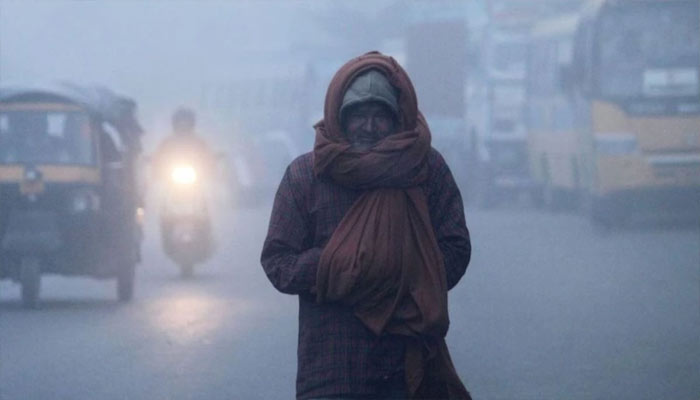
Mumbai’s AQI Nearly Matches Delhi’s as Both Cities Battle Smog; Who Has Worse Air Pollution?
Mumbai and Delhi are increasingly facing a common environmental challenge: deteriorating air quality. While Mumbai continues to experience hot and humid weather, Delhi is preparing for winter, with pollution levels rising in both cities. Recent reported figures show Mumbai’s Air Quality Index (AQI) at 164, just below Delhi’s 165.
The reported wind speed in Mumbai was 17.6 kmph, compared with 8.3 kmph in Delhi. Stronger winds can help disperse pollutants, while slower winds may allow them to accumulate. However, pollution levels also depend on wind direction, atmospheric stability and emissions from local sources.
Mumbai’s air quality has drawn particular attention after reports indicated that its AQI had remained comparable to, or higher than, Delhi’s for four consecutive weeks.
Mumbai and Delhi AQI: What Do the Numbers Show?
The reported readings of 164 in Mumbai and 165 in Delhi fall within the ‘moderate’ AQI category. However, Delhi’s air quality subsequently deteriorated into the ‘poor’ category on Wednesday, when the AQI crossed 200.
Delhi’s pollution comes from several sources, including vehicle emissions, industrial activity, construction dust, waste burning and seasonal crop-residue fires. Mumbai faces pollution from construction and redevelopment projects, road dust, vehicular traffic and weather conditions that can limit the dispersal of pollutants.
The comparison highlights the need for sustained pollution-control measures in both metropolitan cities, although AQI readings can vary by location and time.
Fadnavis Faces Questions Over Mumbai’s Air Quality
Mumbai’s worsening air quality has also become a subject of online criticism directed at Maharashtra Chief Minister Devendra Fadnavis.
Fadnavis recently posted on X about meeting President Droupadi Murmu at Rashtrapati Bhavan in New Delhi and inviting her to attend the hoisting of the Dharmadhwaj for the Nashik-Trimbakeshwar Simhastha Kumbh Mela 2027.
In response, a social media user questioned whether the Chief Minister had raised Mumbai’s pollution concerns with the President. The user also criticised the alleged cutting of trees in Nashik for preparations for the religious event and expressed concerns about the environmental impact of El Niño and worsening pollution in Mumbai and Thane.
Delhi’s Pollution Worsens After Dussehra
Delhi’s latest deterioration in air quality coincided with Dussehra celebrations, which included Ramlila performances, the burning of effigies of Ravana, Kumbhakarna and Meghnad, and fireworks at several locations.
Fireworks release particulate matter and other pollutants into the atmosphere. However, the extent to which the celebrations contributed to the subsequent rise in Delhi’s AQI has not been established.
The seasonal transition towards winter can further complicate the situation. Falling temperatures and atmospheric conditions that restrict the movement of air may allow pollutants from vehicles, construction sites, industries and waste burning to accumulate closer to the ground.
According to the Air Quality Early Warning System forecast cited in the supplied information, Delhi’s air quality was expected to remain in the ‘poor’ category through October 23, with poor conditions also forecast for the following six days.
Stubble Burning Adds to Delhi’s Pollution Concerns
Crop-residue burning in neighbouring states remains another potential contributor to Delhi’s seasonal pollution.
Earlier in October, the ICAR-Indian Agricultural Research Institute detected 19 farm-fire incidents across six monitored states. Punjab and Uttar Pradesh recorded seven incidents each, followed by four in Madhya Pradesh and one in Haryana.
Farmers often burn crop residue to clear fields for the next planting cycle. Smoke from these fires can travel across state borders, but its impact on Delhi depends on the location and number of fires, wind direction and prevailing weather conditions.
The presence of farm fires alone does not establish how much they contributed to pollution on any particular day.
GRAP-1 Measures Introduced Across Delhi-NCR
With Delhi’s AQI entering the ‘poor’ category, the Commission for Air Quality Management (CAQM) invoked Stage I of the Graded Response Action Plan (GRAP) across the National Capital Region.
The measures are intended to curb pollution-generating activities and strengthen enforcement of existing environmental rules.
Key restrictions and actions include:
Tandoor fuel: The use of coal and firewood in tandoors at hotels, restaurants and open eateries is prohibited under the cited measures.
Diesel generators: Their use is restricted, subject to exemptions for specified emergency and essential services.
Dust control: Agencies must strengthen measures to control construction dust and road dust.
Enforcement: Authorities have been directed to implement applicable restrictions immediately and prevent further deterioration in air quality.
GRAP restrictions become progressively stricter as pollution levels rise. Stage I applies to ‘poor’ AQI levels of 201–300, Stage II to ‘very poor’ levels of 301–400, Stage III to levels of 401–450, and Stage IV to AQI readings above 450.
Delhi’s Winter Action Plan Targets Vehicle and Construction Pollution
The Delhi government has also announced a winter action plan scheduled to run from November 1 to February 28.
Among the proposed measures is a restriction on the entry of vehicles registered outside Delhi that do not meet BS-VI emission standards. The government has also announced a ‘No PUC, No Fuel’ policy, under which vehicles without a valid Pollution Under Control certificate would not be allowed to purchase fuel at petrol pumps.
Other measures include checks on construction and demolition activities, tighter monitoring of construction-material transportation, road-dust control and efforts to encourage public transport and electric buses.
Mumbai Steps Up Action Against Construction Dust
In Mumbai, the Brihanmumbai Municipal Corporation (BMC) has intensified enforcement against construction sites accused of violating pollution-control requirements.
The civic body recently issued a stop-work notice to a demolition site in Oshiwara, Andheri West, and imposed a penalty of ₹35,000 following complaints about dust spreading across the neighbourhood.
According to reports, the BMC identified several alleged violations, including inadequately covered construction materials and debris, loose soil and debris dumped on roads and footpaths, uncovered cutting and drilling operations, and the absence of effective dust-extraction and vehicle tyre-washing facilities.
The notice was issued under Section 354A of the Mumbai Municipal Corporation Act, 1888. Local police were also directed to monitor compliance.
Construction, demolition, excavation, material handling and debris transportation can generate substantial amounts of dust, placing redevelopment projects under closer scrutiny as the city tackles pollution.
BMC’s 28-Point Framework for Construction Pollution
In November 2025, the BMC introduced a 28-point framework aimed at reducing dust and pollution at construction sites. The requirements include real-time air-quality monitoring and measures to manage dust from excavation, demolition, building-material handling and debris transportation.
The civic body’s standard operating procedure for implementing GRAP also provides for Stage IV measures if Mumbai’s city-level or local-area AQI remains above 200 for three consecutive days. Depending on pollution levels and compliance, construction activities may be restricted or suspended.
Can Developers Get More Time if Construction Is Halted?
Pollution-related construction restrictions can affect project completion schedules, raising questions about extensions for developers.
Legal experts have pointed to Section 6 of the Real Estate (Regulation and Development) Act, 2016, which allows the Maharashtra Real Estate Regulatory Authority (MahaRERA) to extend project registration on grounds of force majeure, generally for up to one year. Any extension depends on the circumstances and applicable guidelines.
Bombay High Court advocate Nilesh Gala explained that the circumstances behind a delay are important.
“When a developer violates air quality norms, they are not eligible for a construction timeline extension, as the delay results from their own violation. However, when the authorities announce a general suspension of construction activities, the case may be eligible for an extension of the construction timeline,” Gala said.
BMC Temporarily Suspends Rule Affecting Architects
The BMC has also temporarily suspended a rule that held architects and licensed surveyors accountable alongside developers for pollution at construction sites.
The decision followed a meeting between architects’ representatives and civic officials on October 8. The Council of Architecture had opposed a September 2 circular that provided for the suspension of licences if pollution-control measures were not implemented.
The temporary suspension offers interim relief to architects and licensed surveyors while the matter remains under consideration.
El Niño and Weather Conditions May Be Affecting Mumbai’s Air Quality
Apart from construction dust and vehicle emissions, meteorological conditions may also be influencing Mumbai’s pollution levels.
Atmospheric scientist Gufran Beig, chair professor at the National Institute of Advanced Studies (NIAS-IISc), linked the increase partly to the prevailing El Niño pattern, which is associated with unusually warm sea-surface temperatures in the central and eastern equatorial Pacific Ocean.
“This year, Mumbai is experiencing an El-Nino pattern of climate, as a result of which the wind speed has slowed down tremendously, while it is hot and humid. This factor is preventing air circulation and, as a result, pollutants are getting settled in the lower atmosphere, leading to a rise in pollution,” Beig told The Indian Express.
The relationship between El Niño and Mumbai’s local pollution levels depends on multiple meteorological factors, including wind speed, temperature, humidity and atmospheric circulation. Local emissions from construction and transport remain important contributors.
Mumbai Weather Forecast: Hot and Humid Conditions Expected
The India Meteorological Department (IMD) forecast hot and humid conditions in isolated pockets of Mumbai, Thane, Palghar and Raigad on October 22. Dry weather was expected across these districts from October 23 to 25.
On Wednesday, the IMD’s Colaba observatory recorded a minimum temperature of 27°C, while Santacruz registered 24.8°C.
Although Mumbai and neighbouring districts were expected to experience dry weather later in the week, parts of the Konkan region were forecast to receive rain.
Ratnagiri was forecast to receive light rain or thundershowers on October 22, followed by light to moderate rain or thundershowers on October 23. Sindhudurg was also likely to experience light to moderate rain or thundershowers on October 22 and 23, with dry weather expected on October 24 and 25.
Several other parts of Maharashtra, including Dhule, Nandurbar, Ahilyanagar, Pune and Solapur, along with districts in the Marathwada region, were expected to remain predominantly dry during the five-day forecast period.
Mumbai or Delhi: Which City Has Worse Air Quality?
Based on the reported readings of 164 for Mumbai and 165 for Delhi, the two cities had nearly identical AQI levels in the snapshot provided, with Delhi marginally worse by one point. However, Delhi subsequently crossed the AQI threshold of 200 and entered the ‘poor’ category.
Mumbai’s hot and humid conditions, construction-related dust and concerns about slowing winds underline that air pollution is not limited to Delhi’s winter smog. Both cities face different combinations of emissions and weather-related challenges.
The latest figures offer a snapshot rather than a complete picture of long-term exposure. Comparing air quality over several days, across multiple monitoring stations and alongside pollutant-specific readings would provide a clearer assessment of which city is experiencing more severe pollution.
Comments are closed.