
‘Sundar Pichai Said No’: Trump Claims Google Rejected His Bid to Rename Atlantic Ocean After Himself

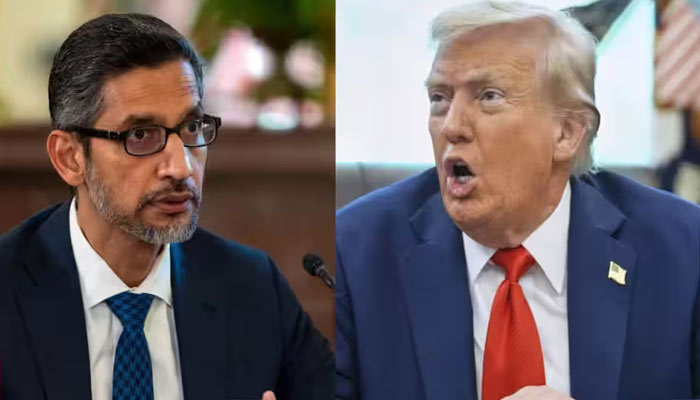
‘Sundar Pichai Said No’: Trump Says Google Rejected His Idea to Rename Atlantic Ocean ‘Trump Ocean’
US President Donald Trump has claimed that he considered renaming the Atlantic Ocean “Trump Ocean” but dropped the idea after Google CEO Sundar Pichai reportedly turned down his request, citing the international nature of oceans.
Trump shared details of the alleged conversation with Pichai while discussing his interest in geographical names. He said he had approached Google Maps to explore whether the Atlantic Ocean could be renamed after him but was told that the proposal could not be accepted because the ocean borders multiple countries.
“I said, Sundar, I’m thinking of the Atlantic Ocean. Can you handle it?” Trump said, recalling the exchange.
According to Trump, Pichai responded, “No, no, no. This time I’m not doing it.”
Trump further claimed that the Google CEO explained, “Oceans are different, sir. They cover a lot of countries. Please don’t ask us to do that.”
Accepting the reported refusal, Trump suggested that he would leave the ocean’s name unchanged.
“So, I’ll probably pass. Should I pass it? I think let’s keep it the Atlantic Ocean, right?” he said.
Trump also praised Pichai and Google co-founder Sergey Brin, calling them “totally brilliant guys.”
Speaking about his naming preferences, the President said he was interested in only the Atlantic and Pacific oceans, adding that he would not seek to associate his name or America’s name with other oceans.
“I only like two oceans, the Atlantic Ocean and the Pacific Ocean. I’m not going to put either Trump or America on any other ocean but these two,” he said.
Trump also recalled his father’s assessment of his ability to identify suitable locations, saying, “My father said that kid has the greatest eye for location.”
Trump’s Earlier Remarks on Renaming an Ocean
Trump’s latest comments follow earlier reports that he had floated the idea of renaming either the Atlantic or Pacific Ocean after himself.
A Washington Post report published on October 10, 2026, said Trump raised the possibility during a rally in Clarksville, Tennessee, suggesting names such as “Trump Ocean” and “Ocean of the Americas.” The remarks reportedly drew laughter and applause from the audience.
CNN subsequently reported that Trump described the proposal as a joke and claimed that Google had declined his request. He said he had sent the company an image labelled “The Trump Ocean” but was told that oceans cover multiple countries and cannot be renamed in the same manner as certain domestic geographical features.
Google Maps and the ‘Lake America’ Naming Dispute
The reported exchange comes amid other geographical renaming initiatives under the Trump administration, including the adoption of “Gulf of America” for the Gulf of Mexico in US government usage.
Google Maps has also displayed “Lake America” for Lake Ontario among users in the United States, following a naming change announced by Trump. The decision drew criticism from Canadian officials amid trade tensions between Washington and Ottawa.
Google said its mapping service reflects name changes recorded in official government sources, including the US Geographic Names Information System (GNIS).
“Since we update Google Maps to reflect name changes in official government sources, which is GNIS for the US, people using Maps in the US will see ‘Lake America,’ those in Canada will continue to see ‘Lake Ontario,’ and those outside of the US and Canada will see both names,” the company said in a blog post, according to AFP.
As a result, users may see different geographical labels depending on their location. Google Maps displays “Lake America” in the United States, retains “Lake Ontario” in Canada and shows both names in other regions.
Apple Maps, meanwhile, continued to display “Lake Ontario” at the time of the AFP report.
Trump’s comments have once again drawn attention to his approach to geographical naming and the role of technology companies in reflecting official government designations on digital maps.
Comments are closed.