
PBKS vs MI, IPL Play of the Day: Jasprit Bumrah’s Mid-Off Brilliance Turns the Game for Mumbai Indians

Modern IPL cricket is designed to make bowlers feel irrelevant. Flat pitches, shorter boundaries, fearless batting.
And the Impact Player rule have tilted the game so heavily towards runs that captains are often expected to be batting superstars first and tacticians second. In that landscape, the idea of a fast bowler leading a side can seem almost outdated.
And yet, on a chilly evening in Dharamsala, Jasprit Bumrah offered a reminder that a bowling captain can still control a T20 game without dominating the wicket column.
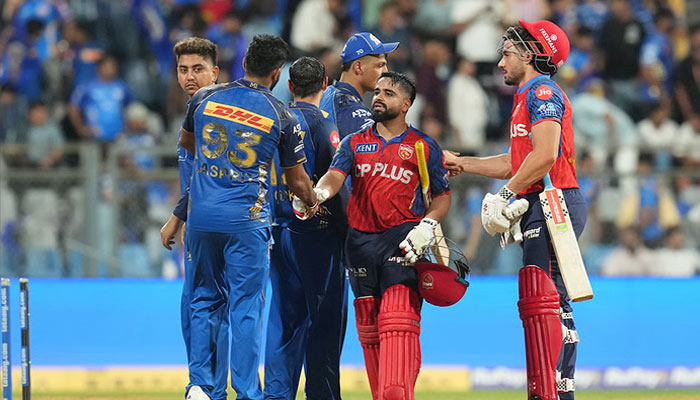
With Hardik Pandya sidelined and Suryakumar Yadav unavailable, Mumbai Indians handed Bumrah the captaincy for the first time in the IPL against Punjab Kings. The result was not just a victory. It was a demonstration of how deeply Bumrah understands the rhythm of a T20 contest.
The Dharamsala surface was not the typical batting paradise many expected. There was enough dryness and uneven pace to reward bowlers willing to stay patient. Bumrah sensed it early, chose to bowl first, and built an entire strategy around disciplined hard lengths rather than flashy variations.
He opened with himself, not searching desperately for wickets but setting the tone. Then he moved into a role rarely highlighted in T20 cricket — the captain who guides bowlers through chaos in real time.
From mid-off, Bumrah became a constant presence. He spoke regularly with Deepak Chahar, whose around-the-wicket angle produced the breakthrough against Priyansh Arya. He worked closely with Shardul Thakur, encouraging him to trust cross-seam deliveries into the pitch. The approach paid off as Shardul removed both Prabhsimran Singh and Shreyas Iyer during a decisive middle-overs spell.
Bumrah’s influence was perhaps most visible with young Raj Angad Bawa. After a difficult previous outing, Bawa could easily have been left short on confidence. Instead, Bumrah stayed alongside him, helping him adjust to the conditions ball by ball. The trust was rewarded when Bawa bowled Cooper Connolly with a delivery that held its line just enough to beat the batter completely.
That was the defining feature of Bumrah’s captaincy. He understood the emotional side of bowling in modern T20 cricket — the frustration of momentum swings, the constant tactical resets, and the pressure of operating when every mistake disappears into the stands. Rather than controlling from a distance, he operated like a fast bowler who knew exactly what his teammates were experiencing because he lives those moments himself.
Former Australia captain Michael Clarke described Bumrah as tactically sharp and relentlessly attacking. The description fit perfectly. Even without taking a wicket, Bumrah shaped the innings through field placements, bowling plans, and conversations that steadily pulled Mumbai Indians ahead.
Punjab Kings still finished strongly, crossing the 200-run mark after a late assault. But Mumbai Indians always appeared convinced the target was manageable, and Tilak Varma’s unbeaten innings eventually sealed the chase.
The scorecard will remember Tilak’s runs. The broader takeaway from the night, however, was the sight of Bumrah standing at mid-off, reading the pitch, calming his bowlers and quietly dictating the flow of the game.
For years, Bumrah has been viewed as Mumbai Indians’ bowling spearhead. In Dharamsala, he looked something more — a captain whose understanding of pressure and conditions may be just as valuable as his yorkers.
Comments are closed.