
Trump at UNGA: Fact-Checking His Claims on India-Pakistan, Climate Change and AI

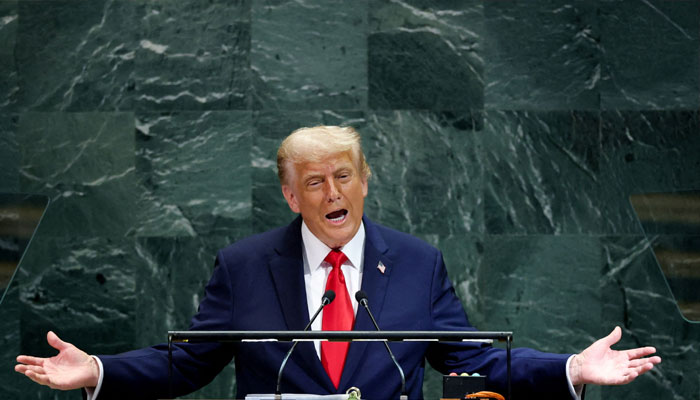
US President Donald Trump used his address to the United Nations General Assembly to highlight what he described as major achievements of his administration.
From claiming credit for ending conflicts to touting US military strength, oil reserves and advances in artificial intelligence, Trump presented a broad account of his foreign-policy and domestic record.
But several of his statements require additional context. Some claims conflict with the positions publicly stated by other governments, while others do not align with available data.
Here is a fact-check of some of the major claims Trump made at the UNGA.
CLAIM: Trump Helped End the India-Pakistan Conflict
Trump again claimed credit for helping bring the 2025 India-Pakistan conflict to an end, saying he had helped settle eight wars during his presidency. He also pointed to statements from Pakistani Prime Minister Shehbaz Sharif thanking him for his role.
THE FACTS: India has consistently rejected the claim that Washington mediated the cessation of military operations between India and Pakistan in May 2025.
New Delhi has said the decision was reached directly between the two countries through established military channels, following Pakistan’s request. Prime Minister Narendra Modi has also stated that India does not accept third-party mediation.
Trump announced on May 10, 2025, that India and Pakistan had agreed to an immediate ceasefire, while Pakistan has credited US diplomatic efforts. The two countries therefore continue to offer different accounts of the US role.
CLAIM: Trump Settled Eight Wars
Trump said it was his “great honour” to have settled eight wars, citing India-Pakistan, Cambodia-Thailand, Kosovo-Serbia, Rwanda-DRC, Armenia-Azerbaijan and Gaza, among others.
THE FACTS: The conflicts and disputes on Trump’s list do not all fit the description of wars that he ended.
The Egypt-Ethiopia dispute, for example, centres on Ethiopia’s Grand Ethiopian Renaissance Dam and disagreements over Nile water. The two countries have faced prolonged diplomatic tensions but were not engaged in a war that Trump brought to an end.
Kosovo and Serbia also remain involved in a long-running dispute over Kosovo’s status. Trump helped broker an economic normalisation agreement between them in 2020, but that did not resolve the wider political dispute.
CLAIM: America Has More Munitions Than It Could Ever Use
Trump said the US has more munitions than it could “ever possibly even think of using” and claimed production was taking place at unprecedented levels.
THE FACTS: The US possesses large weapons stockpiles and has increased production of several systems. However, US officials and defence analysts have also raised concerns over depleted stocks of some advanced weapons.
Heavy use of systems such as Tomahawk missiles and Patriot and THAAD interceptors has highlighted the time required to replenish certain inventories. The available evidence therefore provides a more complicated picture than Trump’s suggestion of effectively unlimited supplies.
CLAIM: US and Venezuela Control More Than 60% of the World’s Oil
Trump said the US and Venezuela together possess more than 60% of the world’s oil.
THE FACTS: Available estimates are nowhere near that figure when measured against proven reserves.
Fact-checkers have estimated that the two countries together account for roughly 22% of global proven oil reserves. Proven reserves are quantities considered economically and technically recoverable, which is different from broader estimates of total oil resources.
CLAIM: US Strikes Destroyed 97% of Drugs Entering by Sea
Trump said US strikes against suspected cartel boats had destroyed 97% of drugs entering the country through maritime routes.
THE FACTS: Seizure figures cannot establish what percentage of all drugs entering the country has been intercepted.
Authorities know how much narcotics they seize, but they cannot accurately measure the amount that successfully evades detection. Available seizure data therefore does not substantiate a claim that 97% of all maritime drug shipments were destroyed.
CLAIM: The US Is Far Ahead of China in AI
Trump said the US was ahead of China in artificial intelligence “by a lot”.
THE FACTS: The US has advantages in several areas of AI development, but the size of the overall lead is difficult to measure precisely.
Experts have pointed to rapid Chinese advances in AI models and infrastructure, with some saying the gap between the two countries is relatively small in certain areas. The competitive landscape is also changing quickly as both countries continue to invest heavily in AI.
CLAIM: Climate Change and AI Warnings Are Part of the Same ‘Hoax’
Trump connected warnings about AI with what he described as previous “hoaxes” involving climate change, Russia and Ukraine.
THE FACTS: Concerns over AI risks are not limited to one political camp or ideological group.
Executives and researchers from major AI companies have themselves warned about potential risks associated with increasingly powerful systems. Their views differ significantly on the scale of those risks and how they should be addressed.
CLAIM: The World Has Entered the Era of ‘Superintelligence’
Trump said the US and the world should begin using the term “superintelligence” instead of artificial intelligence.
THE FACTS: Superintelligence is already a recognised concept in AI research, but it generally refers to hypothetical systems that would surpass human capabilities across virtually all cognitive tasks.
Today’s AI systems can exceed human performance in some specialised areas but remain limited and inconsistent in others. Describing the current period as an era of superintelligence is therefore a broader characterisation than the technical definition generally used in AI research.
Trump’s UNGA address combined claims about foreign-policy achievements, military power, energy resources and emerging technology. In several cases, the underlying events or trends are real, but the scale or interpretation presented in the speech differs from the available evidence.
Comments are closed.