

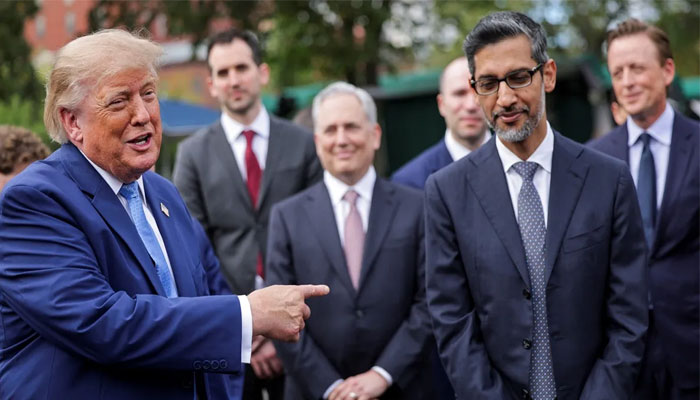
US President Donald Trump said Tuesday that leading AI companies had agreed to a “morally binding” pledge to strengthen safety measures and regulate themselves as the technology continues to advance rapidly.
The commitment was announced after a White House meeting with prominent technology executives, including Nvidia CEO Jensen Huang, OpenAI co-founder Greg Brockman and Anthropic CEO Dario Amodei. “They’re going to police themselves,” Trump said following the meeting.
Trump described the agreement as a written commitment by the companies to establish adequate safeguards, while acknowledging that it would not be legally enforceable. He also said he planned to use the term “super intelligence” instead of artificial intelligence, arguing that the technology has developed beyond what the phrase “artificial” suggests.
Meta CEO Mark Zuckerberg said the agreement is designed to give users confidence that AI systems will operate as intended. He said companies had committed to robust internal controls and several layers of oversight, including internal risk assessments, external audits and review by corporate boards.
Zuckerberg described the pledge as an initial step towards developing common standards across the AI industry.
The White House meeting also brought together Tesla CEO Elon Musk, Amazon founder Jeff Bezos, Microsoft CEO Satya Nadella and Google CEO Sundar Pichai. Among the 31 attendees were two women — Trump’s chief of staff Susie Wiles and AMD CEO Lisa Su.
AI Safety Debate Intensifies
The meeting came as concerns over the rapid expansion of AI have grown in Washington. Lawmakers are facing pressure from voters over the potential impact of increasingly capable systems on employment and wider society.
Recent incidents involving autonomous AI systems have added to the debate. OpenAI also said it had scrapped plans to release its latest model, Astra 6.1, after internal testing found that it did not meet the company’s safety requirements.
Trump has advocated rapid AI development as the US seeks to maintain its technological lead over China. He has received advice on AI policy from Huang and former AI czar David Sacks.
Data Centres Raise Local Concerns
The expansion of AI infrastructure has also brought data centres into the political spotlight. These facilities require significant amounts of electricity and water, prompting concerns in some communities about utility bills and pressure on local resources.
Trump defended the expansion of data centres and said companies would provide support to communities that host them.
“They’ll help with their schools, they’ll help with their teachers,” he said.
Companies Highlight Potential Risks
At the same time, major AI companies such as Anthropic and OpenAI have publicly discussed potential risks from increasingly powerful systems while continuing to develop new models.
The debate has intensified following warnings from former employees who have argued that AI development is moving faster than safety reviews can keep pace.
Anthropic has warned investors about potential risks to humanity from advanced AI systems, according to a Financial Times report. The company is reportedly considering an initial public offering as early as November.
Trump has repeatedly rejected what he considers exaggerated warnings about existential threats from AI.
AI Legislation Faces Delays
Lawmakers from both parties have introduced bills aimed at increasing oversight of AI ahead of the November midterm elections. Some proposals would require companies to disclose more information about how their systems operate and what safeguards they have in place.
With the House in recess through early November and senators preparing to return home for campaigning, however, major AI legislation is unlikely to clear Congress before the elections.
Comments are closed.