

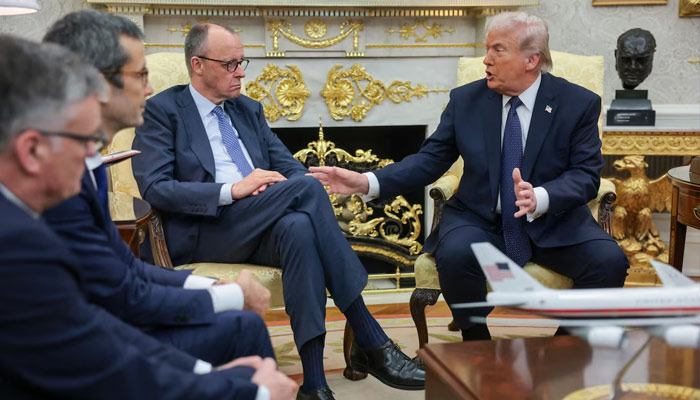
Trump’s Attacks on European Leaders Deepen Transatlantic Strain
Tensions between Washington and Europe have intensified in recent weeks as US President Donald Trump escalated criticism of several European leaders and signalled policy moves that have unsettled NATO allies.
Trump recently criticised German Chancellor Friedrich Merz over his remarks on the Iran conflict, calling him “totally ineffective.” Shortly after, the Pentagon announced plans to reduce US troop levels in Germany by around 5,000 personnel and indicated possible higher tariffs on European Union vehicle imports — a step expected to hit Germany’s auto industry.
In the United Kingdom, Trump targeted Prime Minister Keir Starmer, saying he is “not Winston Churchill” and warning of potential tariffs on British goods, further adding to diplomatic unease.
There were also reports of discussions within the US administration about reviewing NATO-related arrangements involving Spain and reassessing strategic positions affecting the UK, adding to concerns among European allies.
“It’s unnerving to say the least. We are braced for anything, anytime,” said one European diplomat, reflecting the growing uncertainty within diplomatic circles.
Europe’s uneasy recalibration
The latest developments come after months of friction over tariffs, Ukraine aid, and earlier US policy signals, including disputes over Greenland and defence burden-sharing within NATO.
Despite repeated attempts by European leaders — including Merz, Starmer, and Italian Prime Minister Giorgia Meloni — to stabilise relations through engagement with Washington, tensions have resurfaced in the context of the Iran conflict.
Even NATO Secretary General Mark Rutte reportedly faced a tense exchange during a recent White House meeting, highlighting the strained tone of current transatlantic interactions. European diplomats say they still value the alliance but acknowledge that the relationship is shifting.
“We can’t rely anymore on the post-World War status quo… we need to be not only a soft power space, but also a space backed by power,” one Western diplomat said, noting accelerated efforts to strengthen European defence capabilities.
Unease inside US political circles
Some voices within the United States have also raised concerns about the approach. Republican lawmaker Don Bacon warned that weakening NATO ties or reducing troop presence in Germany could undermine US strategic interests.
“The continued attacks on NATO allies are counterproductive,” he wrote, arguing that US bases in Germany remain critical for operations across multiple regions.
A relationship under pressure
While official cooperation continues, analysts say the tone of US–Europe relations has become increasingly unpredictable. Diplomatic engagement, public criticism, and domestic political pressures on both sides are now shaping a more volatile transatlantic dynamic, with allies reassessing long-held assumptions about stability in the partnership.
Comments are closed.