
US Midterm Elections: Democrats Take Senate, Capitalise on Voter Backlash Against Trump to End GOP Dominance

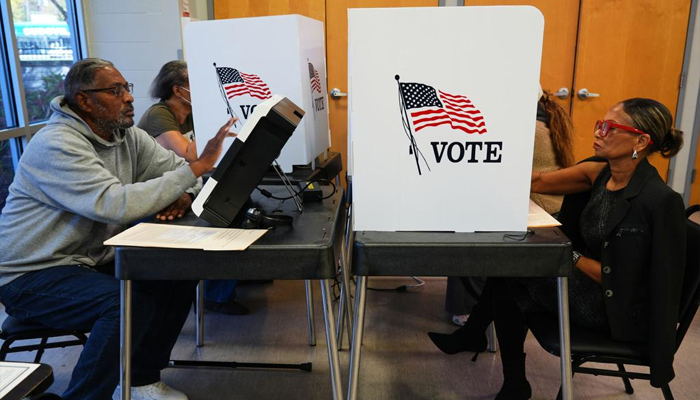
Democrats Seize US Senate Control, Deliver Major Blow to Trump as Voters Reject Republican Rule
Democrats have reclaimed control of the US Senate, ending Republican dominance in Washington and setting the stage for a major political showdown with President Donald Trump during the remaining two years of his second term.
The midterm elections, which concluded on Tuesday, reflected growing public dissatisfaction with rising inflation, the war in Iran and concerns over government corruption. Democrats also made significant advances in House races, flipping several Republican-held seats as they pushed to secure control of both chambers of Congress.
The Senate victory is expected to create fresh obstacles for Trump’s legislative priorities, including his efforts to maintain a conservative influence over the US Supreme Court. Trump, meanwhile, has indicated that he would use his presidential veto to block Democratic initiatives, raising the possibility of legislative deadlock.
DEMOCRATS SCORE SURPRISE VICTORIES IN REPUBLICAN STRONGHOLDS
Democrats charted an unexpected route to Senate control by winning several traditionally Republican states.
Josh Turek defeated Republican Representative Ashley Hinson in Iowa, while Adam Hamilton unseated Senator Roger Marshall in Kansas. In Texas, James Talarico defeated Republican Ken Paxton, while Annie Andrews secured an upset victory in South Carolina.
Former Senator Sherrod Brown also returned to the Senate after defeating Republican Jon Husted in Ohio. Roy Cooper captured an open Senate seat in North Carolina.
In Georgia, Democratic Senator Jon Ossoff successfully defended his seat against Republican Representative Mike Collins. Chris Pappas also won in New Hampshire, defeating former Senator John Sununu in the contest to replace retiring Democrat Jeanne Shaheen.
On the Republican side, Ashley Moody won a special election in Florida to complete Marco Rubio’s Senate term following his appointment as Secretary of State in 2025. Wyoming Representative Harriet Hageman also won the Senate seat vacated by retiring Senator Cynthia Lummis.
HOUSE CONTROL HANGS IN THE BALANCE
Democrats also registered substantial gains in the House of Representatives, defeating Republican incumbents in several closely contested districts.
Tom Kean of New Jersey and Pennsylvania Republicans Ryan Mackenzie, Scott Perry and Rob Bresnahan lost their re-election bids. Democrats additionally captured open seats in North Carolina and Kentucky.
The party’s victories brought it closer to the majority, although the final outcome remained uncertain.
Republicans had invested heavily in defending vulnerable districts and had pursued an aggressive redistricting strategy to improve their electoral prospects. However, Democratic candidates continued to make gains even in areas that Trump had comfortably won in the previous presidential election.
INFLATION AND PUBLIC DISSATISFACTION DRIVE VOTERS
Economic concerns emerged as a major factor behind the election results. According to the AP Voter Poll, approximately three-quarters of voters described the US economy as either not very good or poor.
Around eight in 10 voters said inflation had caused moderate or severe financial difficulties for their households.
Government corruption and the rising cost of living were also among the most important issues influencing voting decisions. Nearly six in 10 voters believed Trump was prioritising his personal interests over the country’s interests.
Overall, roughly three-quarters of voters reported feeling angry or dissatisfied with the direction of the country.
These findings highlighted the political challenges confronting Republicans despite the party’s earlier electoral advantages.
TRUMP DISTANCES HIMSELF FROM REPUBLICAN DEFEAT
Trump had urged Republican voters to participate in the midterms as though he himself were contesting the election. However, as Democratic victories accumulated, the president sought to distance himself from the results.
“I wasn’t on the Ballot and if I was, we would have won IN A LANDSLIDE!” Trump wrote on his social media platform.
Republicans had hoped to overcome the historical disadvantage faced by the party occupying the White House during midterm elections. However, voter dissatisfaction and Democratic gains made that increasingly difficult.
DEMOCRATS ALSO MAKE GAINS IN GOVERNOR ELECTIONS
The Democratic Party recorded victories in several important gubernatorial contests.
Josh Shapiro in Pennsylvania, JB Pritzker in Illinois, Wes Moore in Maryland, Maura Healey in Massachusetts and Kathy Hochul in New York all secured re-election.
In Texas, Democrat Gina Hinojosa defeated Republican Governor Greg Abbott in a major upset. Georgia Democrat Keisha Lance Bottoms also won, becoming the first Black woman elected governor of a US state.
Meanwhile, Florida Republican Byron Donalds made history by becoming the first Black Republican elected governor in the country.
In Ohio, Democrat Amy Acton defeated Republican Vivek Ramaswamy in another closely watched contest.
NEW CONGRESSIONAL BATTLE AWAITS TRUMP
Democratic control of the Senate is expected to transform the political environment in Washington. The party will have greater opportunities to challenge the administration’s decisions, initiate investigations and scrutinise senior government officials.
House Democratic Leader Hakeem Jeffries has outlined a proposed 100-day agenda centred on reducing living costs and increasing congressional oversight of the Trump administration. If Democrats also take control of the House, he could become the first Black Speaker of the chamber.
The election results could also strengthen the position of several potential Democratic presidential contenders while creating challenges for Republican leaders hoping to succeed Trump politically, including Vice President JD Vance.
With congressional power shifting, Trump’s remaining presidential term is likely to face a more confrontational relationship with lawmakers, potentially reshaping the legislative and political agenda in Washington.
Comments are closed.