
Zakir Naik Under Fire in Three Countries for Backing Taliban’s Restrictions on Girls’ Education

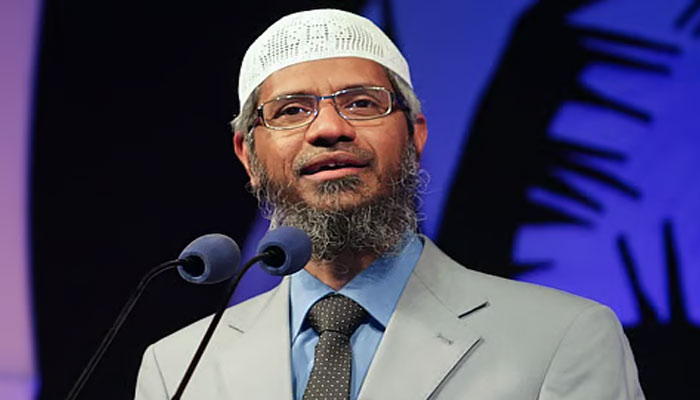
Zakir Naik Sparks Outrage With Defence of Taliban’s Curbs on Girls’ Education
Islamic preacher Zakir Naik has triggered a fresh controversy after defending the Taliban’s restrictions on girls’ education in Afghanistan. His remarks have attracted sharp criticism from activists, journalists and academics in India, Pakistan and Afghanistan, with critics accusing him of justifying the exclusion of millions of girls from schools and universities.
The controversy began after a video of Naik’s comments went viral on social media. In the clip, he questioned the accuracy of media reports about Afghanistan and suggested that the Taliban had only postponed secondary and higher education for girls until suitable arrangements were in place.
“Everything that comes in the media is not true,” he said.
Naik argued that there was nothing wrong with delaying education until the availability of appropriate teachers. He claimed that primary education remained accessible to girls up to Class 6, while higher classes and university education had been put on hold because of security concerns and a shortage of female teachers.
He also claimed that Afghan women were pursuing advanced studies, including master’s and doctoral degrees, in Islamic studies and Sharia.
Malala’s father condemns Naik’s remarks
The comments drew a strong reaction from the father of Pakistani Nobel Peace Prize laureate Malala Yousafzai, who described Naik’s defence of the Taliban as “deeply troubling and disappointing”.
He questioned how a prominent Islamic scholar could rationalise the systematic exclusion of girls from education.
“Presenting an indefinite ban as a mere ‘postponement’ and invoking a shortage of female teachers without explaining how that shortage can be addressed is not a credible defence,” he said.
He further warned that such arguments risk legitimising the restrictions imposed on Afghan women.
Malala herself became an international advocate for girls’ education after surviving a Taliban attack in Pakistan. She was shot in 2012 after publicly campaigning against the denial of education to girls.
Afghan leader mocks the female-teacher argument
Exiled Afghan parliamentarian Mariam Solaimankhil also took a sarcastic dig at Naik’s explanation, pointing to the Taliban’s restrictions on women’s employment.
“According to Zakir Naik, Afghan girls aren’t banned from education. They’re just waiting for female teachers. The same female teachers the Taliban banned from working?” she wrote on X.
“Brilliant logic, Doctor!” she added.
Indian historian Ruchika Sharma also criticised Naik, arguing that influential religious figures should unequivocally oppose the restrictions on Afghan women. She described the denial of education as a grave human rights violation.
Why Zakir Naik left India
Naik left India in 2016 after Bangladeshi investigators reportedly found that one of the gunmen involved in the July 2016 Dhaka café attack had been inspired by his speeches. Indian investigative agencies subsequently initiated inquiries into his activities.
He moved to Malaysia in 2017 and was granted permanent residency there.
UNICEF highlights education crisis in Afghanistan
The criticism comes amid continuing international concern over the Taliban’s restrictions on female education. UNICEF estimates that more than 2.6 million Afghan girls have been denied secondary education since September 2021, when the Taliban returned to power.
The organisation has described Afghanistan as the only country where girls and women are effectively barred from secondary and higher education.
“Five years may be brief in a country’s history, but it is a defining period in a girl’s life,” UNICEF Executive Director Catherine Russell said.
The restrictions have deprived generations of Afghan girls of opportunities to continue their education, while Naik’s comments have intensified debate over the international response to the Taliban’s policies.
Comments are closed.