
Ronaldo Fires Blank as Portugal’s Biggest World Cup Flaw Comes to Light

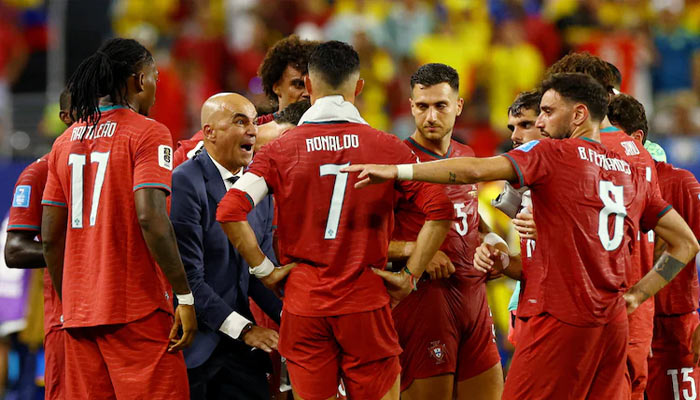
Cristiano Ronaldo’s Quiet Night Highlights Portugal’s Biggest World Cup Concern
Cristiano Ronaldo made history just three days ago by becoming the first footballer to score in six different FIFA World Cups, roaring “I’m back” into the television cameras after inspiring Portugal’s emphatic victory over Uzbekistan.
Against Colombia, there was no repeat performance.
Instead, the 41-year-old spent much of the evening waiting for service that rarely arrived as Portugal laboured to a 0-0 draw in their final Group K match. Colombia controlled large stretches of the contest, while Ronaldo cut an increasingly isolated figure inside the penalty area.
The result was enough to send Portugal into the Round of 32 as runners-up, where they will face Croatia, while Colombia topped the group to set up a meeting with Ghana. In the other Group K fixture, DR Congo came from behind to beat Uzbekistan 3-1, sealing one of the best third-place qualification spots and earning a knockout clash with England.
- Portugal are still alive in the tournament.
- But for the first time, they looked vulnerable.
- Costa Rescues Portugal
If Portugal escaped Miami with a point, much of the credit belonged to goalkeeper Diogo Costa.
Colombia created the clearer chances throughout the night, finishing with 24 shots compared to Portugal’s 13 and forcing Costa into a series of outstanding saves. Jhon Arias, Jhon Cordoba and Luis Diaz repeatedly stretched Portugal’s defence, while Davinson Sanchez thought he had snatched a stoppage-time winner before VAR ruled the goal out for offside.
- Costa was comfortably Portugal’s standout performer.
- That alone underlined how difficult the evening had become.
- Portugal’s Midfield Lost Control
- Portugal possess arguably one of the deepest midfields in international football.
Bruno Fernandes, Vitinha, Ruben Neves and Joao Neves combine creativity, intelligence and technical quality, while Joao Felix offers another attacking outlet between the lines.
Yet against Colombia, that talent never translated into control.
Portugal struggled to progress the ball through midfield with any consistency. Passing lacked tempo, movement ahead of the ball was limited and attacks frequently broke down before reaching dangerous areas.
Rather than imposing themselves, Portugal spent long spells reacting to Colombia’s pressing.
The disconnect became increasingly obvious as the match wore on.
Ronaldo Left Isolated
Ronaldo’s subdued display was less about individual decline than collective dysfunction.
Against Uzbekistan, Portugal consistently attacked from wide areas and delivered early crosses into the box, allowing Ronaldo to thrive as a penalty-area striker.
That supply line disappeared against Colombia.
Time after time, Ronaldo pointed towards spaces for teammates to exploit or called for crosses that never arrived. Instead of stretching Colombia’s defence, Portugal repeatedly recycled possession across midfield, allowing their opponents to regroup.
The veteran striker managed only a handful of attempts, most from difficult positions, and spent much of the game chasing opportunities rather than finishing them.
- His frustration was visible.
- So too was Portugal’s inability to provide him with meaningful service.
- Martinez Faces Tough Questions
Roberto Martinez has assembled one of the most gifted squads in the tournament, but performances against top-quality opposition continue to raise familiar concerns.
Portugal often rely on flashes of individual brilliance rather than a clearly identifiable attacking structure. Against Colombia, when those moments failed to materialise, the team looked short of ideas.
The midfield struggled to dictate play, the attack lacked cohesion and Portugal rarely sustained pressure despite the quality available across the pitch.
Against elite opponents, talent alone is rarely enough.
Croatia Await
Portugal’s reward is a Round of 32 meeting with Croatia, whose experienced midfield of Luka Modric and Mateo Kovacic will pose an even greater tactical challenge.
If Portugal again surrender control in midfield and fail to connect with Ronaldo in advanced areas, Croatia are unlikely to be as forgiving as Colombia proved to be.
One intriguing storyline also disappeared with the final whistle. By finishing second in Group K, Portugal moved to the opposite half of the knockout bracket from Argentina, meaning a long-awaited World Cup meeting between Cristiano Ronaldo and Lionel Messi can now only happen if both teams reach the final.
That possibility remains alive.
But after Portugal’s disjointed display against Colombia, Martinez’s side have more immediate concerns than dreaming about a historic final.
Their biggest challenge is not whether Ronaldo can still score.
It is whether Portugal can consistently create the chances for him to do so.
Comments are closed.