

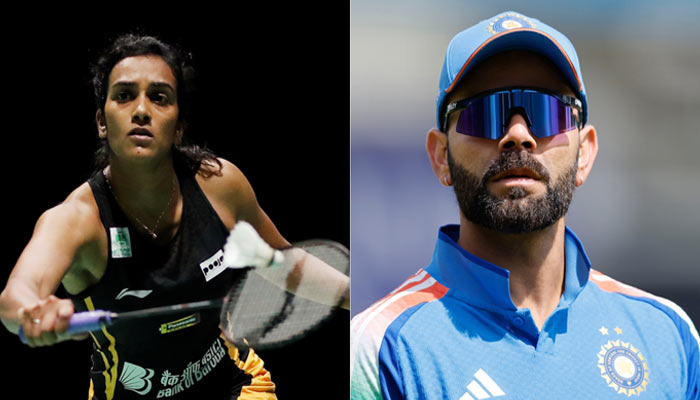
How Virat Kohli’s Advice Helped PV Sindhu Rediscover Her Winning Touch
When PV Sindhu ended her wait for a major title at the Japan Open last week, the victory was about far more than silverware. It marked the culmination of a long, difficult journey that began during one of the darkest phases of her career—with a phone call to Virat Kohli.
For nearly two years, Sindhu battled injuries, inconsistent results and growing doubts. A stress fracture, an early exit at the Paris Olympics and a prolonged title drought had left the two-time Olympic medallist searching for answers. Looking for someone who understood the pressures of competing at the highest level, she reached out to former India captain Virat Kohli.
Speaking after her Japan Open triumph, Sindhu revealed that Kohli responded almost immediately.
“One thing I’ll always be grateful for is Virat bhai. I reached out to him at one of the lowest points of my career. Injuries were piling up, the results weren’t coming, and I just needed someone who understood. He replied within minutes, and we met the very next day,” she wrote on X.
Sindhu and her husband, Venkata Datta Sai, met Kohli in Bengaluru, where the trio spent hours discussing the highs and lows of elite sport. While Sindhu chose not to disclose the details of their conversation, she admitted it fundamentally changed her outlook.
“What we spoke about will always stay between us. But I’ll always be grateful that when I needed someone, he was there. He didn’t say much, but every word stayed with Datta and me. Some conversations change the way you see things. That was one of them.”
- A Shift in Perspective
- The most enduring lesson from that meeting was surprisingly simple.
- “The biggest thing I took away was the importance of finding your joy again,” Sindhu said.
“Today, I know exactly why I wake up for those 5:30 a.m. sessions. And I can honestly say it isn’t the trophies. It isn’t the wins. It’s something much deeper.”
That change in mindset soon reflected on court. At the Japan Open, Sindhu defeated home favourite Akane Yamaguchi 21-17, 21-17 in the final to become the first Indian to win the prestigious tournament. The victory also made the 31-year-old the oldest women’s singles player to claim a BWF Super 750 title.
Rebuilding From the Ground Up
Behind the victory lay months of painstaking work. Along with Datta Sai, strength trainer Wayne Lombard and Indonesian coach Irwansyah, Sindhu rebuilt her game from scratch.
She improved her fitness, shed around 3.5 kilograms and diversified her attacking game, relying on greater variation at the net and better rally construction rather than depending solely on her trademark power.
“For me, taking it one day at a time mattered a lot. I kept telling myself, ‘Let’s see what comes next. Let’s see what tomorrow brings.’ Slowly, I started getting better.”
She also resisted the temptation to return before she was fully fit.
“I wanted to be at my best and at 100%. Because if I’m only 50% fit and go onto the court, lose in the first round and come back, that doesn’t really matter.”
Trusting the Process
Sindhu admitted there were moments when injuries tested her confidence, but she never stopped believing she could return.
“When you have an injury as an athlete, you do doubt yourself. You wonder, ‘Can I come back stronger? Will this niggle be alright? Can I give my 100%?’ Those were the thoughts going through my mind because you’re emotionally drained and mentally really low.”
Another key element of her revival has been the use of performance data to monitor training loads and recovery.
“Data has been one of the most important aspects. It helps you understand why you’re not moving properly on a given day instead of immediately thinking something is wrong.”
With the World Championships in New Delhi and the Asian Games approaching, Sindhu believes the Japan Open triumph has restored the confidence she had been searching for.
“I’ve always believed in myself. This title was very, very important. It gives me confidence and belief that I can do it. And it’s not over yet.”
For Sindhu, the Japan Open title was not simply the end of a trophy drought. It was proof that rediscovering purpose can be just as important as rediscovering form—and that one conversation can sometimes change everything.
Comments are closed.