
PM Modi Meets Iran President, Pushes for Trade Expansion Amid US Sanctions Threat

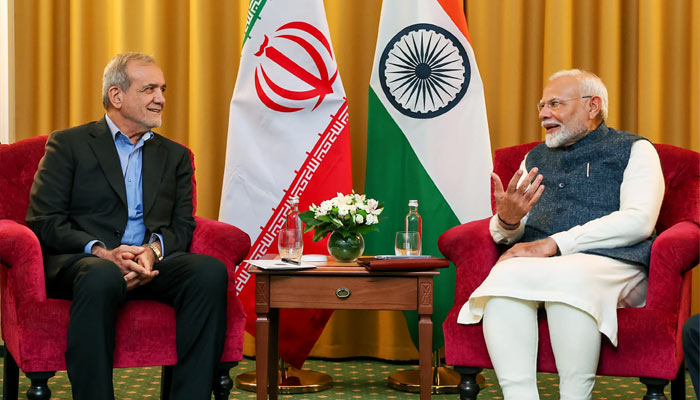
Prime Minister Narendra Modi and Iranian President Masoud Pezeshkian on Monday discussed ways to expand bilateral trade.
The escalating situation in West Asia and the safety of commercial shipping during their meeting on the sidelines of the Shanghai Cooperation Organisation (SCO) summit in Bishkek. The talks came amid growing US pressure on Iran. The Donald Trump administration has warned countries and businesses that economic engagement with Tehran could invite penalties as Washington intensifies efforts to isolate the Iranian economy.
US Treasury Secretary Scott Bessent has described the campaign as an “economic D-Day”, warning that companies continuing to do business with Iran could face secondary sanctions and restrictions on access to the dollar-based financial system.
Despite the pressure, Modi and Pezeshkian discussed expanding and diversifying the India-Iran trade basket.
“Met President Masoud Pezeshkian in Bishkek. Reiterated our commitment to strengthening India’s long standing friendship with Iran across diverse sectors,” Modi said in a post on social media.
“We want to expand and diversify our trade basket in the times to come. We had a discussion on the prevailing situation in the region. India will continue to support all efforts aimed at ensuring lasting peace,” he added.
The Ministry of External Affairs said the two leaders reviewed bilateral relations and discussed the evolving situation in West Asia.
INDIA EMPHASISES SAFETY OF SHIPPING
Modi expressed concern over the escalation of tensions in West Asia and reiterated India’s position that all issues should be resolved through dialogue and diplomacy.
He also stressed the importance of protecting freedom of navigation and commerce, particularly amid growing risks to commercial shipping in the region.
The MEA said Modi emphasised that civilians and civilian infrastructure, including commercial vessels and seafarers, must not be targeted under any circumstances.
IRAN REJECTS US SANCTIONS
Iran has strongly rejected Washington’s latest pressure campaign. Its Foreign Ministry described the sanctions as a challenge to international law and the UN Charter.
The ministry said countries that value their sovereignty and national interests would not accept what it called systematic US pressure.
Iranian Economy Minister Ali Madanizadeh said Tehran was prepared to withstand the latest measures and had a two-year plan to counter their impact.
Iranian Parliament Speaker Mohammad Baqer Ghalibaf also dismissed US threats against countries trading with Tehran, arguing that Washington lacked the economic leverage to force Iran’s partners to sever ties.
PEZESHKIAN SEEKS INDIA’S ROLE IN PEACE EFFORTS
According to an Iranian readout, Pezeshkian thanked India for its support and cooperation during the recent conflict and urged New Delhi to step up diplomatic efforts to restore peace and stability in West Asia.
The Iranian President said Tehran had consistently favoured dialogue and negotiations but accused the US of choosing military confrontation instead.
Pezeshkian also urged Modi to use India’s relations with various countries and its regional and global influence to help bring the parties back to dialogue.
He said the continuation of war was in the interest of neither the countries involved nor the wider region or the international community.
TEHRAN WANTS STRONGER INDIA TIES
Pezeshkian said Iran was ready to expand cooperation with India across political, economic, scientific and cultural sectors.
He highlighted the two countries’ long-standing historical and cultural links and said stronger bilateral cooperation could help counter the effects of sanctions.
Despite pressure from the US and Israel, Pezeshkian said Tehran remained committed to strengthening ties with India across multiple areas.
OIL MARKET PRESSURE EASES
The shift towards economic pressure rather than direct military confrontation has eased some concerns in the oil market, according to a Reuters report.
Ole Hansen, head of commodity strategy at Saxo Bank, said the latest US sanctions were less aggressive than some traders had expected.
The development has also raised hopes that Washington and Tehran could eventually return to negotiations. However, analysts warned that oil prices could rebound sharply if Iran retaliates against US military targets in the region.
The conflict began after US and Israeli strikes on Iran in late February. Iran and Oman have since discussed a proposal for a temporary navigational corridor through the Strait of Hormuz and possible efforts to clear mines from the strategic waterway.
MODI INVITES PEZESHKIAN TO INDIA
During the meeting, Modi reaffirmed India’s willingness to cooperate with Iran through multilateral platforms such as BRICS and the SCO.
He also invited Pezeshkian to India for the upcoming BRICS Summit, according to the MEA.
MODI MEETS ARMENIAN PM
Separately, Modi held talks with Armenian Prime Minister Nikol Pashinyan on the sidelines of the SCO summit.
Modi said India-Armenia cooperation was expected to expand in areas including defence, information technology, space, education and pharmaceuticals.
The two sides also expressed interest in strengthening trade and investment ties.
Comments are closed.