
PM Modi Connects With Gen Z, Uses ‘OG’, ‘Dhurandhar’ and ‘Naaraaz Fufa’ References

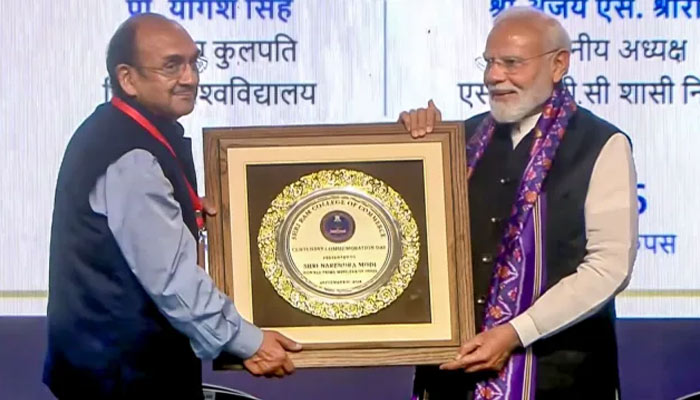
In 2013, Narendra Modi arrived at Delhi’s Shri Ram College of Commerce (SRCC) as a prime ministerial challenger, addressing students at a time.
When the UPA government was battling mounting crises and the “Modi wave” was beginning to gather momentum. Nearly 13 years later, he returned to the same campus as Prime Minister for a third term, speaking to a generation shaped by a very different political landscape — and amid a wave of student protests that had put his government under pressure.
Modi’s message was aimed squarely at the youth. Many of the students listening to him at the prestigious college will be first-time Lok Sabha voters in 2029 and were barely old enough to remember his 2013 appearance. His address also came after young protesters in the capital had openly challenged his government, making the outreach particularly significant.
The Prime Minister built his speech around a comparison between India in 2013 and the country today. He told students they were too young at the time to fully understand the problems confronting the nation and urged them to revisit newspaper headlines from that period.
His argument was straightforward: the past 13 years had transformed India’s governance, economy, security and global standing. At the same time, Modi appeared keen to draw a distinction between young protesters who criticised his government and those he described as habitual opponents.
Using a Gen Z-style expression, he referred to such critics as “naaraaz fufa” or “angry uncle”, portraying them as a source of negativity and suggesting that their outlook was out of step with the aspirations of today’s youth.
The remark also helped Modi position himself differently from the student protesters. He had earlier said he “forgave” the young demonstrators and appeared to suggest that their anger was separate from the criticism directed at him by established political opponents. He said the latest hostility had intensified after his use of the phrase “dimagi Naxal” during his Red Fort address.
Modi also embraced Gen Z terminology while talking about SRCC’s alumni. Recalling his earlier interactions with students, he described their seniors as “OG” — a term used by younger generations for someone regarded as an original or highly respected figure.
“In your language, the alumni from here are OG. They have spread the name of SRCC across the world,” Modi said.
He urged the students to think beyond conventional career goals and prepare themselves to play a role in India’s journey towards becoming a developed nation by 2047.
The Prime Minister also brought popular culture into his address, invoking the recent hit film Dhurandhar while speaking about SRCC and its alumni.
“Dhurandhar na ho, lekin dhoom to machayi hai,” he said, encouraging students to make an impact even if they did not consider themselves “Dhurandhar”.
Modi devoted part of his speech to former Union minister Arun Jaitley, an SRCC alumnus, recalling his strong connection with the institution. He said Jaitley frequently spoke about his college days and often shared stories from his time at SRCC.
He also highlighted the wide range of talent produced by the college, saying its alumni had made their presence felt not only in economics but also in the arts, politics, law and the judiciary.
Turning to the ambitions of young Indians, Modi said ambition could not simply be created through coaching. Instead, he argued, it grows in an environment that encourages people to dream bigger.
He cited the aspirations of young Indians to launch startups, build unicorns, work in space and drone technology, develop cutting-edge AI solutions and introduce innovation into agriculture.
According to Modi, students today can imagine possibilities that their seniors could not have considered 13 years ago.
“Today’s India has also created an ecosystem that supports those dreams,” he said, adding that the time had come for young people to set bigger goals and work towards achieving them.
The Prime Minister then returned to his central theme of comparing 2013 with the present. He cited national security, terrorism, the economy and India’s global position to highlight what he described as the distance the country had travelled.
Modi claimed that those spreading terrorism were now on the back foot and pointed to India’s willingness to strike across the border in response to Pakistani aggression. He also cited improved security conditions in Jammu and Kashmir and the Northeast and said the backbone of Maoist terrorism and Naxalism had been broken.
He contrasted this with the situation in 2013, when, he said, the world was concerned about “policy paralysis” in India. Today, he argued, the international community was instead discussing India’s “policy dynamism”.
Modi also revisited several major crises from the previous decade to reinforce his argument. Referring to the 2013 Kedarnath disaster, he said the government at the time had struggled to respond to the crisis.
He cited the 2008 global financial crisis as another example, claiming that the government then had failed to act decisively as India’s banking system came under severe pressure.
The Prime Minister also referred to the 2008 Mumbai terror attacks, alleging that the government of that time had come under external pressure and lacked the political will to take strong action against Pakistan.
By repeatedly contrasting the India of 2013 with the India of today, Modi sought to connect his political record with the aspirations of a younger generation — one that may have little direct memory of the era he described but will play an increasingly decisive role in India’s electoral future.
Comments are closed.