

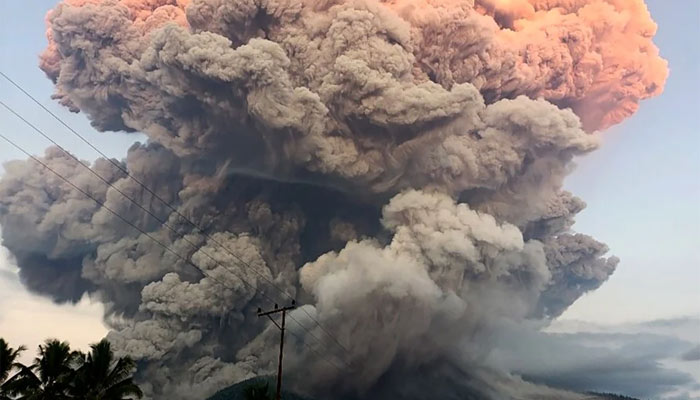
Indonesia Volcano Eruptions Disrupt Flights, Shut 8 Airports, Strand 170,000 Passengers
Repeated eruptions from Indonesia’s Anak Krakatau volcano have triggered widespread travel disruption, with massive ash clouds forcing the closure of eight airports and affecting around 170,000 passengers.
More than 1,550 flights were cancelled by Monday morning after volcanic ash rose as high as 50,000 feet, according to Reuters.
Located in the Sunda Strait between Java and Sumatra, Anak Krakatau began showing heightened activity on Friday. The volcano erupted for around 30 seconds at 3:53 am on Sunday, followed by another shorter eruption roughly three hours later. A third eruption was recorded at 8:23 pm on Sunday.
No deaths or injuries have been reported so far. Authorities have not issued an evacuation order but have warned people to stay at least 3 kilometres away from the crater.
Eight Airports Shut Amid Ash Cloud
Airspace restrictions were imposed around Jakarta’s Soekarno-Hatta International Airport and Halim Perdanakusuma Airport, as well as six other airports, including Radin Inten II Airport in Lampung.
The airports were initially ordered to remain closed until 8:59 am Monday. However, Soekarno-Hatta’s operator later announced that the airport would remain shut until 6 pm local time.
Air services at airports in Bali and Medan were also affected by the volcanic activity.
Indonesia’s Transport Minister Dudy Purwagandhi said authorities could not predict when the disruption would end because of changing weather conditions.
Ash Plumes Reach 50,000 Feet
Indonesia’s weather agency BMKG said satellite monitoring detected two significant ash clouds.
The first rose to approximately 20,000 feet and moved across Jakarta, Banten and West Java. The second, larger plume reached around 50,000 feet, spreading across Banten, Lampung and Bengkulu, the southern Sunda Strait and parts of the Indian Ocean west of Sumatra.
Lana Saria, head of Indonesia’s Geological Agency, said volcanic activity had intensified since July and that Sunday’s eruption was the strongest recorded during that period.
According to Saria, the activity suggests a continuing supply of magma and gas beneath the volcano. Officials, however, have not determined whether the increased activity could lead to a larger eruption.
- Authorities have warned that further eruptions remain possible.
- Passengers Stranded as Flights Are Cancelled
Thousands of travellers have been left stranded as airlines cancel or delay flights and passengers wait for information about alternative arrangements. Spanish tourist Diego Urdiales, who was scheduled to travel back to Madrid, said he was still waiting for his airline to confirm a new flight.
Another passenger, Michele Gouw, described the disruption as an unavoidable consequence of the volcanic eruption. “It’s a natural disaster, it’s a force majeure,” she said, according to the Associated Press.
The ash has also disrupted education in affected areas. Schools in parts of Jakarta and Lampung have shifted to online classes to protect students from exposure to volcanic ash, state news agency Antara reported.
Indonesia’s disaster management agency has advised residents to wear masks while outdoors.
Airlines Warn of Further Disruptions
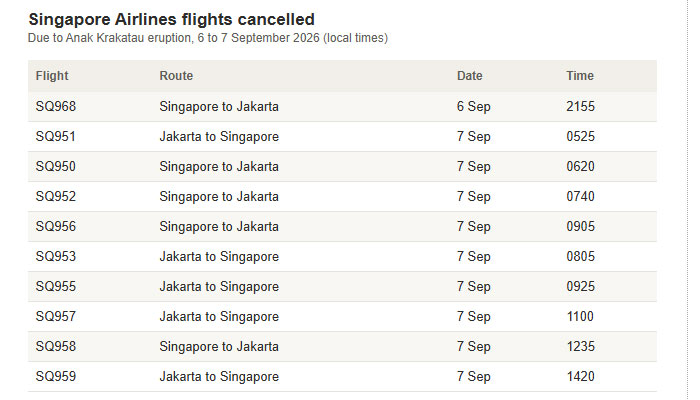
Singapore Airlines cancelled 10 flights between Singapore and Jakarta scheduled for September 6 and 7 because of the volcanic eruption. The airline warned that additional flights could be affected as volcanic and weather conditions remain unpredictable.
Passengers who booked directly with Singapore Airlines can request rebooking or refunds through the airline’s online system. Those who booked through travel agents or other airlines have been advised to contact the respective providers.
The airline apologised to affected passengers and said it was continuing to monitor developments around the volcano.
Meanwhile, social media reports claimed that more than 200 flights had been diverted from Jakarta’s Soekarno-Hatta airport following the eruption. Posts also circulated footage attributed to the World Meteorological Organization showing smoke from Indonesian forest fires drifting towards Malaysia, Singapore and the Philippines.
The name Anak Krakatau translates to “Child of Krakatau”. The volcano emerged from the remnants of Krakatau, whose massive 1883 eruption remains one of the deadliest volcanic disasters in modern history. The eruption triggered devastating tsunamis that killed more than 36,000 people and caused atmospheric changes that affected global temperatures for years.
Anak Krakatau erupted again in 2018, triggering an underwater landslide that caused a large section of the volcano’s flank to collapse. The collapse generated a tsunami that struck parts of Sumatra and Java, killing at least 430 people. The event also significantly reduced the size of the volcanic island.
Comments are closed.