
Support for Protesting Students in France Grows as Demonstrations Intensify

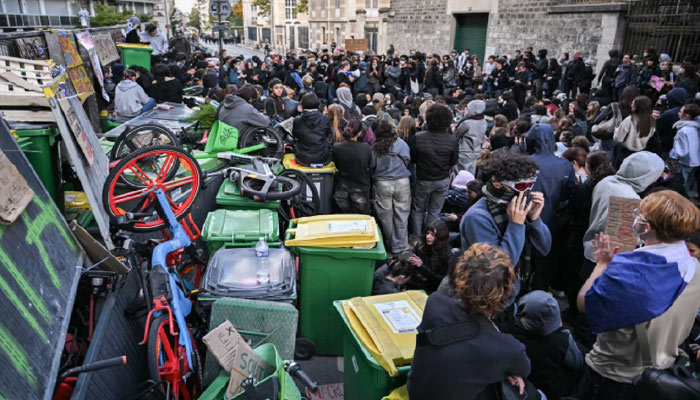
France Protests Escalate as 1.6 Lakh People Join Students’ Fight for Better Schools
France witnessed a major wave of demonstrations on Tuesday as tens of thousands of people took to the streets to support high school students demanding improved educational facilities and an end to alleged police repression. The protests have intensified pressure on President Emmanuel Macron’s government at a time when the country is grappling with economic uncertainty and mounting political tensions.
According to the Interior Ministry, approximately 161,500 people participated in rallies across the country, more than double the 71,500 recorded during demonstrations last Thursday. Trade unions, however, estimated the turnout at 480,000.
Although most gatherings remained peaceful, confrontations occurred in Paris and Lyon, where police used tear gas to disperse groups of demonstrators.
Violence Reported During Demonstrations
Paris witnessed some of the most serious incidents, with the Interior Ministry estimating that 41,500 people attended two marches in the capital. During one of the demonstrations, masked youths reportedly attempted to erect barricades, threw objects and set cars on fire. Police responded with tear gas near Place des Invalides.
Similar scenes were reported in Lyon, where officers also used tear gas during a rally.
Swedish activist Greta Thunberg joined a demonstration in Saint-Denis, outside Paris, expressing concern about the future facing young people.
“Our future is being robbed,” she said.
Rallies were also held in Nantes, Marseille, Bordeaux, Strasbourg, Toulouse and Lens, reflecting the movement’s growing reach.
Students Highlight Shortages and Poor Infrastructure
The protests began last month when students at French secondary schools, known as lycées, started blocking entrances to demand better learning conditions.
Their grievances include teacher shortages, deteriorating school buildings, overcrowded timetables and inadequate classroom facilities. Students have also criticised the authorities’ response to the protests, alleging that police action has been excessive.
“We stand in solidarity with the high schools that are worse off. We need real measures and proper dialogue, not repression,” said 16-year-old Emeline during a demonstration in Marseille.
Seventeen-year-old Nina echoed the sentiment, saying students felt their concerns were not being heard by the government.
The movement gained further momentum following reports of serious injuries during earlier demonstrations. One teenager reportedly lost a hand after picking up a police stun grenade, while another lost an eye. A third suffered the loss of teeth after a tear gas canister was fired at close range.
Interior Minister Laurent Nunez said internal investigations had been opened into 36 allegations of violence against protesters. He also reported that nearly 900 police officers had been injured during the demonstrations. The Education Ministry separately confirmed injuries to 147 teaching staff members.
Opposition and Student Unions Strengthen Support
The opposition France Unbowed (LFI), a far-left political party led by presidential hopeful Jean-Luc Mélenchon, has extended strong support to the student movement. Mélenchon was seen among demonstrators in Paris.
The growing protests come as Macron’s second and final presidential term approaches its end. His centrist government is also facing a difficult parliamentary debate over a cost-cutting budget, with opposition from both the left and right amid concerns about France’s rising public debt and pressure in financial markets.
The student agitation could merge with wider public discontent over living costs. National demonstrations against the cost of living are planned for Saturday, and unions and student organisations expect the two movements to reinforce each other.
University students have also joined the campaign. The student union l’Union Étudiante reported that 90 per cent of universities had closed nationwide in solidarity with the protesters. According to the Education Ministry, 214 schools, most of them high schools, were closed on Tuesday.
Government’s Teacher Plan Fails to Satisfy Protesters
Following last week’s demonstrations, the government announced plans to deploy 3,000 substitute teachers to 114 schools facing the greatest staffing shortages. Students have rejected the measure as insufficient, insisting that their concerns require more comprehensive solutions.
“We’re not giving up the fight, whether it’s for the high school students who were hit with a harsh crackdown, or for denouncing police violence,” said Patricia, a 20-year-old university student who joined the Paris demonstration.
Students have vowed to continue blocking school entrances, including after the half-term holidays later in October.
“We are continuing the blockades. We are not budging,” said Naouel, a high school student in Brest, expressing hope that the campaign would continue beyond the break.
Macron Appeals for Calm Amid Growing Pressure
On Monday, Macron called for restraint, saying the issues raised by students required time, consultation, discussion and respect.
However, the latest demonstrations suggest that the government’s assurances have yet to resolve the students’ concerns. With further rallies planned and unions preparing to mobilise against the cost of living, the authorities face mounting pressure to address demands over school conditions, staffing shortages and alleged police misconduct.
The coming weeks will test the government’s ability to respond to the movement while managing France’s broader economic and political challenges.
Comments are closed.