

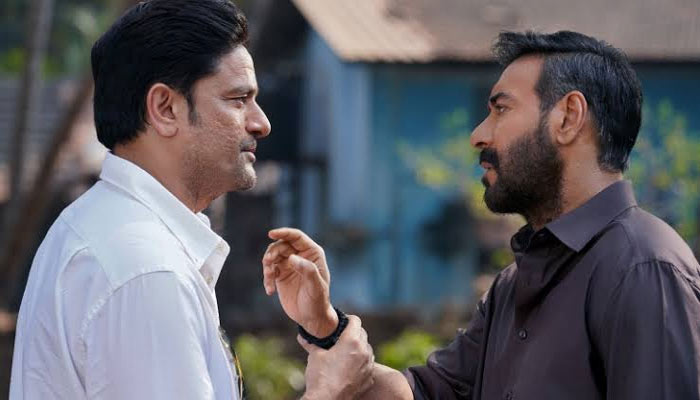
Jaideep Ahlawat Finally Finds a Way to Rattle Ajay Devgn’s Vijay Salgaonkar in Drishyam: The Conclusion
Vijay Salgaonkar has spent two films proving that he is almost impossible to outsmart. He has stayed ahead of the police, anticipated their questions and built an elaborate version of events so convincing that the truth itself struggled to break through.
But Drishyam: The Conclusion finally introduces a man who refuses to play by Vijay’s rules.
Jaideep Ahlawat’s Rajveer Singh Tomar arrives as the first investigator in the franchise who seems genuinely capable of matching Vijay’s intelligence. He does not treat him as a lucky amateur. He does not assume that the Salgaonkar family simply escaped because of a few fortunate breaks. From the beginning, Rajveer senses that there is a carefully constructed story in front of him — and he wants to find the cracks.
That makes him a dramatically different opponent.
In the earlier films, Vijay’s biggest advantage was that people underestimated him. His background as a cable operator made it easy for investigators to believe that he was simply an ordinary man caught in extraordinary circumstances.
Rajveer does not make that mistake.
He understands that Vijay’s apparent simplicity is part of his strength.
Ahlawat plays the character with an intimidating calmness. Rajveer does not need dramatic outbursts or constant threats to establish authority. A look, a pause or a seemingly casual observation is often enough to suggest that he is thinking several steps ahead.
That restraint makes his scenes with Ajay Devgn particularly effective.
Devgn’s Vijay has always been defined by control. He knows when to speak, when to stay silent and when to allow others to believe they have figured him out. His greatest weapon has never been physical strength. It is his ability to manufacture a believable reality and persuade everyone around him to accept it.
Rajveer attacks that very ability.
He is not merely looking for evidence. He is questioning the story behind the evidence.
One of his most telling observations comes when he points out that something as ordinary as a cigarette can potentially become forensic evidence. That mindset captures Rajveer perfectly. Nothing is insignificant if it can connect two pieces of a case.
- Vijay sees details as tools for constructing an alibi.
- Rajveer sees those same details as possible cracks in the alibi.
- That is where the third film finds its strongest conflict.
Ahlawat’s physical presence also gives the confrontation a different visual energy. Devgn has traditionally commanded the frame as Vijay, but Rajveer’s imposing stature immediately creates a sense that Vijay has finally encountered someone who cannot be easily intimidated.
More importantly, Rajveer appears to have the confidence to back up that presence with intelligence.
His arrival therefore feels like an escalation rather than a replacement for the investigator played by Akshaye Khanna in Drishyam 2. Ahlawat does not attempt to imitate Khanna’s approach. Instead, he gives Rajveer a distinct personality — more direct, more physically imposing and seemingly more interested in the intellectual duel with Vijay.
And that is exactly what the franchise needed.
For years, the audience has known that Vijay is capable of manipulating the system. We have watched him construct timelines, anticipate police procedures and exploit the weaknesses of those investigating him.
Rajveer, however, begins pulling at the loose threads left behind.
He approaches the case without the emotional baggage that drove earlier investigations. He is not initially motivated by personal revenge. He is a police officer determined to solve a case that has remained an embarrassment for years.
That makes him more dangerous.
He is not obsessed with proving Vijay guilty simply because he dislikes him. He believes there are unanswered questions — and he is willing to keep asking them.
The first half of Drishyam: The Conclusion benefits enormously from that tension.
For once, the audience cannot completely relax in the knowledge that Vijay will inevitably find another escape route. There is a genuine sense that someone may finally have entered the game with enough patience and intelligence to challenge him.
Unfortunately, the screenplay eventually fails to capitalise fully on the character it has created.
The second half moves Rajveer away from the central investigation at precisely the point when the Vijay-Rajveer conflict should be intensifying. His involvement in other official responsibilities may be believable within the story, but it takes oxygen away from the most compelling battle in the film.
- That becomes the film’s biggest missed opportunity.
- Because Ahlawat had already established the ingredients for a truly memorable showdown.
- Vijay is the master of constructing a story.
- Rajveer is the man determined to dismantle it.
- Vijay knows how to make people remember what he wants them to remember.
- Rajveer knows that memory can also contain inconsistencies.
- Vijay has survived because everyone around him underestimated him.
- Rajveer’s greatest strength is that he doesn’t.
That is why Jaideep Ahlawat makes such an impression in Drishyam: The Conclusion. Even when the screenplay pulls his character away from the central conflict, the idea he introduces remains powerful.
For the first time in the franchise, Vijay Salgaonkar looks vulnerable.
Not because he has suddenly become less intelligent.
But because someone has finally arrived who is intelligent enough to make him work for every move.
Ahlawat does not have to defeat Ajay Devgn’s Vijay to leave his mark.
He only has to make the audience wonder whether Vijay’s perfect game can finally end.
And for a franchise built around one man’s ability to stay ten steps ahead, that is a formidable achievement.
Comments are closed.