

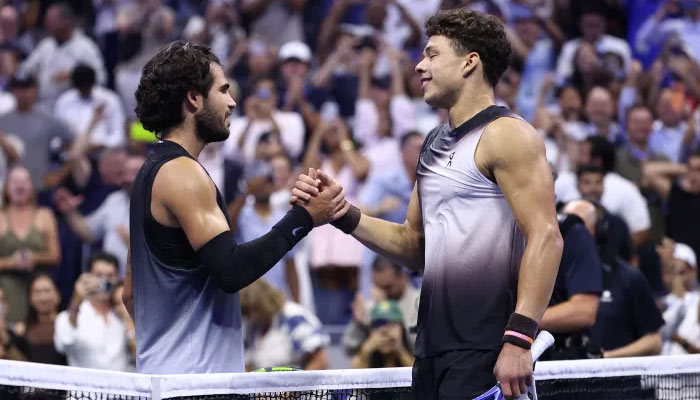
The commentary box had barely finished reacting when the point was already becoming a snapshot of the entire match.
Carlos Alcaraz had dragged Ben Shelton across the court with a pass that looked destined to end the rally. But Shelton somehow reached it, stretched out his racket and kept the ball in play. He then recovered, raced back towards the centre and produced a lob over Alcaraz.
“That is insane. It’s incredible athleticism from both these guys.”
The point came in the first-set tiebreak, but it offered an early indication of what was to come. For the next four hours and 28 minutes, Shelton and Alcaraz turned Arthur Ashe Stadium into the stage for a brutal contest of power, speed and endurance.
Shelton eventually described it perfectly.
“I’m tired. That was a war, epic match. I mean, so physical.”
And the American had the final word, ending the defending champion’s US Open campaign at 3:33 in the morning with a 146 mph ace.
Power against power
This was not the kind of tactical battle often seen when Alcaraz faces another elite all-court player. There was little hesitation from either man. Shelton attacked Alcaraz’s pace rather than trying to avoid it, while the Spaniard responded in kind whenever he found his rhythm.
The American’s serve provided the biggest weapon.
Shelton repeatedly approached the 150 mph mark, eventually reaching 149 mph. Of his 156 serves, 54 went untouched by the returner. He won 70% of his first-serve points and 57% behind his second serve.
His biggest deliveries repeatedly changed points before rallies could properly develop. There was a 145 mph serve, a 148 mph ace down the middle and, eventually, the 146 mph missile that closed the match.
Yet the serve was only part of Shelton’s success.
He remained aggressive once the ball came back, attacked short deliveries and trusted his forehand. He also used his movement effectively, winning eight of nine points at the net during the opening set.
Alcaraz strikes first
The opening set was decided by the finest margins.
Shelton held a 5-3 advantage in the tiebreak and was just two points away from taking the set. Alcaraz responded like a champion, winning four straight points to steal the opener.
For Shelton, however, the setback did not trigger a collapse. Instead, it appeared to unlock another level.
The second set belonged almost entirely to the American.
Shelton increased the pressure on Alcaraz’s serve, while the Spaniard’s first-serve percentage dropped from 65% in the opening set to 50% in the second. The errors followed.
Alcaraz had entered the tournament looking remarkably sharp after a four-and-a-half-month absence from competitive tennis caused by a right wrist injury. But Shelton’s relentless pace offered a far tougher examination.
The Spaniard’s timing began to drift. Forehands found the net, balls landed shorter than usual and frustration started to show.
By the end of the set, Alcaraz had made 32 unforced errors compared with 13 from Shelton.
The American won the set 6-1.
Shelton takes control
The momentum continued into the third set.
Shelton won nine games in succession across the second and third sets and quickly moved 3-0 ahead in the third. He was not simply waiting for Alcaraz to make mistakes; he was creating the conditions that forced them.
Every shot came with pace. Every shorter ball was attacked.
For a stretch, Alcaraz appeared unable to match the intensity.
But the Spaniard has built his career on finding solutions when matches begin to slip away.
He found one again.
Alcaraz fights back
The fourth set belonged to Alcaraz.
He broke Shelton early, stepped into his shots and began pushing the American further behind the baseline. Suddenly, the player who had looked frustrated and uncomfortable was back in command.
Shelton’s advantage disappeared.
Alcaraz raced through the set 6-1, forcing a deciding fifth.
The final set became a contest of nerves as much as tennis.
Neither player could break. Shelton threatened at 4-4, creating break points, but Alcaraz survived. The American’s serve then held when the pressure was at its highest.
A fifth-set tiebreak would decide everything.
One final punch
Shelton made the better start, moving 3-1 ahead after an early mini-break.
Alcaraz, as he had done all night, refused to disappear. He turned the momentum around and moved 5-3 ahead.
At 6-6, the match had reached its defining moment.
Shelton landed the next big blow, moving to 8-6.
Then came the finish.
A 146 mph serve.
Alcaraz could not handle it.
After four hours and 28 minutes, Shelton had knocked the defending champion out of the US Open.
The numbers tell the story
The statistics reflected the closeness of the contest.
Alcaraz hit 38 winners to Shelton’s 34 and had the advantage in longer rallies. But Shelton was more effective in the short exchanges that repeatedly decided crucial points.
The American made 35 unforced errors, while Alcaraz committed 53. Shelton also won 55% of rallies lasting four shots or fewer.
Those small differences mattered.
It would be tempting to blame Alcaraz’s defeat entirely on his long layoff. This was his first tournament since April, and he admitted that he began to feel the physical strain after the third set.
But the result was more complicated than simple rust.
Alcaraz recovered from losing the second and third sets, dominated the fourth and pushed Shelton to the brink in the fifth. He had every opportunity to win the match.
What Shelton possessed was the ultimate pressure-release weapon: his serve.
At any moment, a huge delivery could erase the danger before a rally even began.
And that was exactly what happened at the end.
A victory built on belief
Shelton did not beat Alcaraz by trying to turn the match into something it wasn’t. He embraced the Spaniard’s intensity and met it with his own.
There were no easy passages. No long stretches of passive tennis. Instead, there were enormous serves, explosive forehands, desperate defensive recoveries and two players repeatedly demanding one more burst of energy from their bodies.
The opening tiebreak rally had already captured the essence of the contest.
Shelton stretched for the ball, recovered, raced back into position and somehow produced the lob.
Four hours later, the match ended with another extraordinary athletic effort of a different kind — Shelton’s 146 mph serve.
The commentary-box verdict from the opening set remained appropriate until the very end.
It was insane.
It was physical.
It was a war.
And this time, Ben Shelton won it.
Comments are closed.