
G20 Should Consider New Trade Barriers to Address China Imbalances: US Treasury Chief

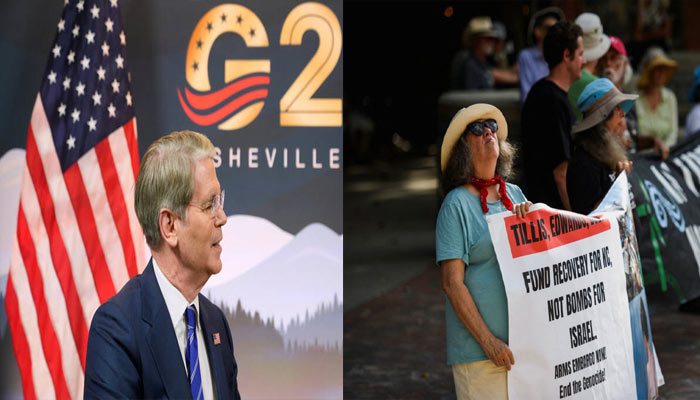
US Treasury Secretary Scott Bessent is expected to call on G20 nations to rethink their trade relations with China, as Washington seeks a broader international response to Beijing’s export-heavy economic model and its growing trade surplus.
Speaking ahead of a G20 meeting of finance officials, Bessent warned that China’s export boom was becoming unsustainable and urged Beijing to shift its economy toward stronger domestic consumption. “The world cannot have a China with a $1.2 trillion trade surplus,” Bessent said, arguing that China’s weak domestic economy was driving it to depend excessively on overseas markets.
Bessent said the US trade deficit with China was improving, but warned that restricting Chinese imports into the US could push those goods into other markets. Chinese exports have increasingly flowed toward Europe and Latin America as Washington has imposed steep tariffs and restrictions on a range of products.
He said other major economies now faced difficult choices and would need to reconsider their trade arrangements with Beijing to encourage China to reduce its dependence on exports. “The rest of the world is going to have to examine their terms of trade with China,” Bessent said.
The US is seeking a joint G20 statement aimed at addressing trade and current-account imbalances. China’s embassy in Washington had not immediately responded to the proposal.
US Census Bureau data showed that the US trade deficit with China dropped by about one-third during the first six months of 2026 from the corresponding period a year earlier, reaching $73.9 billion. Bessent said the improvement demonstrated the impact of US tariff policies, although some Chinese shipments had been accelerated earlier as companies sought to avoid anticipated duties.
Bessent rejects new Plaza Accord
Bessent also pushed back against proposals for coordinated action to strengthen China’s yuan, including suggestions for a new “Plaza Accord” similar to the 1985 currency agreement. He argued that currency adjustments would not solve the underlying trade problem, pointing instead to China’s industrial subsidies and weak domestic demand as the main causes of the imbalance.
Meanwhile, Bessent said US and Chinese officials were continuing preparations for a planned late-September meeting between President Donald Trump and Chinese President Xi Jinping at the White House.
It remains unclear whether Bessent will meet Chinese Vice Premier He Lifeng in person before the Trump-Xi summit. Discussions between Washington and Beijing are expected to include possible tariff cuts on non-strategic goods and safeguards for advanced artificial intelligence technology.
Bessent estimated that tariffs could potentially be removed from around $30 billion worth of non-strategic, non-critical goods on each side. The talks come as the Trump administration works to rebuild its tariff framework after the US Supreme Court struck down broad duties imposed under an emergency law, including a 20% tariff on Chinese imports.
Washington later imposed a 12.5% tariff on Chinese goods following an anti-forced-labor investigation and is preparing possible additional tariffs linked to China’s excess industrial capacity. Bessent also confirmed plans to meet People’s Bank of China Governor Pan Gongsheng during the G20 conference in Asheville, but declined to reveal details of the planned discussions.
Comments are closed.