

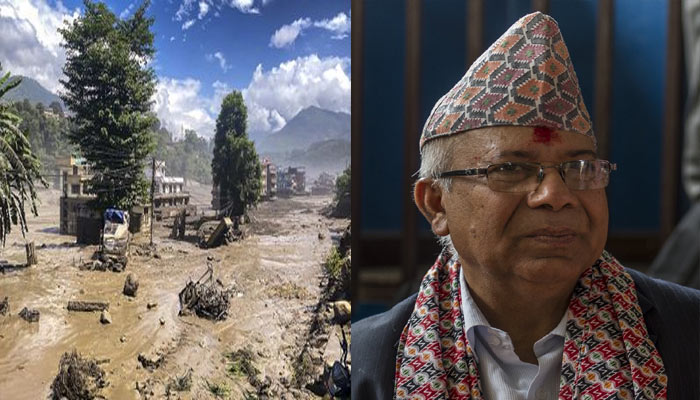
Former Nepal Prime Minister Madhav Kumar Nepal has criticised the country’s new Gen Z-led administration over.
The pace of its response to the devastating flash floods, urging the government to speed up rescue and relief operations as the death toll nears 800 and more than 3,000 people remain missing.
The massive flash flood and mudslide along the Nepal-China border has caused widespread destruction, devastating communities and damaging roads, infrastructure and hydropower projects. Rescue teams remain engaged in a search for missing people, including workers feared to be trapped inside hydropower tunnels. Tourists, pilgrims and workers in the affected areas have also been caught up in the disaster.
Speaking about the government’s handling of the crisis, Nepal said concerns were growing over the slow pace of rescue and relief operations.
“There is a complaint that the government is not moving fast in many of the things,” he said, identifying the search for missing people, treatment of the injured and distribution of relief supplies as the government’s most urgent priorities.
Nepal said financial and material support had poured in from across the country, with political parties, businesses, banks, government employees and Parliament contributing alongside international partners. However, he said the government needed to ensure that the assistance was delivered quickly to people in affected communities.
“The speed is less, that’s why we need to act very fast,” Nepal said.
He suggested that the lack of administrative experience among members of Prime Minister Balendra Shah’s newly formed government could be contributing to the difficulties. “The government people are new, they don’t have that experience,” Nepal said, adding that responding to a major national disaster requires “total dedication for the people, love and affection for the people”.
The former prime minister also called for closer monitoring of officials overseeing rescue and relief work, saying the government needed to ensure its administrative machinery was functioning effectively on the ground.
“There are some shortcomings, lagunas, in the working style of the government,” he said.
Nepal welcomed the decision to bring in foreign rescue specialists to assist with the crisis. Nepal had initially been reluctant to accept outside rescue teams but later allowed specialised teams from India and China to participate in operations, including difficult searches inside hydropower tunnels.
On concerns over China’s role and allegations that Nepal may not have received sufficient early-warning information, Nepal urged caution and rejected attempts to turn the disaster into a geopolitical dispute. “No one should have any mindset to have anti-China, anti-India mentality. This is not the time to blame each other,” he said.
Instead, he called for Nepal to cooperate with all its international partners as it tackles the humanitarian crisis.
The disaster is also expected to place significant pressure on Nepal’s economy, with the government facing major challenges in healthcare, logistics, infrastructure repair and reconstruction. Nepal, however, stopped short of directly blaming the Shah administration for the broader difficulties.
Rather, he said the government should focus on improving its performance.
“I want to inspire them to show them that they should do their work in a fast way, and in a proper way as well,” Nepal said.
His strongest criticism was directed at Shah’s political approach during the crisis.
Nepal accused the prime minister of failing to consult political parties, parliamentarians and other sections of society, saying broader political coordination was particularly important during a national emergency. “That is the problem for our Prime Minister, Mr. Balen Shah. He doesn’t take the initiative to have a consultation with the political parties, parliamentarians, and other people,” Nepal said.
Describing the approach as “really strange”, the former prime minister said a national crisis required the prime minister to maintain regular communication with political leaders and wider society. For Nepal, the immediate challenge is therefore twofold: accelerating rescue and relief operations while improving coordination across the government and political system as the country confronts one of its most devastating disasters.
Comments are closed.