
H-1B Visa Row: JD Vance Accuses Microsoft, IT Giants of Exploiting Foreign Workers

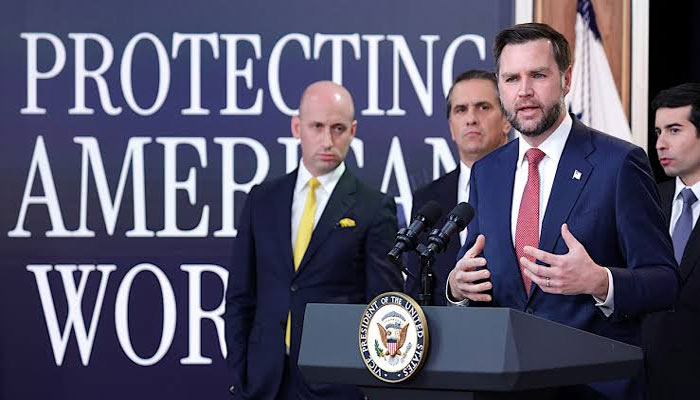
JD Vance Slams Microsoft Over H-1B Visas, Calls Foreign Workers ‘Indentured Servants’
US Vice President JD Vance has accused Microsoft and other technology companies of exploiting the H-1B visa programme to recruit foreign employees at lower wages while laying off American workers. Vance described some workers brought into the country through outsourcing firms as “indentured servants”, alleging that companies were using the system to cut labour costs and boost profits.
The remarks come amid a broader crackdown by the Trump administration on alleged misuse of US immigration programmes. Microsoft has reportedly been suspended from a programme that allows employers to sponsor foreign workers for permanent residency, following allegations of fraud.
“If you are working as an H-1B visa in the United States of America, you’re earning $20,000 less than an American citizen hired in the same position. If you were brought in by one of these foreign outsourcing firms, you’re making $48,000 less than an American citizen in a similar position,” Vance said.
He argued that certain companies were taking advantage of lower wage costs by bringing in foreign employees while reducing their American workforce.
“You bring in indentured servants from outside the country, you lay off American workers and, if you’re a corporation, you make a ton of money by undercutting the wages of American workers, replacing them with people who frankly shouldn’t be in the United States of America to begin with,” the Vice President said.
Vance Raises Questions Over Microsoft’s Layoffs
Vance specifically targeted Microsoft, alleging that the company had misused the H-1B visa system on a significant scale. He referred to its workforce reductions in 2025, claiming that the company laid off 6,000 American employees after certifying that qualified US workers could not be found for certain positions.
According to figures cited by Vance, Microsoft also received approvals for more than 6,000 H-1B visas and filed 3,682 applications for permanent labour certification, known as PERM.
Nearly 1,000 of these applications reportedly involved positions matching jobs held by American employees who had been laid off.
The allegations have renewed debate over the hiring practices of major technology companies that depend on international professionals. Vance maintained that the H-1B programme, intended to help employers recruit specialised talent, had become vulnerable to abuse.
However, the figures and allegations cited by the Vice President do not, on their own, establish that every visa application or hiring decision involved misconduct.
Cognizant, Infosys, Wipro Among Firms Named
US Labour Secretary Keith Sonderling said Microsoft was not the only technology company facing action under the programme. Other companies named in connection with suspensions included Cognizant, Infosys, Tata, Wipro, HCO, Capgemini and Adobe.
The administration also announced investigations into nine universities, including Harvard, Yale and Stanford, over allegations that international student recruitment practices were being used to undercut American wages.
Labour Department Inspector General Anthony D’Esposito said subpoenas had already been issued as part of the investigations.
The measures reflect the administration’s wider effort to examine employers’ compliance with immigration and labour regulations. The scrutiny could have implications for technology and outsourcing companies that depend on foreign professionals, including major Indian IT service providers operating in the US.
How H-1B Visa Holders Apply for Green Cards
The H-1B visa allows eligible foreign professionals to work temporarily in the United States, whereas a green card grants permanent resident status. Holding an H-1B visa does not automatically make someone eligible for a green card, although many workers pursue employment-based permanent residency through their employers.
For many employment-based applications, the process begins with PERM labour certification. Employers generally must demonstrate that there are insufficient qualified, willing and available American workers for the position and that hiring a foreign worker will not adversely affect the wages and working conditions of similarly employed US workers.
After PERM approval from the Department of Labour, the employer can generally file an I-140 immigrant petition with US Citizenship and Immigration Services. The employee may then apply for permanent residency when an immigrant visa becomes available, subject to the relevant category and other eligibility requirements.
The latest controversy has brought renewed attention to the relationship between temporary work visas, permanent residency applications and safeguards designed to protect American workers. As the investigations proceed, employers and foreign professionals could face greater scrutiny over recruitment practices, wages and compliance with immigration rules.
Comments are closed.