
Markets Slide: Sensex Down 200 Points, Nifty Below 25,550 as Bajaj Twins Lead Losses

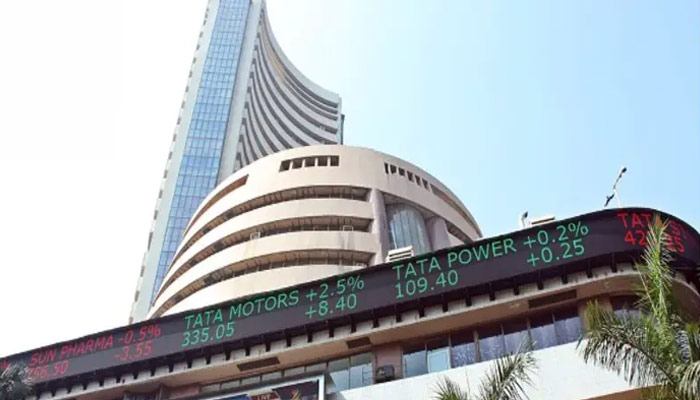
Indian equity benchmarks ended lower on Tuesday as selling in financial and auto stocks weighed on sentiment despite positive global cues and optimism around U.S.–India trade talks.
After a strong start, the BSE Sensex gave up early gains to close 212 points, or 0.25%, lower at 83,324, while the NSE Nifty50 settled 67 points down at 25,507. The markets remained volatile through the session, with stock-specific action dominating amid the ongoing Q2FY26 earnings season.
Market Movers
Bajaj Finance led the declines, plunging over 6% following concerns over its loan book performance. Its parent company, Bajaj Finserv, also fell nearly 4%. Weakness in Tata Motors, Power Grid, Kotak Mahindra Bank, SBI, and NTPC further dragged the indices.
Among gainers, Mahindra & Mahindra rose 1.2%, supported by strong SUV sales data. TCS, Infosys, BEL, and HCL Tech also ended higher, lending some support to the benchmarks.
Broader Market & Sectoral Trends
In the broader markets, the Nifty MidCap index slipped 0.05%, while the Nifty SmallCap index gained 0.10%. Sectorally, financials and auto stocks bore the brunt, with the Nifty Financial Services index losing 0.7% and Nifty PSU Bank falling 0.5%. IT and FMCG indices, however, held firm.
Global Market Overview
Global sentiment remained upbeat after U.S. President Donald Trump hinted at progress toward a “fair trade deal” with India, saying the two countries were close to finalising a new framework.
Asian markets mirrored Wall Street’s rally overnight, buoyed by gains in tech and industrial shares. Japan’s Nikkei 225 rose 0.56%, South Korea’s KOSPI jumped 2.24%, and Hong Kong’s Hang Seng advanced 0.4%.
On Wall Street, AI stocks drove a sharp rebound, with the Nasdaq Composite gaining 2.27%, the S&P 500 up 1.54%, and the Dow Jones adding 0.81%.
Analysts said that while global cues remain supportive, domestic markets could stay choppy in the near term amid stock-specific volatility and uncertainty over corporate earnings.
Comments are closed.