
NASA Sends $4 Billion Telescope Into Orbit To Probe The Universe’s Biggest Mysteries

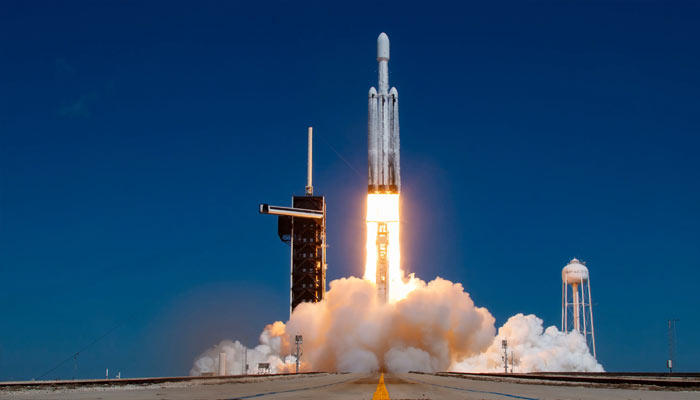
NASA’s Nancy Grace Roman Space Telescope has successfully launched from Florida, beginning a mission to explore some of the universe’s most puzzling questions, including the nature of dark matter, dark energy and planets beyond our solar system.
The roughly $4 billion observatory lifted off from NASA’s Kennedy Space Center on Sunday aboard a SpaceX Falcon Heavy rocket. Despite earlier weather concerns, the launch took place under blue skies with scattered clouds. Roman is now headed towards Lagrange Point 2, located about 1.6 million kilometres from Earth. Its primary mission is expected to last five years, although NASA said it carries enough fuel to potentially operate for another five years.
The telescope will expand on the work of the Hubble and James Webb Space Telescopes. While Webb is designed to deliver highly detailed observations of distant cosmic objects, Roman will focus on surveying much larger areas of the sky.
NASA Science Mission Directorate chief Nicola Fox said Roman would dramatically expand humanity’s view of the cosmos, comparing previous observations to looking through a keyhole. Roman’s senior project scientist Julie McEnery said the telescope would offer image sharpness and sensitivity similar to Hubble but with a far wider field of view.
“One month of observations to survey our Milky Way galaxy would take about a century with Hubble,” McEnery said.
Mapping The Universe
A major objective of the mission is to investigate dark matter and dark energy, which together are believed to account for about 95% of the universe. Roman’s primary survey is expected to take more than a year and map more than two billion galaxies, creating one of the most detailed three-dimensional pictures of the universe ever produced.
Scientists estimate that ordinary matter makes up only about 5% of the cosmos, while dark matter accounts for roughly 27% and dark energy around 68%. Dark matter has never been directly observed but is inferred through its gravitational effects on galaxies and stars. Dark energy, meanwhile, is the name given to the unknown force believed to be accelerating the universe’s expansion.
By studying these effects across vast cosmic distances, Roman could help scientists understand how the universe has evolved and why its expansion is speeding up.
Searching For New Worlds
Roman will also conduct a major survey for exoplanets — planets orbiting stars beyond the solar system. NASA expects the telescope to discover thousands of exoplanets and provide scientists with a statistical picture of planetary systems across the galaxy.
Researchers say the observatory could also make unexpected discoveries, as previous flagship telescopes have often revealed phenomena that scientists did not anticipate before launch.
A New Partner For Webb And Hubble
Roman is not intended to replace Hubble or Webb. Instead, its wide field of view will complement their ability to examine individual objects in extraordinary detail. NASA compares Roman to a wide-angle camera lens, while Webb functions more like a powerful zoom lens capable of probing extremely distant and faint objects.
Roman’s panoramic surveys could identify interesting targets for Webb and other telescopes to investigate more closely.
Mission Survives Funding Threats
The Roman programme faced repeated funding threats during Donald Trump’s first and second presidential terms, including proposals to cut or eliminate its funding. Congress ultimately preserved the mission.
NASA said Roman launched about nine months ahead of schedule.
The observatory’s combination of a wide field of view, high sensitivity and long-duration survey capability is expected to give astronomers an unprecedented look at the structure and evolution of the universe — while opening the door to discoveries that could challenge existing theories.
Comments are closed.