

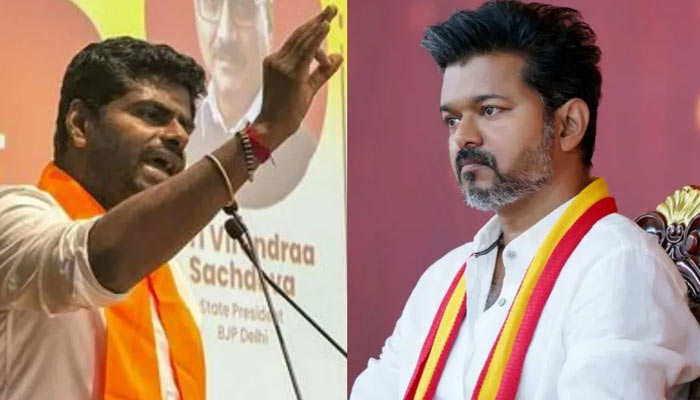
When former Tamil Nadu BJP chief K Annamalai broke the party’s decades-old political template in the state, many viewed him.
As an ambitious outsider trying to impose a northern political model on a land deeply rooted in Dravidian politics. But six years after the former IPS officer joined the BJP, Tamil Nadu has a new Chief Minister whose rise appears to validate much of what Annamalai had believed. In fact, actor C Joseph Vijay’s rise from an actor to the chief minister of Tamil Nadu proves why Annamalai’s model could be a blockbuster.
Annamalai, the former state unit chief of the BJP, had been arguing there was a political vacuum in Tamil Nadu, that voters were becoming less attached to traditional Dravidian binaries — the DMK and the AIADMK — and that a new political force blending Tamil pride, governance, and a broader ideological appeal with nationalism could emerge victorious.
However, any breakthrough idea needs time. The BJP grew impatient and returned to alliance politics with its long-time regional partner, the AIADMK.
Tamilaga Vettri Kazagham (TVK) chief Vijay, on the other hand, embraced many of the same political assumptions, packaged them differently, and converted them into electoral success, becoming the single biggest party in the 2026 Assembly election, bagging 108 seats out of the total 234.
Only two years of its inception, Vijay’s TVK shattered the Dravidian parties’ six-decade duopoly in Tamil Nadu and sparked a debate on whether Annamalai’s brand of politics could have actually worked for the BJP if the party’s top brass had waited for some more time.
ANNAMALAI’S RESIGNATION LETTER REVEALS IDEOLOGY
Annamalai’s resignation was accepted by the BJP’s national president, Nitin Nabin, on Friday. The former Karnataka Police’s ‘Singham’ IPS officer announced that he will be launching his own political movement and will not be associated with any party.
Annamalai held meetings with Union Home Minister Amit Shah, Nabin, and national general secretary of the party BL Santhosh, and submitted his resignation letter to the party leadership on June 2.
Several political observers believe that Annamalai should have exited the BJP much earlier and should have started his own political party. Even Annamalai, in his resignation letter, mentioned that the national parties never understood Tamil Nadu.
“National parties never spoke the language that people in Tamil Nadu understood. I have tried to change this belief and also found reasonable success despite multiple roadblocks, barriers, and obstructions from both inside and outside,” Annamalai said in his resignation letter.
“As a nationalist deeply rooted in regional aspirations, I take immense pride in the richness of my language, the diversity of my culture, and the unique heritage of my region. I firmly believe that a strong and united India is built upon the strength, dignity, and aspirations of its many regions and communities,” he added.
These words are a clear indication that Annamalai was unhappy with the party affairs in Tamil Nadu and the way the national leadership dealt with them.
However, the BJP’s top brass, understanding the value Annamalai brings to the party, continued its efforts to persuade the IPS officer-turned politician to reconsider his decision. According to sources of India Today TV, senior leaders remained hopeful until the last moment that Annamalai could be convinced to stay. However, he did not reconsider his decision and moved on from the saffron camp.
THE POLITICS THAT ANNAMALAI TRIED TO BUILD WHILE IN BJP
The BJP, an election juggernaut as it is widely regarded, from the very beginning of its inception, has struggled to dominate the land of Tamil Nadu. It was perceived as an outsider that relied on Hindi and Hindutva. Remember, Tamil Nadu is the state that saw anti-Hindi agitations way back in 1938, and the language agitation turned into an inferno in the 1960s.
However, the BJP grew at a good rate in Tamil Nadu after Annamalai joined the camp in 2020. Annamalai adopted a model of attacking the DMK and the AIADMK, but carefully crafted his position regarding the father of the Dravidian movement, Periyar EV Ramasamy.
Periyar being a cult figure in Tamil Nadu, taking on him would damage any political party or leader deeply. Annamalai landed in controversy regarding Periyar’s statement, but he acknowledged Periyar’s role in advancing social equality while simultaneously arguing that Dravidian politics had drifted away from Tamil interests and become a vehicle for dynastic politics, corruption, and social division.
Annamalai’s political messaging from day one attempted to combine Tamil identity with nationalism. However, this style of politics is what made the BJP a prime target in the state, as the Dravidian politics in the state made the nationalist push weak. But Annamalai’s craft of shaping the ideology and being the son of the soil gained traction for the BJP.
Annamalai consistently highlighted Tamil civilisational pride through figures such as Rajendra Chola and the Chola empire while arguing that celebrating Tamil history need not come at the cost of national identity.
This was neither traditional Hindutva politics nor conventional Dravidian politics. It was an attempt to create a third space, advocating for the “real Tamilian pride” that the former BJP state unit chief pushed for.
At the heart of Annamalai’s project was the belief that the absence of M Karunanidhi and J Jayalalithaa — the popular faces of the DMK and the AIADMK, respectively — had created an unprecedented leadership vacuum. Repeatedly, Annamalai argued that Tamil Nadu was entering a new political era in which voters would be willing to consider alternatives to the Dravidian forces.
Then came Annamalai’s famous En Mann, En Makkal padayatra. As the captain of the ship, Annamalai, undertook the 1,700-km padayatra, covering all 39 parliamentary constituencies of Tamil Nadu. The yatra made the BJP’s vote share spike from nearly 3% to over 11% in the 2024 general election.
The results initially appeared encouraging. This was the first time the party had entered double-digit vote share in Tamil Nadu. Despite failing to win seats, the performance convinced many that Annamalai’s experiment was beginning to resonate with young voters and first-time supporters. However, the captain of the ship himself lost the election with over 1.18 lakh votes against the DMK candidate.
Since the setback in the Lok Sabha polls in Tamil Nadu, the anxiety of the BJP’s national leadership grew, and it planned to take the tried and tested route in the state for the Assembly election in 2026.
ANNAMALAI’S BJP STARTED BLINKING DUE TO THE PARTY HIGH COMMAND’S RESTLESSNESS
The BJP’s national leadership appeared unconvinced with the strategy of Annamalai. The state party president’s visible downfall started in Tamil Nadu, even after the BJP achieved its best vote share performance. The top bosses of the BJP viewed that the party had a vital chance as it sensed an anti-incumbency wave in the state against the then-ruling DMK. But the top brass also understood that contesting solo in the state is not a viable option and showed signs of renewing ties with its long-time ally, the AIADMK.
The major hurdle for this alliance was Annamalai’s aggressive attacks on the AIADMK. Annamalai’s criticism of CN Annadurai and Jayalalithaa made the AIADMK miffed with the BJP leader and demanded his apology. The AIADMK decided to exit from its alliance ahead of the 2024 Lok Sabha election. Gradually, after Annamalai softened his tone, the AIADMK joined hands with the BJP and decided to fight the 2026 elections in alliance.
All seemed well, but the alliance came with a political cost, much affecting the BJP’s dynamic star, Annamalai.
Annamalai stepped down as state president in 2025, a move widely viewed as necessary to smooth relations with the AIADMK leadership, which had long objected to his criticism of party icons. The saffron party decided to replace Annamalai with BJP leader Nainar Nagenthran, who was formerly associated with the AIADMK as a Cabinet minister under the Jayalalithaa-led government.
This decision of the BJP to replace Annamalai effectively marked the end of the BJP’s independent Tamil Nadu experiment. Annamalai was also not granted a ticket to contest in the Assembly election, and he became a missing star in Tamil Nadu’s state election.
What followed was the opposite of what the BJP top brass had hoped for in the 2026 Assembly polls. BJP’s vote share collapsed back into low single digits (nearly 3%), and the party was reduced to the margins once again.
Under Annamalai, the BJP was making headlines and also appeared to be a strong opposition. At least it was beind discussed. But the BJP’s game of narratives also became fragmented after its single-seat winning performance in the 234-member Assembly.
THE BEGINNING OF THE VIJAY ERA IN TAMIL NADU: ANNAMALAI’S PROPHECY TURNED TO REALITY
The political space that Annamalai built for nearly half a decade did not disappear, and the prophecy that he made about the potential fall of Dravida forces came true. But, not with the ideology of nationalism, rather with the tweaked ideology of Dravidian politics, “neo-Dravidianism”.
The space that Annamalai wanted to occupy was actually conquered by the debutant, actor-turned-politician TVK chief Vijay.
The Thalapathy of Tamil Nadu entered politics with a formula that looked strikingly similar to Annamalai’s in several respects.
Like Annamalai, Vijay recognised the vacuum left by Karunanidhi and Jayalalithaa. He sought to move beyond the traditional DMK-AIADMK binary. He also appealed heavily to younger voters and used digital mobilisation to build a movement. Most importantly, Vijay embraced a softer version of Dravidian politics. These were also some of the ideas adopted by Annamalai during his tenure as the BJP’s state unit president.
Rather than placing Periyar at the centre of his ideological universe, Vijay created a broader political parentheses, which included the father of the Indian constitution, BR Ambedkar, K Kamaraj, a former CM who was popular for his simplicity and administration, Rani Velu Nachiyar and Anjalai Ammal — women leaders who fearless resisted against oppression, fought for women’s empowerment, and a took firm stance on state rights and cultural pride, alongside.
The result that Vijay and his party got was a political identity that retained social justice themes while reducing the ideological rigidity associated with traditional Dravidian parties.
This strategy proved to be a masterstroke for Vijay, making his party secure votes simultaneously from Dravidian voters, anti-DMK voters, centrists, youth, and sections of voters seeking change without embracing the BJP. In many ways, Vijay achieved what Annamalai had attempted: creating a political alternative to the Dravidian duopoly.
The difference was that Vijay carried none of the baggage associated with the BJP brand in Tamil Nadu, and also, his cult fanbase through cinema helped his political journey. While Vijay, a superstar, brought a loyal following with him, Annamalai was trying to cultivate it with his ideology, for which the BJP seemed impatient.
FACTORS THAT HELPED VIJAY WIN IN TAMIL NADU
This is where the debate around Annamalai’s political legacy becomes particularly interesting. Annamalai critics argue that while he succeeded in increasing the BJP’s visibility in Tamil Nadu, he never possessed the broad social coalition required to capture power in a state dominated by regional forces.
Vijay’s rise was driven by factors unique to him. Vijay’s massive film-star appeal, a well-entrenched fan network, anti-incumbency sentiment against the DMK government, and his ability to build a coalition around a softer, more inclusive political message were also factors that made him rise to power within two years.
Yet the 2026 election outcome was like a validation of Annamalai’s core political analysis.
For years, Annamalai maintained that Tamil Nadu was undergoing a generational shift. He argued that the influence of traditional Dravidian politics was gradually weakening, that younger voters were less emotionally invested in old ideological battles, and that the vacuum left by Karunanidhi and Jayalalithaa would eventually create space for a new political force.
Annamalai also insisted that future elections would be fought more on governance, corruption, law and order, development, and cultural identity than on inherited political loyalties. That’s why he chose scientist and former President APJ Abdul Kalam as the brand new icon of his movement.
He knows that he will have to create an entire support base and party machinery. He is planning to train people under the APJ Abdul Kalam Centre for Ethics and Politics, a training and research institution which he will establish in Coimbatore. On Friday, without naming Vijay, he said that one chief minister couldn’t deliver everything that Tamil Nadu craved and asked people to register for the grassroots leadership movement.
“Our political movement has achieved a milestone, with over 10 lakh leaders registering within just 10 hours. This extraordinary response is a powerful reflection of the growing belief in our shared vision and collective mission,” Annamalai posted on X on Friday night.
A million people in 10 hours shows that his idea had resonated among the people.
The BJP eventually abandoned that experiment and returned to alliance politics. Vijay, however, built a successful movement around many of the same issues and assumptions. Annamalai’s attempt to contribute to building a powerful BJP in Tamil Nadu ultimately created a road map of identifying a political moment that, in the end, in a way was taken by Vijay to rise to power. Annamalai is now free to follow his heart. And Vijay proves that the ideology and strategy can be a super hit.
Comments are closed.