

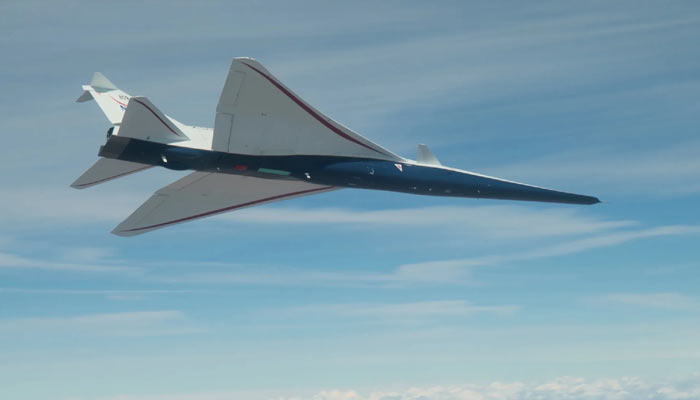
NASA’s X-59 Clears Key Tests Ahead of First Flight. Here’s Why the Quiet Supersonic Jet Matters
NASA’s ambitious effort to bring back supersonic air travel has taken a major step forward.
The agency’s experimental X-59 aircraft has successfully completed a series of crucial ground tests ahead of its maiden flight, moving closer to a mission that could transform the future of commercial aviation. Developed by NASA and Lockheed Martin under the Quiet SuperSonic Technology (Quesst) programme, the aircraft is designed to fly faster than the speed of sound while significantly reducing the noise generated during supersonic flight.
The latest tests evaluated the aircraft’s systems, controls and overall performance, helping engineers verify that it is ready for the next phase of development.
What Is the X-59?
The X-59 is an experimental supersonic aircraft built to tackle one of aviation’s biggest challenges: the sonic boom.
Whenever an aircraft travels faster than the speed of sound, it creates shock waves that combine into a powerful sonic boom heard on the ground. The noise can be loud enough to rattle windows and has long prevented routine commercial supersonic flights over land.
NASA’s solution is the X-59, a uniquely designed aircraft that reshapes those shock waves before they reach the ground.
The aircraft’s most distinctive feature is its elongated nose, which stretches across nearly one-third of its total length. Combined with its carefully engineered fuselage, the design helps spread shock waves apart, reducing the traditional sonic boom to a much softer sound known as a “sonic thump.”
What Were the Latest Tests About?
NASA’s engineers recently conducted a range of ground evaluations to ensure the aircraft’s systems are functioning as intended.
The testing programme included assessments of the avionics, flight-control software and integrated aircraft systems under simulated operating conditions. Engineers also carried out taxi and operational tests to verify the aircraft’s readiness before it takes to the skies for the first time.
According to NASA, the successful completion of these tests marks another important milestone in the aircraft’s development journey.
How Fast Can It Fly?
The X-59 is expected to cruise at around Mach 1.4, or roughly 1,500 kilometres per hour, at an altitude of approximately 55,000 feet.
That speed is considerably faster than conventional commercial airliners, which generally fly at around 900 kilometres per hour.
While the aircraft itself is a research platform rather than a passenger jet, the technologies being tested could eventually be applied to future commercial aircraft capable of cutting travel times significantly.
Why Is NASA Conducting This Mission?
The ultimate goal of the Quesst mission is not simply to prove that the X-59 can fly quietly at supersonic speeds.
NASA wants to collect scientific data that could help reshape aviation regulations around the world.
Once flight testing begins, the aircraft will conduct demonstration flights over selected communities across the United States. Researchers will gather feedback from residents on the noise produced by the aircraft and compare it with technical measurements collected during the flights.
The findings will be shared with aviation regulators, who could use the data when considering future rules governing overland supersonic travel.
Could This Bring Back Supersonic Passenger Flights?
Commercial supersonic travel largely disappeared after the retirement of the Concorde in 2003.
Although several companies have explored faster-than-sound passenger aircraft since then, concerns over noise, environmental impact and operating costs have remained significant barriers. NASA believes the X-59 could help solve one of those major issues by proving that supersonic aircraft do not necessarily have to produce disruptive sonic booms.
If the programme succeeds, it could pave the way for a new generation of quieter supersonic airliners capable of dramatically reducing travel times on long-distance routes. For now, the focus remains on the X-59’s first flight. But with key ground tests now complete, NASA is one step closer to showing whether quiet supersonic travel can become a practical reality.
Comments are closed.