

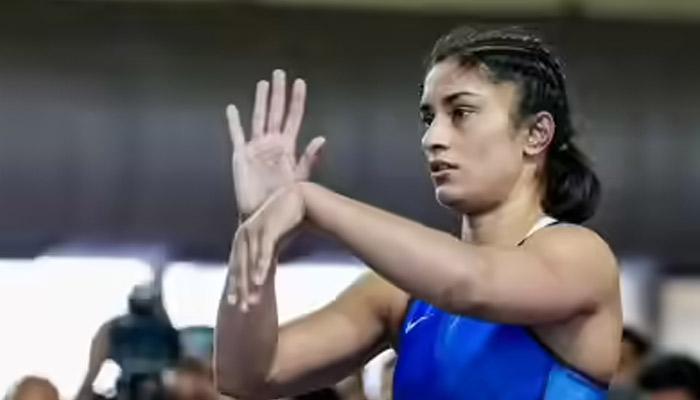
Vinesh Phogat’s Return Exposes Wrestling’s Deep Divisions
The cheers inside Delhi’s KD Jadhav Indoor Stadium on Saturday should have marked a celebration. After nearly two years away from competitive wrestling, Vinesh Phogat returned to the mat in a bid to qualify for the 2026 Asian Games. One of India’s most decorated wrestlers was back where she belonged, and hundreds of supporters had travelled from Haryana and beyond to witness the occasion.
Instead, her comeback became a fresh chapter in Indian wrestling’s bitterest feud.
The strained relationship between Vinesh and the Wrestling Federation of India (WFI) has dominated the sport since the wrestlers’ protests of 2023. Given that history, friction was expected. What unfolded during the selection trials, however, raised uncomfortable questions about the state of the sport and the administration governing it.
Even before stepping onto the mat, Vinesh found herself battling uncertainty.
A day before the trials, the WFI issued a circular stating that she would have to compete in the 50kg category, the same weight class in which she participated at the Paris Olympics. The move came despite Vinesh seeking to compete in a higher weight division and after legal intervention had already cleared the path for her participation.
The dispute escalated to the courts, with both the High Court and Supreme Court becoming involved before the federation ultimately allowed her to compete.
Yet the confusion did not end there.
When Vinesh arrived at the stadium early on Saturday morning for the mandatory weigh-in process, she was initially denied entry by security personnel. According to her camp, the weigh-in itself was delayed, adding further uncertainty to an already tense situation.
By the time she was cleared to compete in the 53kg category, the focus had already shifted away from wrestling.
Inside the arena, the atmosphere reflected the wider divide that has engulfed Indian wrestling. Supporters of Vinesh and backers of the federation engaged in a day-long battle of chants and counter-chants, turning what should have been a sporting event into a political and personal contest.
The tension eventually spilled onto the competition floor.
During her quarter-final bout against Nishu, a refereeing decision triggered a heated confrontation. Vinesh’s camp strongly objected to the officiating, arguing that a crucial review process lacked transparency. Matters were complicated further by technical issues with the review screen, leading to prolonged protests and a temporary halt in proceedings.
The situation escalated to the point where WFI officials and members of Vinesh’s support team found themselves involved in a public confrontation before security personnel intervened.
The wrestling eventually resumed. The controversy did not.
Vinesh’s campaign ended in the semi-finals, where she was defeated by rising wrestler Meenakshi. On paper, that result will be remembered as the defining sporting outcome of the day.
In reality, it was merely a footnote.
The bigger story was the environment surrounding one of India’s most accomplished athletes. Whether one agrees with Vinesh’s allegations against the federation or supports the WFI’s position, it is difficult to ignore the fact that her comeback was overshadowed by administrative disputes, legal battles, security issues and officiating controversies.
A selection trial should primarily test an athlete’s wrestling ability. On Saturday, the wrestling often felt secondary. Questions over weight categories, arguments at entry gates, disputes over reviews and confrontations between officials and supporters dominated the conversation far more than the action on the mat.
For Indian wrestling, that is perhaps the most troubling takeaway.
Vinesh Phogat’s return should have been a significant sporting occasion. Instead, it became another reminder of the deep fractures that continue to define the sport.
Indian wrestling got one of its biggest stars back.
Yet somehow, the spotlight remained fixed on everything except wrestling.
Comments are closed.