
‘We Don’t Count Body Bags’: Operation Sindoor’s Most Powerful Moment Still Echoes

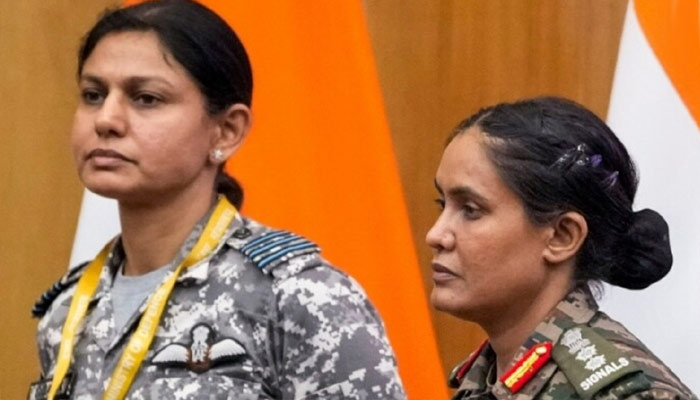
A year after Operation Sindoor, the officers who became the public faces of India’s cross-border anti-terror operation continue to be remembered for their calm briefings.
Sharp messaging and memorable responses during one of the country’s most closely watched military actions in recent years. Operation Sindoor was launched by the Indian armed forces in retaliation for the April 22 Pahalgam terror attack, targeting terror infrastructure in Pakistan and Pakistan-occupied Kashmir. As the operation unfolded, a series of regular media briefings brought several military officers into the national spotlight.
Among them were Sofiya Qureshi, Vyomika Singh and Prerna Deosthalee — three women officers who emerged as widely recognised faces of the operation through their detailed public briefings.
Colonel Sofiya Qureshi, who previously made history by leading an Indian Army contingent at the multinational Exercise Force 18 in 2016, drew praise for her composed and precise communication style during the tense military standoff. A biochemistry postgraduate from Gujarat’s Vadodara, she was commissioned through the Officers Training Academy in Chennai.
Wing Commander Vyomika Singh, a helicopter pilot commissioned into the Indian Air Force in 2004, also gained national attention for her firm and confident briefings. Having logged more than 2,500 flying hours across difficult terrains, Singh repeatedly stressed that India was fully prepared to respond to any provocation from Pakistan.
Commander Prerna Deosthalee represented the Indian Navy during several Operation Sindoor briefings. Commissioned in 2009, she later became the first woman officer to command an Indian naval warship after taking charge of INS Trinkat in 2023.
The operation’s public communication was also led by senior officers including Rajiv Ghai, AK Bharti and AN Pramod, whose blunt responses during media interactions became widely discussed. Air Marshal AK Bharti, then Director General of Air Operations, delivered one of the most recalled remarks from the conflict when asked about casualties during the strikes.
“Our job is to hit the target, not count the body bags,” he had said, underlining that the operation’s objective was precision targeting rather than casualty assessment.
Bharti also made headlines after dismissing speculation around alleged Indian strikes on Pakistan’s Kirana Hills nuclear-linked facilities, sarcastically remarking that India neither knew about nor targeted such a site.
Lieutenant General Rajiv Ghai, who served as Director General of Military Operations during the conflict and was later elevated as Deputy Chief of Army Staff (Strategy), became another prominent voice of the operation. Vice Admiral AN Pramod, who headed naval operations at the time, repeatedly highlighted the strategic importance of India’s long-range precision capabilities.
On Thursday, the three senior officers again addressed the media while marking one year of Operation Sindoor, reiterating that the military action carried a broader strategic message.
“Operation Sindoor was not an end. It was just the beginning,” Lt Gen Rajiv Ghai said during the anniversary briefing.
Air Marshal Bharti said the operation reaffirmed the central role of air power in modern combat, while Vice Admiral Pramod asserted that India’s precision strikes had effectively challenged Pakistan’s “nuclear blackmail” narrative by demonstrating the capability to hit terror hubs deep inside its territory.
Comments are closed.