

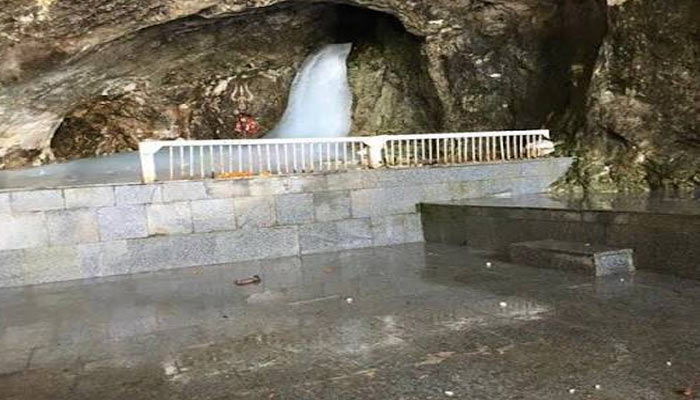
The rapid melting of the sacred Amarnath ice lingam this year has sparked concern among scientists and environmental experts.
Who say the phenomenon reflects the growing impact of climate change on the fragile Himalayan ecosystem. While the ice stalagmite naturally waxes and wanes each year, reports suggest it has shrunk by over 90% within days of the 57-day pilgrimage, far earlier than expected.
Experts caution that there is no single reason behind the accelerated melting. Instead, it is being driven by a combination of rising temperatures, changing snowfall patterns, the cave’s sensitive microclimate, increasing pilgrim footfall and expanding infrastructure around the shrine.
Himalayas warming at an accelerated pace
Located at an altitude of 3,888 metres (12,756 feet), the Amarnath cave relies on freezing temperatures for the natural formation and preservation of the ice lingam. Scientists say those conditions are becoming increasingly difficult to sustain as the Himalayas warm faster than the global average.
Dr Eklabya Sharma, Strategic Advisor and Director of The Himalaya Initiative at ATREE and a Padma Shri awardee, said the unusually rapid melting aligns with long-term climate trends documented across the Himalayan region.
“While no single event should be attributed solely to climate change, the rapid melting is consistent with decades of observed warming across the Himalayas,” he said.
Dr Sharma explained that the region is experiencing elevation-dependent warming, where temperatures rise more rapidly at higher altitudes than elsewhere. If greenhouse gas emissions remain high, temperatures in parts of the Himalayas could increase by up to 5°C by the end of the century, accelerating glacier retreat, reducing snow cover and increasing the frequency of extreme heat events.
His team’s research found that Himalayan snow and glacier cover declined by more than 23% between 2000 and 2022, with the pace of loss accelerating after 2010. The western Himalayas, where the Amarnath cave is located, are among the fastest-warming parts of the mountain range.
Shrinking snow cover and changing climate
According to Professor B.W. Pandey, Director of the Centre for Himalayan Studies at the University of Delhi, the timing of the melting has changed dramatically over the years. “Earlier, the ice lingam would melt gradually over nearly a month. This year, it has almost disappeared within about two weeks,” he said.
Pandey noted that rising temperatures have pushed the Himalayan snow line to higher elevations, while changes in the region’s hydrological cycle are altering snowfall and snowmelt patterns. Alpine plants and animals are also gradually shifting to higher altitudes in response to the warming climate.
Global weather patterns add to warming
Experts say the Himalayas are influenced not only by local weather but also by large-scale atmospheric circulation.
Pandey explained that heatwaves developing over the Atlantic and Mediterranean regions can affect weather patterns across north-western India, contributing to higher temperatures in the western Himalayas alongside the long-term effects of global warming.
- Pilgrim numbers and the cave’s microclimate
- Scientists also point to the cave’s fragile internal environment.
The Amarnath cave maintains a delicate microclimate that must remain below freezing for the ice formation to survive. A surge in visitors raises air temperature and humidity inside the enclosed space through body heat, potentially accelerating the melting process.
This year’s pilgrimage has drawn an exceptionally large number of devotees, with more than 93,000 pilgrims visiting the shrine in the first four days.
Professor Sarmistha Pattanaik of IIT Bombay said the issue should be viewed through both environmental and human lenses.
“This is not simply a climate change story. Rising temperatures, declining snowfall, increasing tourism and human intervention together are putting pressure on a highly fragile mountain ecosystem,” she said.
She added that artificial lighting, generators, temporary shelters and other facilities introduced to support the pilgrimage may further alter the cave’s natural thermal balance.
Infrastructure and environmental pressures
Over the years, improved roads, accommodation, electricity, solar lighting and community kitchens have made the pilgrimage more accessible. However, experts say such development also changes the local environment.
Pattanaik noted that construction activity, heavy machinery and support infrastructure near the shrine can disturb the cave’s natural insulation and contribute to localized warming, making it more difficult for the ice lingam to survive during the summer.
Finding a balance
Experts stress that preserving the Amarnath shrine requires balancing religious traditions with environmental conservation.
Measures such as regulating daily pilgrim numbers, limiting permanent infrastructure near the cave, reducing heat-generating activities around the shrine and strengthening environmental management have been suggested to help protect the site’s fragile microclimate.
At the same time, researchers emphasize that any conservation strategy must also consider the livelihoods of local communities that depend on the annual pilgrimage. Dr Sharma said safeguarding the Himalayas is about far more than protecting a single sacred site.
Comments are closed.