

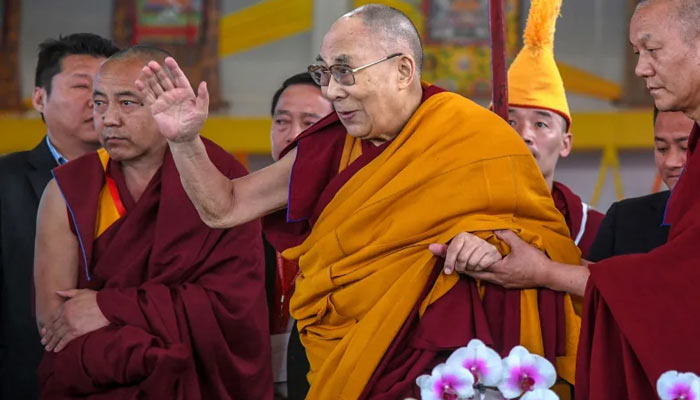
Dalai Lama at 90: What His Title Means and Why His Succession Plan Is Sparking Tensions with China.
As the 14th Dalai Lama, Tenzin Gyatso, prepares to celebrate his 90th birthday on July 6, he has reaffirmed that the spiritual institution of the Dalai Lama will continue after his death. But his latest statement on succession has sparked fresh tensions with China, which insists that it must have the final say on his successor.
What Does ‘Dalai Lama’ Mean?
While the Dalai Lama is widely seen as the global face of Buddhism, he is specifically the head of the Gelug school of Tibetan Buddhism, one of the four main Tibetan traditions.
The title “Dalai Lama” combines two words:
‘Dalai’: a Sino-Mongolian word meaning “ocean” or “vast sea”
‘Lama’: a Tibetan word meaning “teacher” or “guru”
Together, the name reflects wisdom as vast as the ocean. The title was first given to the third Dalai Lama by Mongol chief Altan Khan in the 16th century. Tibetans also consider the Dalai Lama to be the reincarnation of Avalokiteśvara, the bodhisattva of compassion, known across Asia as Chenrezig (Tibet), Guanyin (China), and Kannon (Japan).
The Succession Plan: What the Dalai Lama Said
In a statement released ahead of his birthday, the Dalai Lama reiterated that only the Gaden Phodrang Trust—a non-profit established by his office—has the authority to recognise his reincarnation.
“I hereby reiterate that the Gaden Phodrang Trust has the sole authority to recognise the future reincarnation. No one else has any such authority to interfere,” he said in a video message on July 2.
This firm declaration came after years of speculation, during which the Dalai Lama had suggested that his successor could be a woman, be born outside Tibet, or that the institution might end altogether.
Why China Is Opposed
China quickly rejected the Dalai Lama’s claim. Foreign Ministry spokesperson Mao Ning said the next Dalai Lama must be chosen through the ‘Golden Urn’ system, a method introduced by China’s Qing dynasty in the 18th century. It involves drawing lots from a golden urn to select high-ranking lamas—a process China insists must be followed, along with approval from the central government.
“The reincarnation of the Dalai Lama must follow the principles of domestic recognition, the Golden Urn process, and central government approval,” said Mao.
What’s at Stake
The clash is more than symbolic—it reflects the ongoing power struggle over Tibet’s religious and cultural identity. The Dalai Lama, exiled since 1959, remains a powerful symbol for Tibetan autonomy. China, meanwhile, seeks to maintain control over religious succession to assert its authority in Tibet.
Celebrations for the Dalai Lama’s birthday began on June 30 at Tsuglagkhang Temple in McLeodganj, Dharamshala. The moment is historically significant: in 2011, he had said that at age 90, he would decide whether the role of Dalai Lama would continue. With this week’s announcement, that question appears to be answered.
Comments are closed.