

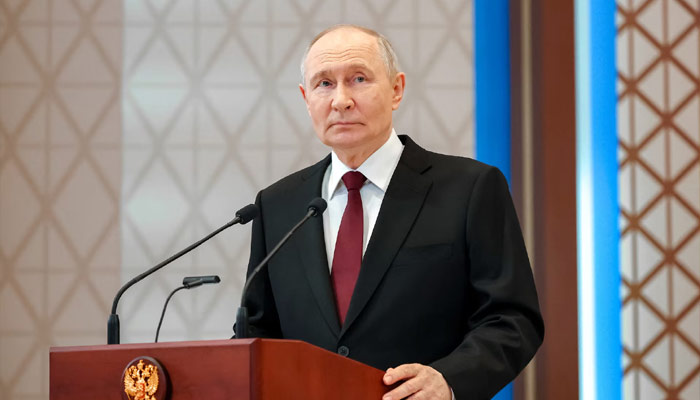
President Vladimir Putin presided over Russia’s flagship investment forum in St Petersburg on Thursday, where sharply contrasting views emerged over the country’s direction as the war in Ukraine continues with no clear end in sight.
The St Petersburg International Economic Forum—often referred to as Russia’s “Davos”—became a stage for competing narratives among political leaders, business figures and policymakers. One camp urged Moscow to press ahead with the war and prepare for long-term confrontation with the West, while another pointed to growing economic strain and suggested the conflict may need to be brought to an end.
The discussions reflected deeper tensions within Russia’s elite over the costs and consequences of a prolonged war. While nationalist voices argued that Russia must brace for an extended geopolitical struggle, others warned that economic stagnation and battlefield deadlock were weakening the country’s position and increasing pressure for a negotiated settlement.
“We will be at war in the next few years, maybe for a couple of decades,” said Andrey Bezrukov, a former intelligence officer, echoing the hardline view that Russia must adapt to a long-term confrontation with the West. His remarks drew strong reactions from sections of the audience at the packed forum hall.
At the same time, some participants highlighted the economic risks of continuing the conflict, arguing that a resolution—potentially through international mediation—could unlock long-term stability and investment opportunities. The debate underscored the absence of consensus on Russia’s strategic direction more than four years after the invasion of Ukraine.
The forum, once a key venue for Western investors and global executives, has increasingly taken on a different character amid Russia’s isolation from much of the Western financial system. This year’s event featured prominent displays of military equipment, drones and surveillance technology, reflecting the growing intersection between economic policy and defence priorities.
On the battlefield, Russia continues to hold significant territory in Ukraine, though advances have slowed and the front lines remain largely static in many areas. Kyiv has repeatedly rejected any recognition of Russian claims over occupied regions, keeping diplomatic progress stalled.
While the Kremlin maintains that it is not seeking a wider conflict beyond Ukraine, influential nationalist figures at the forum framed the war as part of a broader and longer confrontation with the West. Ideologue Alexander Dugin said the conflict would end only with “victory or never,” highlighting the uncompromising tone of Russia’s hardline camp.
The competing visions laid out at the forum illustrated the balancing act facing Putin, as he manages internal divisions between those advocating escalation and those warning of mounting economic and political costs.
Comments are closed.