

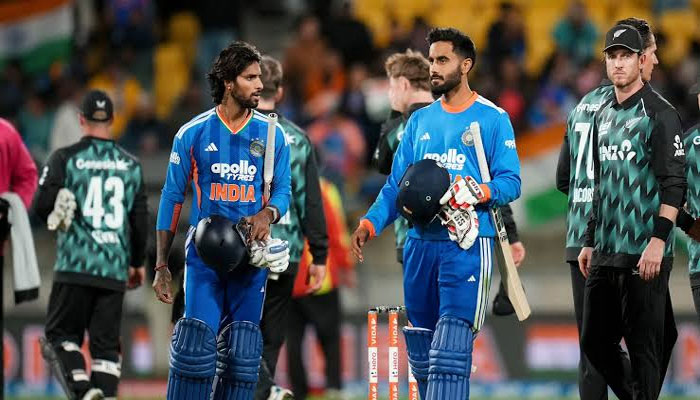
India clinched the five-match T20I series, but back-to-back defeats in the final two games have raised concerns over the team’s approach and selection strategy.
The manner of the latest loss was particularly disappointing, with the visitors struggling to cope with New Zealand’s pace attack before being outplayed in the chase.
In the fifth T20I on Sunday, November 1, Mitchell Santner’s New Zealand defeated India by seven wickets in Hamilton. Tim Seifert produced a match-winning performance, smashing 93 off just 50 balls to guide the hosts to the target of 192 in only 18 overs.
India’s Batting Collapses After Early Setbacks
For the first time in the series, India lost the toss and were asked to bat. The change in circumstances exposed the top order, as New Zealand’s fast bowlers made the most of the seam and swing available at Seddon Park.
India suffered an early double blow when Abhishek Sharma miscued Jacob Duffy to mid-on in the opening over. Sanju Samson followed soon after, giving Michael Bracewell a leading edge that was caught in the covers.
Samson’s dismissal added to his disappointing run in the series. After scoring 67 in the first T20I, the wicketkeeper-batter failed to make a meaningful contribution in his subsequent outings. His continued struggles also renewed the debate over Vaibhav Sooryavanshi’s absence from the playing XI, particularly with the series already decided.
India needed a partnership to prevent further damage, and Ishan Kishan and Shreyas Iyer stepped up. The two batters rebuilt the innings with a combination of attacking shots and calculated stroke play.
Kishan took the initiative, putting pressure on both the pace and spin departments and bringing up his half-century in just 28 deliveries. Iyer complemented him with a fluent innings as India recovered to 111/2 at the halfway mark.
New Zealand, however, broke the partnership soon after the drinks break. Blair Tickner and Nathan Smith dismissed Kishan and Iyer, respectively, giving their side the opening it needed to regain control.
Despite some fielding errors, New Zealand’s bowlers managed to restrict India’s scoring towards the end. Adam Milne delivered the standout performance, finishing with figures of 4/19 in four overs. Tickner and Smith claimed two wickets each as India ended their innings at 191/8.
Seifert Leads New Zealand’s Dominant Chase
A target of 192 appeared achievable, but India failed to put the New Zealand batters under sustained pressure. The hosts lost Finn Allen in the second over, yet that proved to be their only significant setback during the chase.
Seifert launched an aggressive assault on the Indian bowling attack, finding boundaries regularly and keeping the required run rate under control. Daryl Mitchell added to the momentum with a quick 29 off 16 balls, while Glenn Phillips continued his impressive form.
Phillips, who had scored a century in the previous match, produced another half-century to ensure New Zealand remained comfortably ahead of the required rate.
Seifert’s 93-run innings off 50 deliveries laid the foundation for the victory. Phillips eventually finished the job in the 18th over, hitting two successive boundaries through fine leg and third man to take New Zealand across the finish line.
India’s Experimentation Strategy Raises Questions
While the series result favoured India, the final two matches have exposed areas that the team management cannot afford to ignore. With the 2028 T20 World Cup still some time away, the bilateral format provides an opportunity to experiment with combinations and assess emerging talent.
The decision to persist with struggling players while keeping young alternatives such as Vaibhav Sooryavanshi out of the side raises questions about India’s selection priorities.
The bigger concern is whether the team management is using these matches to prepare for future challenges or placing too much emphasis on maintaining winning results in bilateral contests.
India may have won the series, but the heavy defeat in the final T20I has highlighted why experimentation, fresh combinations and opportunities for young players should remain central to its long-term preparations.
Comments are closed.