

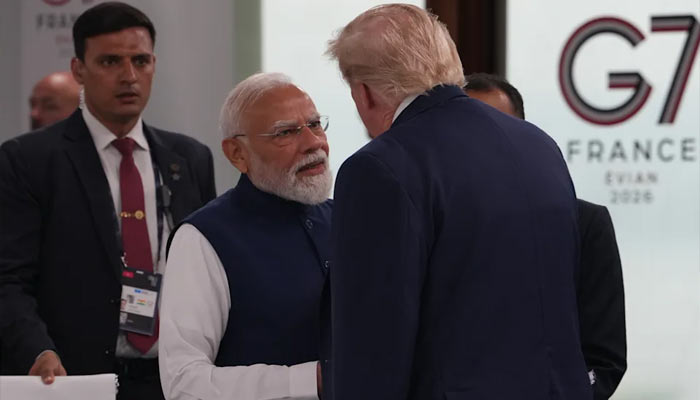
US President Donald Trump on Wednesday praised Prime Minister Narendra Modi during a bilateral interaction on the sidelines of the G7 summit, projecting strong personal chemistry despite recent strains over trade disputes, energy sanctions and a military strike involving Indian nationals.
The meeting in France came as India and the United States continue to navigate tensions linked to tariffs, India’s Russian oil imports and the fallout from a recent US military strike in the Gulf of Oman that killed three Indian mariners. At the interaction, Trump dismissed any suggestion of friction and repeatedly lauded Modi, describing him as a close friend and a tough negotiator.
“We have the best relationship. We cannot be closer than we are,” Trump said, stressing that the partnership between the two countries was driven by their direct engagement.
Modi, in his remarks, raised concerns over maritime safety in light of the recent incident and underlined the importance of protecting Indian seafarers operating on international shipping routes. The Indian Foreign Ministry has already lodged a formal protest over the strike.
Trump responded by acknowledging the risks faced by those at sea, calling it a “tough profession,” and said both countries were working together on the issue of maritime security.
The interaction took place as negotiations continue on a broader India-US trade agreement. The Trump administration has previously imposed tariffs on Indian exports, partly over New Delhi’s continued purchase of Russian oil, though both sides have been engaged in efforts to finalise a wider deal.
Despite ongoing differences, Trump struck an optimistic tone on trade talks, saying an agreement was “very close,” while also describing Modi as a formidable negotiator. The exchange recalled earlier periods of visible warmth between the two leaders during Trump’s first term, when large diaspora events in Houston and Ahmedabad showcased their personal rapport.
While both sides sought to emphasise continuity in ties, the latest engagement highlighted the balancing act between strategic cooperation and unresolved economic and geopolitical differences.
Comments are closed.